


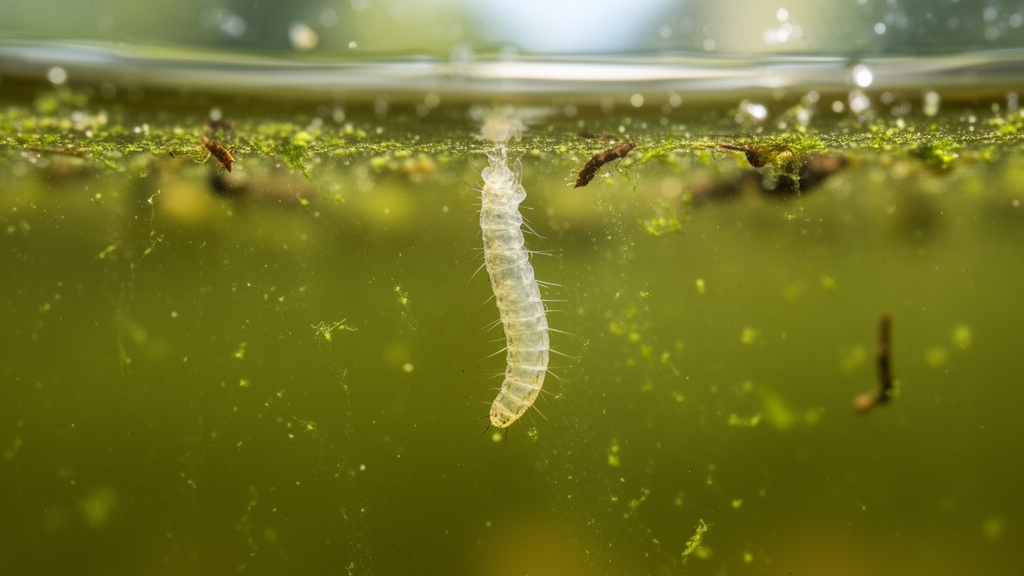
A field study in Nakhon Si Thammarat, Thailand, found that microalgal communities in the guts of pooled third- and fourth-instar Aedes aegypti larvae were broadly similar to those in water from the same breeding sites. The investigators reported a strong positive association between genus-level sequence counts in larval guts and breeding water, while alpha-diversity and community-composition measures did not differ significantly by sample source. The study characterized algae in nine pooled larval-gut samples and nine paired water samples collected from three locations between September 2022 and March 2023.
The samples came from three Aedes aegypti breeding areas in Mueang District: Mum Pom Temple communities, Bun Na Rop Temple communities and Ban Na Kian communities. At each area, three larval and three water samples were collected from sub-sites at least 500 m apart. Each larval sample pooled 300–400 third- and fourth-instar larvae, while each water sample comprised 500 ml pooled from three to five containers. Containers included tyres, plastic containers, ceramic vases and glass bottles. Larvae were identified in the field using locomotion and siphon shape, and only guts with an intact peritrophic membrane were dissected for analysis.
Researchers used light microscopy to examine the morphology of algae isolated from larval guts and breeding water. At least 10 genera were identifiable microscopically across the samples: Ankistrodesmus, Bracteacoccus, Chloromonas, Eudorina, Leptolyngbya, Monoraphidium, Nannochloropsis, Pediastrum, Tetradesmus and Selenastrum. The observations included unicellular, colonial and filamentous cyanobacteria, green algae and diatoms. Both microscopy and molecular sequencing were therefore used because closely similar morphologies can be difficult to distinguish reliably.
For molecular analysis, the investigators amplified the 23S ribosomal DNA marker and conducted paired-end Illumina MiSeq sequencing. After demultiplexing and quality filtering, the dataset contained 308,514 sequences. Of these, 31,447 were unassigned or could not be identified to genus, leaving 277,067 sequences assigned to 25 algal genera and diatoms in the order Achnanthales. That total comprised 136,547 sequences from larval guts and 140,520 from breeding water. Taxonomy was assigned with a naïve Bayes classifier using the µgreen-db reference database, and samples were restricted to 16,447–17,212 sequences for comparisons of relative abundance and diversity.
The most abundant taxa across the metabarcoding dataset were Tetradesmus, Nannochloropsis, Leptolyngbya, Parachlorella and Monoraphidium. Tetradesmus and Leptolyngbya occurred in all 18 samples, although their relative abundance varied substantially among sites. For example, Tetradesmus accounted for 87.36% of the assigned larval-gut reads at sample MP1 and 48.90% at MP3, while Leptolyngbya represented 60.04% of the larval-gut reads at MP2 and 81.09% of the breeding-water reads from that sample. These observations show substantial variation among individual samples rather than a uniform community profile across the three locations.
Most taxa detected in larval guts were also present in the corresponding breeding water. Genus-level sequence counts in the two sample types showed a strong positive correlation, with Spearman’s ρ of 0.84 and P below 0.001. The study did not directly observe feeding events or determine the proportion of the surrounding algal community ingested by any individual larva, so the association does not establish complete consumption of the entire community.
Alpha-diversity measures did not differ significantly between larval guts and water from the same sites. Paired tests for operational taxonomic unit richness, Chao1 richness, Shannon’s Index and Simpson’s Index produced P values of at least 0.18. Across samples, algal OTU counts ranged from 22 to 246, Chao1 values from 23.50 to 267.48, Shannon’s Index from 0.69 to 3.59 and Simpson’s Index from 0.28 to 0.93. These results indicate similar measured diversity in the two sample types, rather than equivalence in every individual sample.
Community composition likewise showed no statistically significant difference by source, location or their interaction. Bray–Curtis-based principal coordinate analysis accounted for 46.42% of the total variance across its first two axes. PERMANOVA results were P = 0.99 for source, P = 0.09 for sampling location and P = 1.00 for the source-by-location interaction. Water temperature ranged from 25.6 °C to 33.5 °C across the locations, and pH ranged from 6.98 to 8.34. Because only three locations and pooled third- and fourth-instar larvae were studied, the results do not resolve differences among individual larval instars, containers or locations in more extensive sampling.
Both identification approaches had limited taxonomic resolution: neither microscopy nor the chosen metabarcoding analysis identified algae to species level. The authors attributed limited assignment partly to insufficient sequence variation, short amplicons and gaps or inaccuracies in reference databases. The study also did not compare water from containers with and without mosquito larvae, so it cannot determine whether the presence of larvae altered algal composition. The authors said the results may help guide selection of algal strains for further investigation as biological-control agents or eco-friendly products for mosquito larvae, but the study did not test larvicidal efficacy or establish human health benefits.
Subject of Research: Microalgal diversity in Aedes aegypti larval guts and breeding sites in Nakhon Si Thammarat, Thailand
Article Title: Microalgae diversity in Aedes aegypti larvae guts and breeding sites in Nakhon Si Thammarat, Thailand revealed by light microscopy and metabarcoding
Article References: Promprao, J., Sanevas, N., Kraichak, E., Saraphol, S., Klankeo, P., Kaewmee, S., Mano, C., Soe, B. K., Rujeerapaiboon, A., Preativatanyou, K., Siriyasatien, P., Walton, C., & Jariyapan, N. (2025). Microalgae diversity in Aedes aegypti larvae guts and breeding sites in Nakhon Si Thammarat, Thailand revealed by light microscopy and metabarcoding. Metabarcoding and Metagenomics, 9, Article e152948. https://doi.org/10.3897/mbmg.9.152948
Image Credits: AI Generated
Keywords: Aedes aegypti, microalgae, larval gut, breeding sites, 23S rDNA, metabarcoding, light microscopy, Thailand, dengue vector, microbial diversity, diversity, Aedes
Cite Scienmag News
Morgan Morrow. (October 20, 2026). Field study finds broadly similar microalgal communities in Aedes aegypti larval guts and breeding water. Scienmag. https://scienmag.com/field-study-finds-broadly-similar-microalgal-communities-in-aedes-aegypti-larval-guts-and-breeding-water/
Morgan Morrow. "Field study finds broadly similar microalgal communities in Aedes aegypti larval guts and breeding water." Scienmag, 20 October 2026, https://scienmag.com/field-study-finds-broadly-similar-microalgal-communities-in-aedes-aegypti-larval-guts-and-breeding-water/. Accessed 20 October 2026.
Morgan Morrow. "Field study finds broadly similar microalgal communities in Aedes aegypti larval guts and breeding water." Scienmag. October 20, 2026. https://scienmag.com/field-study-finds-broadly-similar-microalgal-communities-in-aedes-aegypti-larval-guts-and-breeding-water/


