


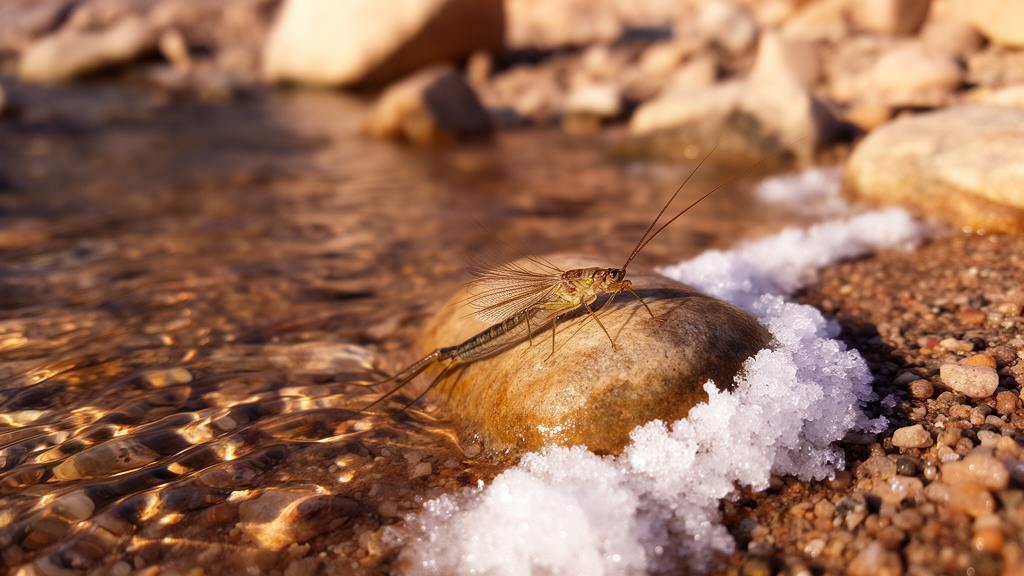
A field survey of freshwater macroinvertebrates in Morocco documented the first recorded occurrence of the mayfly Cloeon vanharteni in the Maghreb. The species was found at a single site in the Upper Draa basin, where larvae were recovered from a saline tributary with conductivity of 19,330–19,660 µS/cm during sampling in March and June 2022. The observation establishes a Moroccan and Maghreb record, rather than a distribution across North Africa as a whole.
The research was part of an ongoing investigation of benthic macroinvertebrates in the southern Draa basin, which extends southward from the High Atlas Mountains into the Sahara. Investigators sampled 17 sites across the basin, including sites that differed in altitude, temperature and water conductivity. The analysis focused on three locations in the western Upper Draa: Ounilla 1, a non-saline tributary; Ounilla 2, a saline right tributary of Oued El Maleh that yielded the mayflies; and Oued El Maleh, a lower-flow stream with temperate water.
At each site, researchers collected macroinvertebrates in March and June 2022 using a 0.20 m by 0.25 m Surber sampler with 500 μm mesh. Twenty sampling spots covering the available microhabitats were sampled at each location. Conductivity was measured with a WTW MultiLine Multi 3510 IDS device, and specimens were preserved in 96% alcohol and sorted under a binocular microscope. Ounilla 2 had conductivity of 19,330 µS/cm in March and 19,660 µS/cm in June, compared with 3,890 and 2,590 µS/cm at Ounilla 1. Conductivity in Oued El Maleh remained high at 10,570 and 12,100 µS/cm.
The collections at the three focused sites contained seven mayfly species and 24 C. vanharteni nymphs. All 24 were collected at Ounilla 2 in March 2022; none was recorded there in June or at the other two sites. Four specimens were deposited on slides at the Museum of Natural History in Marrakech. Morphological examination identified the Moroccan larvae as C. vanharteni, a species described in 2008 from the United Arab Emirates and subsequently reported from Israel, the Palestinian territories and Jordan.
The larval diagnosis included the absence of hindwing pads, lateral spines on abdominal tergites VIII and IX and sometimes VII, a two-segmented maxillary palp, elongated claws bearing two rows of abundant short teeth, and double-lamellate gills in which the upper lamella is approximately half the size of the lower one. The two-segmented maxillary palp distinguished the species from other Cloeon species previously reported in the Maghreb, while its short-toothed claws separated it from members of the Cloeon dipterum group, including C. dipterum and C. peregrinator.
The researchers complemented the morphological analysis with DNA barcoding. They sequenced a 658-base-pair fragment of the mitochondrial cytochrome oxidase subunit 1 gene from one Moroccan specimen of C. vanharteni, one Israeli specimen, three Moroccan specimens of C. peregrinator and one Moroccan specimen of the outgroup Procloeon stagnicola. The dataset also included three additional C. vanharteni sequences from Israel retrieved from GenBank on June 8, 2023, giving nine sequences in total. Analyses used pairwise genetic distances, a Bayesian COI gene tree and the ASAP distance-based species-delimitation method.
All five C. vanharteni sequences, including the Moroccan sequence, formed a strongly supported monophyletic lineage that ASAP identified as a distinct species. The three C. peregrinator sequences likewise formed a strongly supported monophyletic lineage. Mean uncorrected COI p-distance within C. vanharteni was 1.6%, with a range of 0–2.5%, while the mean within C. peregrinator was 0.5%, with a range of 0–0.8%. The mean distance between the two lineages was 17.8%, with a range of 17.3–18.3%.
Ecological observations were limited to the Moroccan sites. The larvae occurred in a low-flow, semi-arid stream environment with a pebble, gravel and sand bottom, cold winters and hot summers. Surveys conducted from 2020 to 2023 at lower-conductivity streams in the basin—including Iriri, Ait Douchene and Ounilla 1—did not detect the species, including at the neighbouring stream with the same name as Ounilla 2 but lower conductivity. These observations associate the local occurrence with high conductivity, but the study did not experimentally test the species’ physiological tolerance or establish that salinity was the cause of its restricted distribution.
The record expands the known distribution of C. vanharteni into the Maghreb and shows that the species was present at one Moroccan site during the survey period. Its broader regional history remains incompletely sampled because standing-water habitats in the Maghreb have received less attention than running waters, and the Moroccan detection came from only one saline stream within a basin-scale field study. The findings therefore document a first regional occurrence and an association with a highly conductive habitat, rather than establishing the species’ wider abundance, environmental limits or ecological effects in Morocco.
Subject of Research: First Maghreb field record and molecular identification of the mayfly Cloeon vanharteni
Article Title: First report of Cloeon vanharteni Gattolliat & Sartori, 2008 ( Baetidae , Ephemeroptera ) in the Maghreb
Article References: Benlasri, M., Vuataz, L., Gattolliat, J.-L., Beermann, A. J., Leßner, H., El Alami El Moutaouakil, M., Ghamizi, M., & Berger, E. (2023). First report of Cloeon vanharteni Gattolliat & Sartori, 2008 (Baetidae, Ephemeroptera) in the Maghreb. Alpine Entomology, 7, 143-152. https://doi.org/10.3897/alpento.7.109562
Image Credits: AI Generated
Keywords: Cloeon vanharteni, mayflies, Ephemeroptera, Morocco, Maghreb, Draa basin, freshwater macroinvertebrates, saline streams, DNA barcoding, COI, First, report
Cite Scienmag News
Drew Townsend. (October 20, 2026). Field study documents first Maghreb record of the mayfly Cloeon vanharteni. Scienmag. https://scienmag.com/field-study-documents-first-maghreb-record-of-the-mayfly-cloeon-vanharteni/
Drew Townsend. "Field study documents first Maghreb record of the mayfly Cloeon vanharteni." Scienmag, 20 October 2026, https://scienmag.com/field-study-documents-first-maghreb-record-of-the-mayfly-cloeon-vanharteni/. Accessed 20 October 2026.
Drew Townsend. "Field study documents first Maghreb record of the mayfly Cloeon vanharteni." Scienmag. October 20, 2026. https://scienmag.com/field-study-documents-first-maghreb-record-of-the-mayfly-cloeon-vanharteni/


