


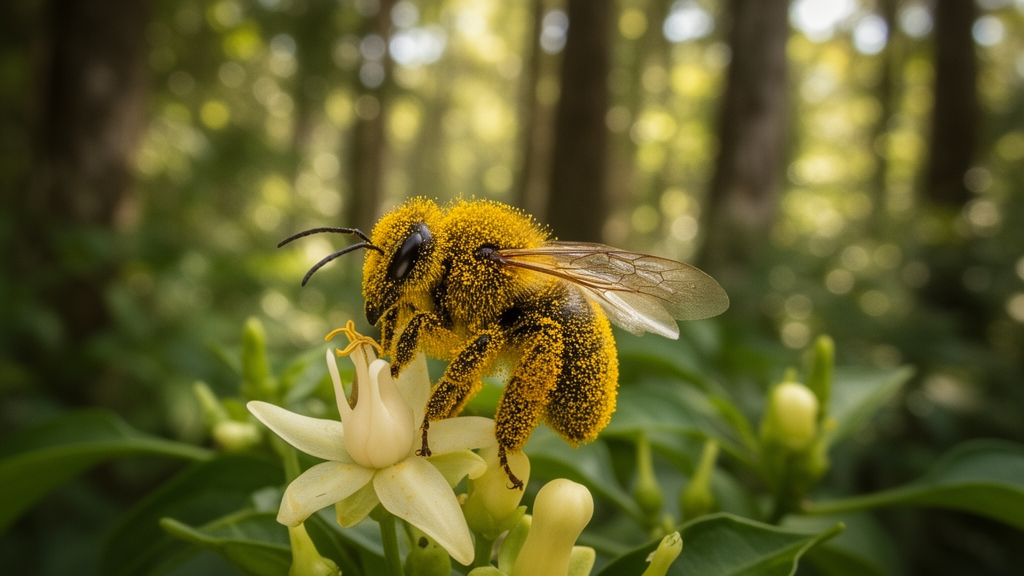
Field sampling of four stingless bee species in Bolivia’s Tucumano forest found that pollen from the wild chili plant Capsicum minutiflorum dominated the pollen stored in nearly every hive examined. The study, conducted near the community of Ticucha in Chuquisaca during March 2022, assessed pollen composition, protein content and plant–bee interactions for Tetragonisca angustula, Scaptotrigona depilis, Scaptotrigona polysticta and Melipona rufiventris.
The researchers established an 800 × 800 metre sampling plot around each of three meliponaries, reflecting the estimated flight range of the four bee species. Each plot was divided into 64 subplots of 100 × 100 metres, with eight 20-metre transects in each subplot. Flowering plants were counted and classified by growth form, while samples were collected for botanical identification and pollen analysis. The survey recorded 25 flowering plant species in 17 families, including 16 herbs, four lianas, four trees and one shrub. Heteropterys umbellata had the greatest relative abundance at 13.64%, followed by Asclepia curassavica at 10.91%.
Stored pollen was collected from three pollen pots per hive and combined for analysis. The sample included eight hives of T. angustula, five each of S. depilis and S. polysticta, and two of M. rufiventris. Researchers identified pollen morphologically after acetolysis, measured grain dimensions, quantified pollen abundance with a Neubauer chamber and measured protein content using the Bradford protocol. They also compared pollen composition among hives and constructed a quantitative interaction network linking bees with plant pollen sources.
Twenty-three pollen types were identified in the hive samples, but the bees collected only eight of the 25 pollen types recorded around the meliponaries. C. minutiflorum made up 98.8% of the pollen volume in T. angustula, 96% in S. depilis, 71.9% in S. polysticta and 66.6% in M. rufiventris. One S. polysticta hive was the exception: C. minutiflorum accounted for 17% of its pollen volume, compared with 36.3% for Solanum riparium and 32.5% for an unidentified Proteaceae pollen type.
Bradford analysis found that C. minutiflorum pollen had the highest protein content among the flowering species surveyed, at 67% by weight. Piper elongatum had the lowest, at 20%, despite having the highest measured pollen density at 1,392,045 grains per cubic millimetre. Protein content was not significantly correlated with pollen quantity or pollen-grain volume. The researchers also observed no significant relationship between pollen quantity and cytoplasmic volume. The results therefore did not show that the collected pollen could be explained simply by the most abundant or largest grains available near the hives.
Protein attribution based on the stored pollen showed that C. minutiflorum accounted for almost all of the measured protein represented in the T. angustula and S. depilis samples. Proteaceae pollen contributed almost 20% of the protein represented in S. polysticta, while Plumbago and two Proteaceae pollen types together contributed almost 25% in M. rufiventris. The interaction network had high connectance, reported as 41.667%, intermediate complementary specialization with H′ = 0.516, intermediate nestedness with NODF = 49.603 and low modularity with Q = 0.163. Its structure was driven predominantly by the four bees’ shared association with C. minutiflorum.
The authors classified all four bee species as polylectic because their collected pollen came from multiple plant families, while noting that they were selective within that broader diet. For example, M. rufiventris collected nine pollen types from nine families, and S. depilis collected nine types from nine families, but only a small fraction of the flowering plants available around the hives appeared in their pollen stores. The concentration on C. minutiflorum, despite its high protein content and the availability of other species, was consistent with nutritional selectivity, although the observational design did not establish protein content as the causal reason for the preference.
Several limits constrain the findings. The study covered one area, one sampling period and a limited number of colonies, and the authors noted that floral availability, distance from the hive, competition, prior experience, seasonal changes and protein-to-lipid ratios may affect pollen selection. Stored pollen also reflects accumulated collecting rather than individual visits, and the interaction network included some plants not detected in the surrounding sampling plots. The results document strong pollen selectivity and a striking association with protein-rich C. minutiflorum in the sampled Bolivian colonies, but they do not establish whether the same pattern persists across seasons or sites.
Subject of Research: Pollen selectivity and protein content in four Bolivian stingless bee species
Article Title: Dominance of Capsicum minutiflorum ( Solanaceae ) pollen in stingless bee hives: An insight into protein composition and foraging behavior by four Meliponini species of the Bolivian-Tucumano forest
Article References: Adler, M., Ajhuacho-Villalobos, M., Flores-Prado, L., Benitez-Vieyra, S., Collao-Alvarado, K., & Pinto, C. F. (2025). Dominance of Capsicum minutiflorum (Solanaceae) pollen in stingless bee hives: An insight into protein composition and foraging behavior by four Meliponini species of the Bolivian-Tucumano forest. Journal of Hymenoptera Research, 98, 689-708. https://doi.org/10.3897/jhr.98.138703
Image Credits: AI Generated
Keywords: stingless bees, Meliponini, Capsicum minutiflorum, pollen nutrition, foraging behavior, Bolivian-Tucumano forest, protein content, bee–plant interactions, field sampling, Dominance, Capsicum, minutiflorum
Cite Scienmag News
Julie Wynn. (October 20, 2026). Stingless bees in Bolivia’s Tucumano forest favor protein-rich Capsicum pollen. Scienmag. https://scienmag.com/stingless-bees-in-bolivias-tucumano-forest-favor-protein-rich-capsicum-pollen/
Julie Wynn. "Stingless bees in Bolivia’s Tucumano forest favor protein-rich Capsicum pollen." Scienmag, 20 October 2026, https://scienmag.com/stingless-bees-in-bolivias-tucumano-forest-favor-protein-rich-capsicum-pollen/. Accessed 20 October 2026.
Julie Wynn. "Stingless bees in Bolivia’s Tucumano forest favor protein-rich Capsicum pollen." Scienmag. October 20, 2026. https://scienmag.com/stingless-bees-in-bolivias-tucumano-forest-favor-protein-rich-capsicum-pollen/


