


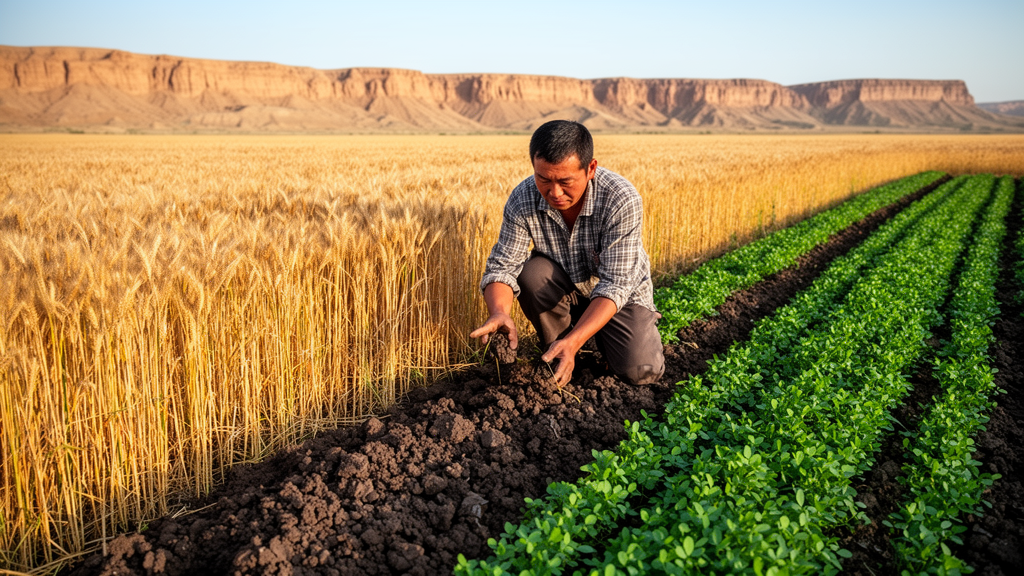
A two-year field experiment in arid irrigated Inner Mongolia, China, found that incorporating green manure after spring wheat harvest increased the following crop’s grain yield by 2.96% to 11.95% compared with fallow. Hairy vetch produced the highest yield and lowest yield-scaled greenhouse gas intensity, while forage oat combined relatively high yield with the lowest cumulative nitrous oxide emissions.
The randomized block experiment was conducted from March 2022 to October 2023 at the Xihai Xin Experimental Site in Ordos City. After the 2022 wheat harvest, researchers compared five green manure species—common vetch, hairy vetch, sesbania, forage rapeseed and forage oat—with a fallow control. Each treatment had three field replicates, producing 18 plots, each measuring 144 square metres. The green manures were sown on August 3, 2022, cut into 10–15-centimetre pieces and incorporated to a depth of 20–30 centimetres in early October.
Ningchun 4 spring wheat was subsequently sown on April 13, 2023. All treatments received the same basal fertilizer, urea top-dressings, irrigation and other field management. Soil carbon dioxide, methane and nitrous oxide fluxes were measured during the wheat growing season with closed static chambers. The researchers also recorded wheat growth at the seedling, booting, heading and grain-filling stages and measured yield components and grain yield at maturity.
The crop–soil system emitted carbon dioxide and nitrous oxide but was a weak methane sink. Relative to fallow, green manure incorporation numerically increased cumulative carbon dioxide emissions by 7.29% to 44.30%. The highest cumulative carbon dioxide emission occurred under sesbania, at 5,466.83 kg per hectare, compared with 3,788.64 kg per hectare under fallow, although the researchers did not detect statistically significant differences among treatments. All green manure treatments except common vetch had greater cumulative methane uptake than fallow, with sesbania recording 49.65% greater uptake.
Cumulative nitrous oxide emission was highest under common vetch, at 2.51 kg per hectare, and lowest under forage oat, at 2.06 kg per hectare, which was comparable to the fallow treatment. Common vetch increased cumulative nitrous oxide emissions by 21.82% relative to fallow. Green manure also numerically increased growing-season global warming potential by 7.44% to 39.64%, with the largest increases recorded under sesbania and forage rapeseed. However, treatment differences in global warming potential were not statistically significant, and carbon dioxide contributed more than 85% of the calculated total.
Green manure improved several measured aspects of wheat growth. At grain filling, plant height was 3.68% to 11.32% higher than under fallow, leaf area index was 4.94% to 52.60% higher, and aboveground dry matter accumulation was 19.10% to 50.11% higher. The yield response was associated with changes in effective spike number, grain number per spike and thousand-grain weight. Grain yield was positively correlated with effective spike number, with a Pearson coefficient of 0.92, and with thousand-grain weight, with a coefficient of 0.95; both relationships had P values below 0.01.
Hairy vetch had the highest effective spike number and grain yield, with yield 11.95% above fallow. Forage rapeseed and forage oat increased yield by 11.24% and 11.09%, respectively. Forage oat had the highest grain number per spike, 25.36% above fallow, while forage rapeseed had the highest thousand-grain weight, 34.19% above fallow. These differing yield components helped explain why the five green manure species did not produce identical responses in either productivity or emissions.
Because global warming potential is measured per unit area, it can rise even when additional grain production lowers emissions per unit of yield. The yield-scaled greenhouse gas intensity results therefore differed from the area-scaled results. Hairy vetch reduced intensity by 4.10% relative to fallow and had the lowest value among the treatments, while common vetch also reduced intensity. Sesbania had the highest intensity, and forage rapeseed ranked second-highest. These comparisons are specific to the measured crop, treatment period and indicators; the study did not establish that green manure species consistently determine whether growing-season global warming potential rises or falls.
The findings offer region-specific evidence for choosing among the tested species: hairy vetch best combined yield with low yield-scaled greenhouse gas intensity, common vetch reduced intensity relative to fallow, and forage oat combined relatively high yield with the lowest cumulative nitrous oxide emission. The authors described those three species as promising for post-wheat incorporation in the Yellow River Basin of Inner Mongolia under the experimental conditions. Important limitations remain: the treatment comparison covered one post-wheat green manure cycle and one subsequent wheat season, used three replicates per treatment, and measured growing-season soil gas exchange rather than full life-cycle emissions or net ecosystem carbon balance. Longer-term effects on soil carbon accumulation, nitrogen-use efficiency, yield stability and economic returns were not established and require further evaluation.
Subject of Research: Comparison of five post-wheat green manure species for spring wheat yield and soil greenhouse gas emissions in arid irrigated Inner Mongolia
Article Title: Species-specific effects of post-wheat green manure incorporation on spring wheat yield and soil greenhouse gas emissions in an arid irrigated system
Article References: Li, B., Wang, L., Li, C., Lu, Z., Zhang, L., Liu, H., Li, J., & Zhang, D. (2026). Species-specific effects of post-wheat green manure incorporation on spring wheat yield and soil greenhouse gas emissions in an arid irrigated system. PLOS One, 21(10), e0360932. https://doi.org/10.1371/journal.pone.0360932
Image Credits: AI Generated
DOI: 10.1371/journal.pone.0360932
Keywords: spring wheat, green manure, hairy vetch, forage oat, grain yield, soil carbon dioxide, nitrous oxide, methane uptake, global warming potential, greenhouse gas intensity, Inner Mongolia, field experiment
Cite Scienmag News
Alan Morgan. (October 20, 2026). Field experiment links post-wheat green manure species to spring wheat yield and soil greenhouse gas intensity. Scienmag. https://scienmag.com/field-experiment-links-post-wheat-green-manure-species-to-spring-wheat-yield-and-soil-greenhouse-gas-intensity/
Alan Morgan. "Field experiment links post-wheat green manure species to spring wheat yield and soil greenhouse gas intensity." Scienmag, 20 October 2026, https://scienmag.com/field-experiment-links-post-wheat-green-manure-species-to-spring-wheat-yield-and-soil-greenhouse-gas-intensity/. Accessed 20 October 2026.
Alan Morgan. "Field experiment links post-wheat green manure species to spring wheat yield and soil greenhouse gas intensity." Scienmag. October 20, 2026. https://scienmag.com/field-experiment-links-post-wheat-green-manure-species-to-spring-wheat-yield-and-soil-greenhouse-gas-intensity/


