


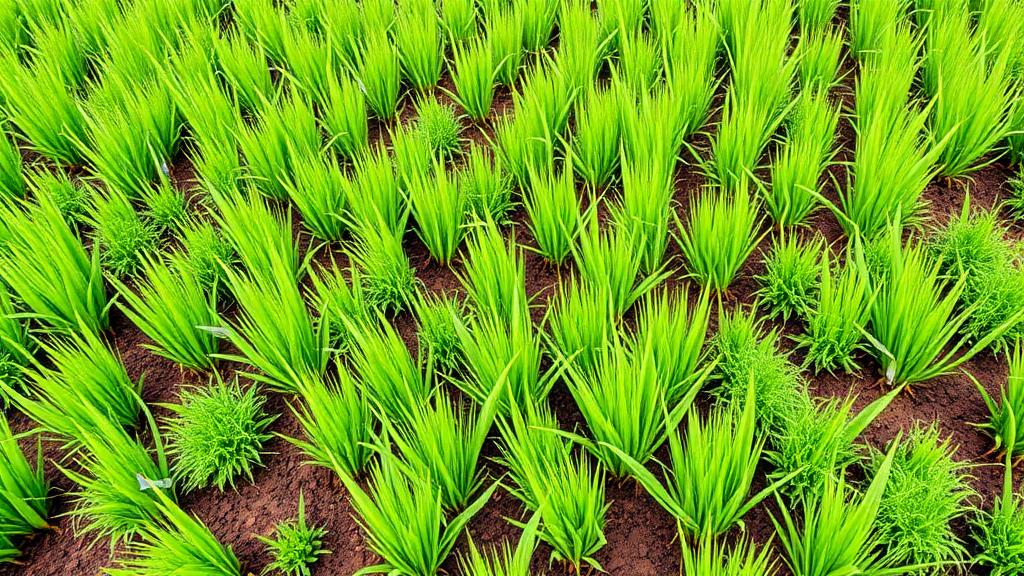
In the flooded paddy fields of Kozhikode district in Kerala, India, a quiet experiment has delivered a result that could reshape how rice is grown across South Asia. Researchers testing combinations of organic soil amendments found that pairing a humble aquatic fern with ordinary compost lifted grain yields by roughly half compared with the traditional organic practices that local farmers already use. The finding, published in the journal Discover Soil, matters because rice feeds more than half of Asia’s population, and the chemical fertilizers that once powered the region’s harvests are steadily degrading the very soils on which future crops depend.
The study, led by Sruthi Padinhariyil and Surendran Udayar Pillai of the KSCSTE-Centre for Water Resources Development and Management in Kozhikode, together with Maite Martínez-Eixarch of the Institute of Agrifood Research and Technology in Catalonia, Spain, was deliberately conducted under real-world conditions. Rather than confining the work to a research station, the team set up their plots in a farmer’s field at Peringalam during the winter rice season of 2020, growing the popular regional variety Karuna, a long-duration cultivar known for pest resistance and tolerance of iron toxicity. This choice of setting and variety was central to the study’s ambition: to generate location-specific evidence that could actually guide farming practice in Kerala, where rice acreage is shrinking even as demand remains high.
The experimental design compared five nutrient management treatments across four replications. The first received only basal nutrients in the form of farmyard manure, following the recommendations of Kerala Agricultural University. The second added compost to the basal nutrients, the third added Azolla, and the fourth combined compost and Azolla with the basal application. A fifth treatment served as the control, representing the farmer’s traditional organic management. Crucially, the researchers standardized nitrogen across treatments, using laboratory analysis of each organic input’s nutrient composition to calculate quantities that would supply equivalent amounts of nitrogen, so that any differences in crop performance could be attributed to the nature of the amendments rather than unequal nitrogen supply.
Azolla is the star of this story, and its biology explains why. This small floating fern has coexisted with rice for centuries, hosting within its leaves a symbiotic cyanobacterium called Anabaena azollae that fixes atmospheric nitrogen into a form plants can use. Under favorable conditions, Azolla can contribute up to 100 kilograms of nitrogen per hectare per crop, a capacity that made it a valued green manure long before synthetic fertilizers dominated agriculture. In the flooded conditions of lowland paddies, where neutral pH and low redox potential create an ideal environment for biological nitrogen fixation, the fern can multiply rapidly across the water surface, continuously adding nitrogen and organic matter as it decomposes into the soil.
The results were striking. The combined treatment, with both compost and Azolla, produced the tallest plants at harvest, reaching 137.7 centimeters on average, along with the greatest number of tillers per hill, the highest leaf area index, the most panicles, and the longest roots. By contrast, plots receiving only farmyard manure as a basal nutrient showed the weakest early growth, with plants measuring just 53.7 centimeters at the tillering stage, a sign that nutrients were limiting during crop establishment. Overall, the combined organic treatment boosted growth and yield parameters by about 50 percent relative to the farmer’s traditional practice, a margin that the authors attribute to the synergistic action of the two amendments.
Yield data told the same story in numbers that farmers would understand immediately. The combined compost and Azolla treatment produced 2,494.7 kilograms of grain per hectare, statistically superior to every other treatment, while the basal-nutrient-only plots yielded just 1,260.7 kilograms per hectare. The mechanism, the researchers explain, involves improved nutrient uptake and photosynthetic efficiency, driven by the biological nitrogen fixation of the Azolla-Anabaena partnership and the slow-release carbon and nutrients supplied by decomposing compost. More tillers and more panicles translate directly into more grain-bearing structures, and the enhanced carbon input supported the translocation of photo-assimilates into the developing grains.
The soil itself was transformed. Post-harvest analysis showed that plots receiving the combined amendments had the highest soil organic carbon, between 0.8 and 1.2 percent, placing them in the high fertility category, whereas plots with basal nutrients alone remained at a medium fertility level of around 0.6 percent. Available potassium reached 262.5 kilograms per hectare in the combined treatment, and available phosphorus was also highest there, likely reflecting enhanced phosphorus release associated with Azolla incorporation and microbial activity in the rhizosphere. Importantly, soil pH and electrical conductivity stayed within a narrow range across all treatments, indicating that the organic approach improved nutrient availability without disturbing the soil’s chemical balance. Plots with organic amendments maintained their available nitrogen through the season, while control plots suffered depletion, probably through leaching and denitrification losses on low nitrogen inputs.
Statistical analysis reinforced the connection between soil health and harvest. Pearson correlation analysis revealed that paddy yield correlated strongly, with coefficients above 0.6, with soil pH, available nitrogen, available phosphorus, and zinc. Organic carbon content itself showed a strong association with soil nitrogen and iron, with a correlation coefficient of 0.72. These relationships confirm the direct link between fertility and productivity, and they align with earlier research showing that Azolla improves both plant nutrition and soil nutrient status. The researchers also point to the priming effect of fresh organic inputs, which accelerates microbial decomposition and nutrient cycling, ensuring a continuous supply of nutrients throughout the cropping season rather than a single pulse that the crop may miss.
The broader context gives these findings urgency. India’s agrochemical use has surged as the country pursues grain production targets of 300 million tonnes, up from 200 million tonnes, yet excessive nitrogen application, particularly urea, degrades soil structure, harms beneficial organisms such as earthworms, and contaminates water bodies. Multi-nutrient deficiencies are now widespread in paddy fields subjected to continuous rice cultivation with poor management. Meanwhile, global food demand is projected to rise by up to 50 percent by 2050, and rice cultivation already demands 1,500 to 2,000 millimeters of water per crop. Kerala has pioneered a response, declaring Kasaragod its first fully organic district after pesticide contamination, but organic farming still covers only about 2 percent of India’s net sown area, partly because region-specific scientific validation of organic amendments has been lacking.
The authors are careful about the limits of their work. The results are location and season specific, drawn from a single field in a humid tropical setting during one cropping season, and the study focused on short-term productivity and nutrient responses rather than long-term effects on soil biology, biodiversity, or economic feasibility. They call for multi-location, long-term trials to test integrated nutrient management across diverse environments, along with policy support and farmer capacity building to drive adoption. Even with those caveats, the message is compelling: a fern that fixes nitrogen for free, combined with compost that many farms can produce themselves, can outperform conventional organic practice by half again, offering rice farmers a practical, low-cost pathway toward sustainable intensification without a bag of synthetic fertilizer in sight.
Subject of Research: Effects of combined Azolla and compost application on soil fertility and paddy rice yield under farmers' field conditions in Kerala, India
Article Title: Assessing the effects of Azolla and compost on soil fertility and paddy yield under farmers’ field conditions in Kerala, India
Article References: Padinhariyil, S., Udayar Pillai, S., & Martínez-Eixarch, M. (2026). Assessing the effects of Azolla and compost on soil fertility and paddy yield under farmers’ field conditions in Kerala, India. Discover Soil, 3(1), Article 131. https://doi.org/10.1007/s44378-026-00254-5
Image Credits: AI Generated
DOI: 10.1007/s44378-026-00254-5
Keywords: Azolla, compost, paddy rice, soil fertility, organic farming, nitrogen fixation, integrated nutrient management, Kerala, soil organic carbon, sustainable agriculture, rice yield, Anabaena azollae
Cite Scienmag News
Alan Morgan. (October 2, 2026). Fern and Compost Combo Boosts Rice Yields by 50% in Kerala Fields. Scienmag. https://scienmag.com/fern-and-compost-combo-boosts-rice-yields-by-50-in-kerala-fields/
Alan Morgan. "Fern and Compost Combo Boosts Rice Yields by 50% in Kerala Fields." Scienmag, 2 October 2026, https://scienmag.com/fern-and-compost-combo-boosts-rice-yields-by-50-in-kerala-fields/. Accessed 17 October 2026.
Alan Morgan. "Fern and Compost Combo Boosts Rice Yields by 50% in Kerala Fields." Scienmag. October 2, 2026. https://scienmag.com/fern-and-compost-combo-boosts-rice-yields-by-50-in-kerala-fields/


