


Chromosomes are among the most basic features of any genome, yet the number of them packed into the cells of a species can vary enormously even among close relatives. A new review published in Frontiers in Bee Science surveys what is known about chromosome evolution across the bees, a group that includes some of the most intensively studied insects on Earth alongside thousands of species whose chromosomes have never been counted. The review, by Robin E. Owen of Mount Royal University in Calgary, draws together chromosome data for roughly 1,850 species of Hymenoptera, the order that contains bees, wasps and ants, and finds that only just over 200 of those species are bees. Despite that sparse sampling, a coherent picture of chromosomal change across the superfamily Apoidea is beginning to emerge, and it raises questions that go to the heart of how genomes are packaged and why that packaging might matter.
The haploid chromosome numbers recorded for bees range from three to twenty-eight, a span that Owen argues probably represents the true range for the entire group. The most common count, the modal number, is seventeen, with a second peak at nine that reflects a single well-studied clade of stingless bees, the Meliponini. That bimodal distribution is itself instructive, because it shows how sampling bias can shape apparent patterns: more than half of all bee chromosome counts come from the meliponids, so the prominence of n equals nine is partly an artifact of where cytogeneticists have concentrated their efforts. Still, the underlying signal seems real, and it points to a broad evolutionary trend from low chromosome numbers in some lineages toward higher numbers in others.
That trend is best understood through the lens of the Minimum Interaction Theory, proposed by Hirotami Imai and colleagues to explain karyotype evolution in ants, bees and wasps. The theory holds that chromosome evolution proceeds in cycles: a centric fission splits one chromosome into two, reducing the size of each and thereby minimizing deleterious interactions between chromosomes during cell division. Over time, heterochromatin accumulates on one arm of the resulting fragments, and pericentric inversions can convert acrocentric chromosomes back into metacentrics. The net prediction is that chromosome numbers should tend to increase over evolutionary time, starting from a low ancestral count. Evidence from across the Hymenoptera supports this general picture, with the ancestral haploid number for the order estimated at eight or fewer, and many lineages having climbed steadily upward through repeated fissions.
Bees broadly conform to this pattern. The families Apidae, Colletidae, Halictidae and Megachilidae all show modal haploid numbers of sixteen or seventeen, consistent with an ancestral low number that has been increased by fission. But the pattern is not universal. The stingless bees, a highly social clade within the Apidae, have a modal number of nine, which is lower than their closest relatives and difficult to reconcile with a simple fission-driven trajectory. Owen notes that chromosome evolution in the Meliponini cannot be explained by a single process, and that while the Minimum Interaction Theory fits some taxa within the group, it fails for others, particularly the genus Melipona itself, where chromosome numbers are low and heterochromatin distribution does not follow the expected pattern.
The review also highlights how much remains unknown. Only twenty-eight species have been karyotyped across the four families Andrenidae, Colletidae, Halictidae and Megachilidae combined, and the single andrenid species examined, Andrena togashii, happens to have one of the lowest chromosome counts in all of bees, with a haploid number of just three. Owen argues that obtaining counts from additional andrenid species is essential to determine whether this is an isolated anomaly or a broader feature of the family, and to further test the Minimum Interaction Theory’s prediction of increasing chromosome number. Unpublished data from a doctoral dissertation suggest at least one other Andrena species also has a low count, hinting that the pattern may be real, but these observations have not appeared in the primary literature and are not included in the Bee Chromosome Database, an online resource that aggregates chromosome numbers and genome sizes for bee species worldwide.
Chromosome size and number are generally inversely related, a relationship that reflects the simple fact that the total amount of genetic material must be packaged somehow. The andrenid Andrena togashii, with only three chromosomes, has individual chromosomes that are relatively long, while the colletid Hylaeus species with twenty-eight chromosomes has chromosomes that are all quite short. Yet genome size itself shows no clear relationship with chromosome number across the Hymenoptera, a manifestation of the long-recognized C-value paradox. Hymenopteran genome sizes range from about 0.1 to 1.14 picograms, and the eighteen bee species for which data are available average 0.57 picograms, with no obvious correlation with how many chromosomes carry that DNA.
One of the most intriguing observations in the review concerns the social parasitic bumble bees of the subgenus Psithyrus, commonly known as cuckoo bumble bees. These bees, which invade the colonies of their Bombus relatives and rely on chemical mimicry to avoid detection by host workers, have a strikingly high haploid chromosome number of twenty-five, well above the modal eighteen found across the rest of the genus. Owen proposes a hypothesis to explain this: the high chromosome number may reduce the variance in the fraction of genes that are identical by descent among a queen’s female offspring, making them more uniform in traits such as cuticular hydrocarbon profiles, which are the chemical signatures that hosts use to recognize intruders. A more uniform brood would be better at blending in, giving the parasite’s offspring a selective advantage. The hypothesis is admittedly speculative, but it is testable, and Owen notes that it would be disproved if Psithyrus offspring turn out not to be unusually uniform in their chemical profiles.
Beyond chromosome counting, more sophisticated cytogenetic techniques are beginning to reveal the fine structure of bee genomes. Fluorescence in situ hybridization has been used to map ribosomal DNA and microsatellite sequences in Neotropical stingless bees, and genomic approaches are now identifying chromosomal rearrangements such as inversions directly from sequence data. In honeybees, for example, genomic studies have detected large inversion blocks on chromosomes seven and nine that differ between highland and lowland populations in Kenya and appear to be maintained by balancing selection, potentially carrying genes involved in foraging behavior. These tools promise to move the field beyond simple counts and toward a mechanistic understanding of how chromosomal architecture evolves and what adaptive significance it may hold.
The review makes clear that bee cytogenetics is a field with far more questions than answers. With over twenty thousand described bee species and chromosome counts for barely one percent of them, the sampling is thin enough that even the modal number of seventeen could shift as new data accumulate. Yet the framework provided by the Minimum Interaction Theory, combined with the growing power of genomic methods, offers a path forward. As Owen concludes, applying these techniques to other taxa of bees will undoubtedly reveal features of great interest, and the potential adaptive value of chromosome number itself remains one of the most compelling open questions in the field.
Subject of Research: Chromosome number evolution and karyotype diversity in bees
Article Title: Chromosome evolution in bees
Article References: Owen, R. E. (2025). Chromosome evolution in bees. Frontiers in Bee Science, 3, Article 1395037. https://doi.org/10.3389/frbee.2025.1395037
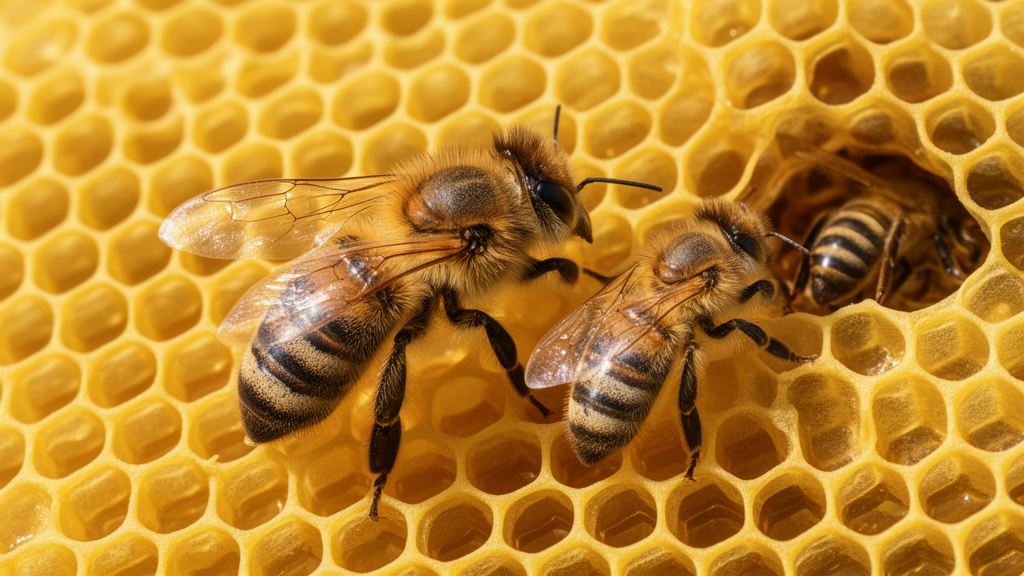
Image Credits: AI Generated
DOI: 10.3389/frbee.2025.1395037
Keywords: bees, chromosomes, karyotypes, Hymenoptera, cytogenetics, Minimum Interaction Theory, stingless bees, bumble bees, honeybees, chromosomal inversions, genome size, social parasitism
Cite Scienmag News
Juliet Wilcox. (October 17, 2026). Why Some Bees Have 25 Chromosomes and Others Just Three. Scienmag. https://scienmag.com/why-some-bees-have-25-chromosomes-and-others-just-three/
Juliet Wilcox. "Why Some Bees Have 25 Chromosomes and Others Just Three." Scienmag, 17 October 2026, https://scienmag.com/why-some-bees-have-25-chromosomes-and-others-just-three/. Accessed 17 October 2026.
Juliet Wilcox. "Why Some Bees Have 25 Chromosomes and Others Just Three." Scienmag. October 17, 2026. https://scienmag.com/why-some-bees-have-25-chromosomes-and-others-just-three/


