


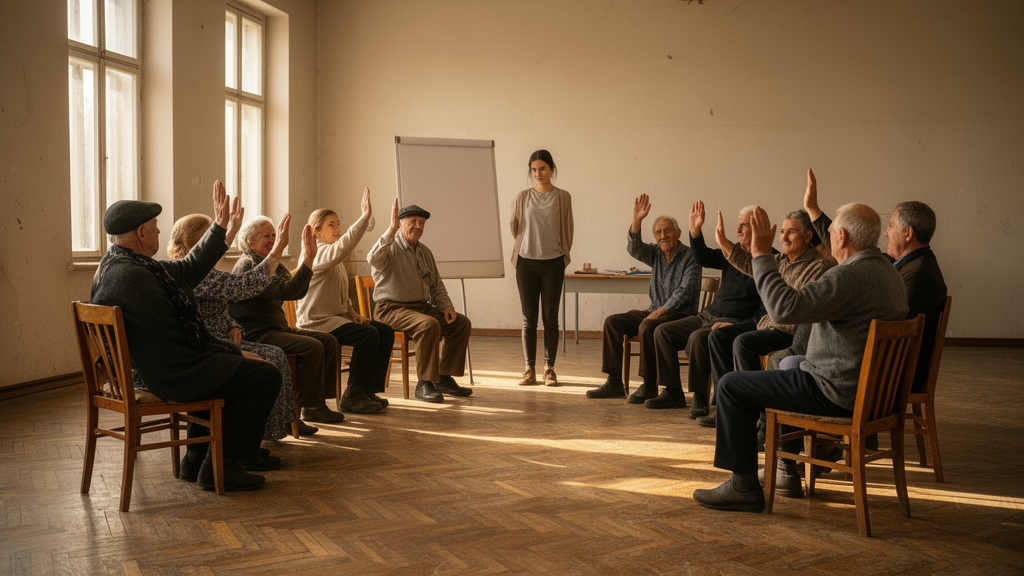
Researchers in Serbia have spent three years testing whether a forgotten institution from the socialist era, the local community council, can be brought back to life as a working site of direct democracy. In a new study published in the European Journal of Cultural Management and Policy, Nina Mihaljinac and Milan Đorđević of the University of Arts Belgrade describe how their EPICA project, funded by the Science Fund of the Republic of Serbia between 2021 and 2024, used participatory action research not merely to study participation but to enact it. Their field site was New Belgrade, a municipality whose housing blocks still carry the material imprint of Yugoslav self-management, now squeezed by privatization, unauthorized construction, and chronic underfunding of public services. The team’s central question was technical as well as political: can an institution hollowed out by legal ambiguity and party co-optation be reactivated through methods of co-creation, collaborative decision-making, and community-based cultural programming?
The theoretical stakes are considerable. The authors position their work against the mainstream of cultural policy, where cultural democracy is often reduced to recognition of diverse practices and inclusive audience participation. Drawing on Stuart Hall’s account of culture as a space of interpretive struggle and Raymond Williams’s insistence that culture cannot be defined without democracy, they advance a more radical formulation. In their view, culture is a political terrain where values, representations, and lived relations are negotiated, and the right to culture includes the right to directly decide on the issues that shape collective life. This distinguishes their approach from governance models of the commons, which focus on how resources are shared rather than how decisions are made. Direct democracy, by contrast, implies continuous, unmediated, egalitarian decision-making that cancels the difference between rulers and ruled, with deliberative assemblies as its key institution.
The methodological choice, participatory action research, has its own lineage. Rooted in communitarian and egalitarian ideologies and shaped since the 1960s by figures such as the Brazilian philosopher Paulo Freire, whose theory of conscientization ties critical reflection to societal transformation, PAR commits researchers and community members to co-designing research actions in the service of the community. Its key elements are direct community participation, a collaborative co-creative approach to knowledge production, and concrete action collectively decided upon. Unlike extractive methods such as surveys or consultations, PAR proceeds through iterative cycles of action and reflection, which the authors argue create conditions for sustained participation aligned with a radical redistribution of institutional authority. Crucially, PAR does not treat participation as a static norm; it investigates its historical layers, current blockages, and potential reactivation.
The EPICA team selected four housing blocks in New Belgrade, blocks 44, 45, 70, and 70a, home to roughly 15,000 residents of diverse socioeconomic backgrounds. The choice was guided by demographic, infrastructural, and political criteria: the blocks host numerous common spaces built under socialist planning, some by volunteer socialist youth, and their inhabitants have mobilized to defend public spaces against privatization. After initial outreach meetings at the Faculty of Dramatic Arts, the team used snowball sampling to recruit activists already engaged in informal organizing. Two opening meetings, in which researchers and local community representatives deliberated for several hours, collectively defined the research streams, an early exercise in the horizontal decision-making the project sought to test.
Four interconnected streams of activity emerged. The first, legal forensics, traced the institutional evolution of local community councils, the mesna zajednica, through archival research, comparative analysis of normative documents, and legal interpretation. The findings were stark. The team analyzed the 1985 Statute of Mesna Zajednica Sava, the 2021 Belgrade City Assembly Decision 09-1234, and the 2023 Constitutional Court Ruling 456/23 on local self-government, and identified deliberate procedural barriers, including an article requiring fifty percent resident attendance for assemblies. While Serbia’s Law on Local Self-Government nominally permits citizen assemblies to propose council candidates, in Belgrade statutory exceptions authorize municipal assemblies to appoint council members unilaterally. The team concluded that no statute of any Belgrade local council is harmonized with higher legal norms, and that even convened assemblies would hold no binding power, an intentional legal architecture of disempowerment.
The second stream investigated citizen mobilization through eight focus groups and one public forum across four neighborhoods over three months, involving 29 participants. Residents catalogued systemic failures: illegal construction, destruction of green areas, absent schools, kindergartens, clinics, and cultural facilities, environmental degradation, and decaying infrastructure including worn-out sewage systems and asbestos roofs. Yet participants also outlined a repertoire of bottom-up organizing, from petitions and protests to community chat groups and informal building councils. Several individuals expressed willingness to participate in local community council elections should such a process become legally viable, leading to a preliminary list of candidate residents, a rare transmutation from analysis to political proposition. Demotivating factors persisted, however: exhaustion, bureaucratic opacity, distrust of institutions, and fear of political co-optation, with citizens often equating any political involvement with party politics.
The third stream activated the physical space of the local community council at Block 45 through cultural programming. The initial plan to curate participatory art events was abandoned in favor of a negotiated approach, with the team recognizing that short-term interventions could not substitute for institutional infrastructure. The key insight is that the cultural expert’s role is not to deliver content but to mediate between local knowledge, institutional logic, and possibilities of shared use. Together with the community, the team co-organized the exhibition Life in the Block, a ten-day public atelier held in October 2024 with no selection process applied. Over 60 contributors, artists and residents alike, created workshops in film production, 3D modelling of ecological public objects, murals, poetry nights, oral history archives, and collective meals, drawing an average of 80 daily participants and roughly 800 visitors. A site-specific mural on the council building staged fragmented phrases about fear and love, sparking informal debates among passersby about who is entitled to safe and dignified housing.
A fourth thread explored situated memory through 17 semi-structured interviews, revealing ambivalent recollections of the councils. In the Yugoslav system they were envisioned as key nodes of grassroots participation, anchoring consumer services, administrative offices, social spaces, and political forums at the center of housing blocks. Yet scholars such as Darko Suvin have documented how self-management suffered deep structural limitations, with participation often fenced in and councils frequently constituting little power cliques dominated by administrators and professional politicians. By the late 1980s many councils had decayed into cafés or semi-private venues, an erosion reinforced by satirical depictions in popular culture that made their revitalization today particularly complex.
The authors are unsparing about the ethical tensions of their own method. Participatory action research was expected to redistribute authority, but under project-based funding its ideals confront material constraints. Researchers held contractual power over budgets and timelines, while participants remained stakeholders rather than co-owners; the project budget was never jointly deliberated as a political resource. The team chose not to fetishize balance but to foreground asymmetry as structurally shaped, treating it as a central object of analysis. They argue that PAR under conditions of projectification is structurally distorted, and that capitalist project-based funding is fundamentally misaligned with the ethos of co-governance unless participants share strong collective motivation to move beyond imposed roles.
Yet the project’s most vital lesson may be what it opened rather than delivered. Although concrete impacts appeared limited, the community later demonstrated high levels of self-organization, convening local assemblies during the wave of student protests that swept Serbia in 2024, when plenums modeled as meetings of equals explicitly called for reviving local councils as platforms of shared governance. The authors conclude that cultural democracy must be reimagined not as a stable policy endpoint but as a conflictual process rooted in collective care and the redistribution of institutional power, beginning in the cracks of the existing order, in forgotten infrastructures and contested spaces, where the promise of self-governance remains fragile, unfinished, but still politically imaginable.
Subject of Research: Participatory action research as a method for reactivating direct democratic practices and cultural democracy in post-socialist local governance
Article Title: Creating conditions for cultural democracy through participatory action research
Article References: Mihaljinac, N., & Đorđević, M. (2025). Creating conditions for cultural democracy through participatory action research. European Journal of Cultural Management and Policy, 15, Article 14707. https://doi.org/10.3389/ejcmp.2025.14707
Image Credits: AI Generated
Keywords: participatory action research, cultural democracy, direct democracy, local community councils, Yugoslav self-management, cultural policy, New Belgrade, community participation, neoliberal governance, public space, co-creation, cultural management
Cite Scienmag News
Courtney Benton. (October 17, 2026). How Participatory Research Is Reviving Forgotten Councils of Direct Democracy in Serbia. Scienmag. https://scienmag.com/how-participatory-research-is-reviving-forgotten-councils-of-direct-democracy-in-serbia/
Courtney Benton. "How Participatory Research Is Reviving Forgotten Councils of Direct Democracy in Serbia." Scienmag, 17 October 2026, https://scienmag.com/how-participatory-research-is-reviving-forgotten-councils-of-direct-democracy-in-serbia/. Accessed 17 October 2026.
Courtney Benton. "How Participatory Research Is Reviving Forgotten Councils of Direct Democracy in Serbia." Scienmag. October 17, 2026. https://scienmag.com/how-participatory-research-is-reviving-forgotten-councils-of-direct-democracy-in-serbia/


