


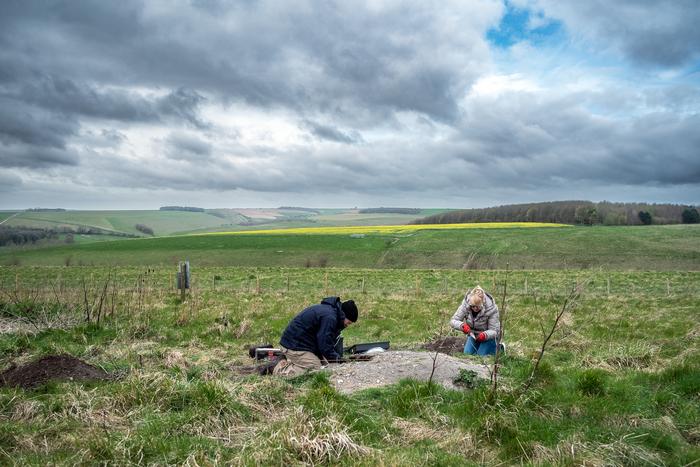
In the rolling landscapes of southern Britain, ancient refuse heaps known as middens are rewriting our understanding of prehistoric social dynamics and animal husbandry practices at the close of the Bronze Age. These colossal mounds, remnants of repetitive communal feasting stretching over centuries, have long captivated archaeologists, but a groundbreaking investigation employing multi-isotope analysis has now unveiled their dynamic role as hubs of extensive regional networks. Drawing from midden deposits across Wiltshire and the Thames Valley, researchers from Cardiff University have unearthed astonishing evidence showing that, far from being mere rubbish dumps, these sites were centers where the origin of feasted animals reflects complex socio-economic interconnections and mobility patterns across vast distances.
The centerpiece of this revelation is the largest study to date targeting prehistoric middens, applying cutting-edge isotopic techniques to bone fragments recovered from six major sites. This method hinges on the principle that the chemical signatures locked within animal bones—particularly isotope ratios of elements such as strontium, oxygen, and sulfur—mirror the geology and water sources of their rearing environments. Since these isotopic markers vary geographically, scientists can trace where the animals were raised, reconstructing ancient trade and exchange circuits previously invisible in the archaeological record. This multi-proxy isotope approach represents a leap forward in archaeological science, enabling unprecedented insights into past human-animal relations and mobility patterns billions of meals old.
Among the middens explored, Potterne in Wiltshire stands out as a monumental feast site encompassing roughly the area of five football pitches. Its layers are a palimpsest of social rituals spanning centuries, containing up to an estimated 15 million bone fragments testifying to the centrality of pork in prehistoric diets. Isotopic data from Potterne illuminated a striking diversity in the geographic origins of the pigs consumed, implicating regions stretching as far north as northern England. The sheer breadth of this procurement signals that Potterne was no local pitstop; rather, it functioned as a nexus drawing producers and communities from a mosaic of locales across Britain, highlighting a network of interaction and exchange that thrived on the coordination of animal husbandry and communal dining.
Contrasting with Potterne, other middens reveal distinct patterns in species focus and sourcing, underscoring varied regional economies and cultural identities that were sustained through feasting. For instance, Runnymede in Surrey appears to have been a cattle-centric hub, sourcing animals from a similarly expansive catchment area. This spatial variability in preferred livestock choices and their origins hints at differentiated but complementary feasting traditions woven into the cultural tapestry of late Bronze Age Britain. It suggests an elaborate system in which communities expressed identity and forged alliances through the deliberate selection and movement of particular animals.
A particularly intriguing case is East Chisenbury, situated merely ten miles from the prehistoric monument of Stonehenge, which was found to be predominantly stocked with sheep. Remarkably, isotope measurements indicate that the vast majority of these animals were raised locally, implying a more insular production and consumption model compared to the long-distance catchments feeding other middens. The monumental scale of East Chisenbury—estimated to contain remains of hundreds of thousands of animals—paired with its localized sourcing, suggests a distinctive social function, possibly reflecting tightly knit regional identities or specialized economic systems embedded in the landscape proximate to one of Britain’s greatest archaeological enigmas.
This nuanced differentiation in animal sourcing across middens challenges prior assumptions about prehistoric feasting as a monolithic phenomenon. Instead, each midden emerged as a lynchpin not only in economic terms but also in social and symbolic realms. The selective focus on particular livestock species and their geographic provenance implies these feasts were instrumental in sustaining specific regional economies and articulating community affiliations during a transformative epoch characterized by economic volatility and shifts in metallurgical traditions. Indeed, as the value of bronze waned and agriculture assumed a more dominant role, these feasting assemblies likely played a pivotal role in stabilizing social cohesion and redistributing resources.
The technological prowess underpinning these revelations highlights the transformative potential of multi-isotope studies in archaeology. By leveraging variations in strontium isotopes, which track underlying geological substrates, alongside oxygen and sulfur isotopes reflective of climatic and environmental conditions, scientists have constructed a multifaceted geographic fingerprint of animal provenance. This technological intersection enables reconstruction of mobility and exchange practices on scales and resolutions previously unattainable, marking a revolution in our capacity to peer into the intricate webs of prehistoric economic and social interactions.
Beyond the scientific intricacies, the study feeds into a larger anthropological narrative about the function of feasting in human societies. As co-author Professor Richard Madgwick notes, the temporal window between the Late Bronze Age and Early Iron Age might arguably represent a “feasting age,” a social phenomenon catalyzed by ecological pressures with broader implications for community formation and political organization. In times marked by climatic and economic instability, communal feasting provided a robust mechanism for consolidating alliances, mediating social tensions, and redistributing wealth—practices fundamental to societal resilience and evolution.
Importantly, this research sheds light on the scale and logistics involved in orchestrating these feasting events. The accumulation of vast midden deposits, some reaching monumental proportions, necessitated not only coordination in animal rearing and procurement but also complex social mobilization for transportation, preparation, and consumption. These findings reveal prehistoric Britain as a landscape teeming with vibrant intercommunity interactions, where food acted as both sustenance and a medium for political and social expression.
Moreover, by unveiling the distinct yet interconnected roles these middens played, the study encourages a reevaluation of prehistoric landscape archaeology. These sites were dynamic arenas where environmental, economic, and social variables converged. Their specific animal assemblages and catchment zones reflect adaptive strategies and cultural identities, reinforcing how prehistoric societies crafted their worldviews and navigated shifting socioeconomic landscapes through ritualized communal consumption.
The implications extend beyond Britain, inviting comparative perspectives across Europe where similar feasting and midden phenomena occur. As isotopic methodologies become increasingly accessible and refined, archaeologists are poised to reconstruct ancient networks of exchange and interaction on continental scales, redefining narratives around mobility, identity, and social complexity in the prehistoric world.
Ultimately, this research from Cardiff University elevates our appreciation of the intricate interplay between environment, economy, and society in prehistoric Britain. It provides a compelling example of how the meticulous scientific investigation of ancient refuse can illuminate vast networks of human behavior, revealing that beneath the seemingly mundane remnants of past meals lie the echoes of far-reaching social connections that shaped the course of history.
Cite Scienmag News
Courtney Benton. (September 9, 2025). Feasting Networks: How Late Bronze Age Food Festivals United Distant Communities. Scienmag. https://scienmag.com/feasting-networks-how-late-bronze-age-food-festivals-united-distant-communities/
Courtney Benton. "Feasting Networks: How Late Bronze Age Food Festivals United Distant Communities." Scienmag, 9 September 2025, https://scienmag.com/feasting-networks-how-late-bronze-age-food-festivals-united-distant-communities/. Accessed 4 September 2026.
Courtney Benton. "Feasting Networks: How Late Bronze Age Food Festivals United Distant Communities." Scienmag. September 9, 2025. https://scienmag.com/feasting-networks-how-late-bronze-age-food-festivals-united-distant-communities/


