


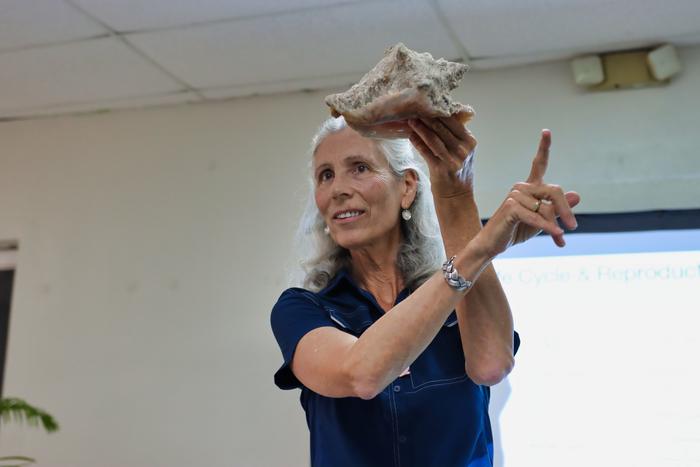
The queen conch (Aliger gigas) is a prized delicacy long harvested for food and revered for its beautiful shell. With a lifespan between 25 to 40 years, the queen conch is second only to the spiny lobster fishery and is the most important molluscan fishery in the Caribbean region.

Credit: IsleLens – Tyrie Moss
The queen conch (Aliger gigas) is a prized delicacy long harvested for food and revered for its beautiful shell. With a lifespan between 25 to 40 years, the queen conch is second only to the spiny lobster fishery and is the most important molluscan fishery in the Caribbean region.
Deeply rooted in the way of life in the Caribbean, many island communities depend on queen conch for their livelihoods. However, intensive fishing and habitat degradation from urbanization and climate change have caused conch populations to significantly dwindle.
Megan Davis, Ph.D., a research professor at Florida Atlantic University’s Harbor Branch Oceanographic Institute, has spent more than 40 years conserving and restoring the queen conch. Now, she and Becky Holt, an assistant director for their aquaculture and conservation program at FAU Harbor Branch, share their vast expertise and knowledge in growing and sustaining the queen conch.
Davis and Holt recently launched “eConch,” a free online training program to grow queen conch, which was developed in collaboration with FAU’s Center for Online and Continuing Education. The program is easy to follow, allows users to move at their own pace, includes high-quality video and provides access to expert advice. The training also includes a comprehensive manual, which provides step-by-step complete illustrations and photos of how to culture queen conch.
The manual includes the science and art of growing queen conch, which Davis developed over four decades, designing, implementing and operating experimental size aquaculture facilities as well as production-scale facilities in Florida and throughout the Caribbean.
“We have received numerous requests throughout Florida and the Caribbean from community members, researchers, aquaculturists, conservationists, educators and students to learn how to conserve and culture queen conch,” said Davis, who is internationally renowned for her research and work with queen conch. “We are incredibly excited to be able to respond to these inquiries with eConch, a first-of-its-kind, free online training program.”
eConch is an experiential online learning program that includes seven descriptive how-to modules. Module topics include collection and hatching of egg masses; larval rearing in the hatchery; microalgae culture to feed the larvae; metamorphosis; nursery culture of the juveniles; ranching for food; and restoration of the species.
“In addition to their socioeconomic importance, the queen conch plays a critical ecological role in seagrass beds,” said Davis. “Aquaculture, along with conservation of breeding populations and fishery management, are ways we can help ensure longevity of this important species.”
In 2019, Davis teamed up with Conservación ConCiencia and Naguabo Fishing Association in Puerto Rico to assist with stock enhancement of the queen conch. The Naguabo Aquaculture Center, which has a queen conch hatchery and nursery for restoration, serves as a demonstration and training facility for Puerto Rico and other Caribbean countries.
“Our work in Puerto Rico has been instrumental in developing and launching eConch and providing an innovative way to save the queen conch,” said Davis. “eConch uses videos and visuals from the Naguabo Aquaculture Center to provide an immersive and hands-on learning experience.”
The goal of this collaboration in Puerto Rico is to produce up to 2,000 queen conch juveniles in a fishers-operated aquaculture facility for release into conch juvenile habitats. The Saltonstall-Kennedy NOAA Fisheries and USDA Agricultural Research Service funded project includes aiding sustainable fisheries practices through aquaculture. The team is working with the fishery communities, utilizing the commercial Fishing Association’s working waterfront for conch aquaculture infrastructure, helping provide diversified incomes for the fishery and local communities, promoting aquaculture practices and ensuring the conch population is available for future fishing and food security through aquaculture and restoration.
For more information about eConch, visit www.conchaquaculture.org.
– FAU –
About Harbor Branch Oceanographic Institute:
Founded in 1971, Harbor Branch Oceanographic Institute at Florida Atlantic University is a research community of marine scientists, engineers, educators, and other professionals focused on Ocean Science for a Better World. The institute drives innovation in ocean engineering, at-sea operations, drug discovery and biotechnology from the oceans, coastal ecology and conservation, marine mammal research and conservation, aquaculture, ocean observing systems and marine education. For more information, visit www.fau.edu/hboi.
About Florida Atlantic University:
Florida Atlantic University, established in 1961, officially opened its doors in 1964 as the fifth public university in Florida. Today, the University serves more than 30,000 undergraduate and graduate students across six campuses located along the southeast Florida coast. In recent years, the University has doubled its research expenditures and outpaced its peers in student achievement rates. Through the coexistence of access and excellence, FAU embodies an innovative model where traditional achievement gaps vanish. FAU is designated a Hispanic-serving institution, ranked as a top public university by U.S. News & World Report and a High Research Activity institution by the Carnegie Foundation for the Advancement of Teaching. For more information, visit www.fau.edu.
Cite Scienmag News
Violet Maxwell. (June 11, 2024). FAU Harbor Branch launches ‘eConch’ to grow and conserve the queen conch. Scienmag. https://scienmag.com/fau-harbor-branch-launches-econch-to-grow-and-conserve-the-queen-conch/
Violet Maxwell. "FAU Harbor Branch launches ‘eConch’ to grow and conserve the queen conch." Scienmag, 11 June 2024, https://scienmag.com/fau-harbor-branch-launches-econch-to-grow-and-conserve-the-queen-conch/. Accessed 3 September 2026.
Violet Maxwell. "FAU Harbor Branch launches ‘eConch’ to grow and conserve the queen conch." Scienmag. June 11, 2024. https://scienmag.com/fau-harbor-branch-launches-econch-to-grow-and-conserve-the-queen-conch/

