

Monday, June 15, 2026
Science
No Result
View All Result
  • Login
  • HOME
  • SCIENCE NEWS
  • CONTACT US
  • HOME
  • SCIENCE NEWS
  • CONTACT US
No Result
View All Result
Scienmag
No Result
View All Result
Home Science News Space

Fast radio burst, a rolling cosmic dice

April 12, 2024
in Space
Reading Time: 2 mins read
0
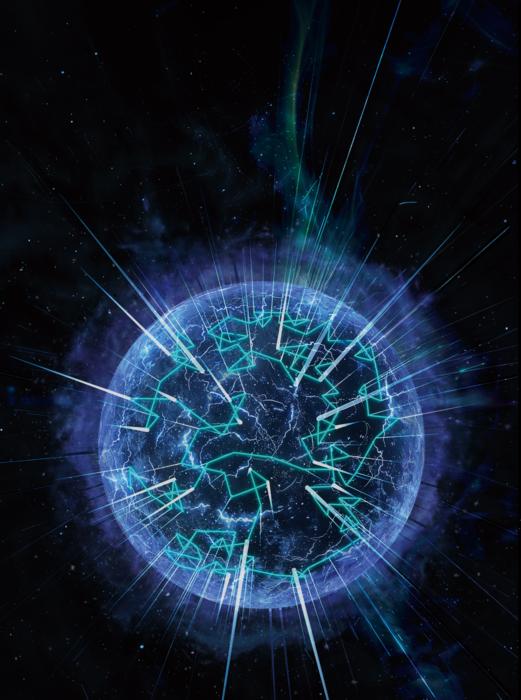
An artist's impression illustrates a compact object’s generating FRBs
67
SHARES
608
VIEWS
Share on FacebookShare on Twitter
ADVERTISEMENT

Fast radio bursts (FRBs) represent the most intense radio explosions in the Universe, releasing sufficient energy, within just a thousandth of a second, to power the global human society for a trillion years. Since the first discovery in 2007, FRBs have garnered significant attention, culminating in the 2023 Shaw Prize in Astronomy. With yet unknown origin, these extreme cosmic bursts are among the most enigmatic phenomena in astronomy as well as physics.

An artist's impression illustrates a compact object’s generating FRBs

Credit: ©Science China Press

Fast radio bursts (FRBs) represent the most intense radio explosions in the Universe, releasing sufficient energy, within just a thousandth of a second, to power the global human society for a trillion years. Since the first discovery in 2007, FRBs have garnered significant attention, culminating in the 2023 Shaw Prize in Astronomy. With yet unknown origin, these extreme cosmic bursts are among the most enigmatic phenomena in astronomy as well as physics.

Causality dictates that FRB sources should be smaller than c·dt in size, where c is the speed of light and dt is the duration of the events. For a typical 1 millisecond burst, this implies a region smaller than 300 kilometers, implying compact objects such as neutron stars or black holes to be the FRBs’ engines. Fast spin have been observed in most compact objects, give rise to the expectation of periodicity in repeating FRBs’ bursts. However, extensive searches for periodicity from millisecond to second scales have all failed, prompting a re-evaluation of FRB emission mechanisms.

A team led by Professor Di Li from the National Astronomical Observatories of the Chinese Academy of Sciences has introduced a novel approach to characterize the FRBs’ behavior in the time-energy bivariate phase space. Quantifying the randomness and chaos using generalized “Pincus Index” and “Lyapunov Exponent”, respectively, they manage to place FRBs in the context of other common physical events like pulsars, earthquakes, and solar flares, systematically.

Both randomness and chaos cause unpredictability, but they are distinct. The unpredictability of a random sequence stays constant over time, picturing rolling dice—the outcome of each roll bears no link to the previous one. In chaotic systems, unpredictability increases exponentially over time. For example, anyone can predict the weather in the coming seconds by looking up and around, while it is still challenging for mankind to predict weather for longer term accurately.

The team found FRBs to roam around the energy-time phase space, with lower level of chaos but higher degree of randomness than those of earthquakes and solar flares. The pronounced randomness of FRB emissions suggests a combination of multiple emission mechanisms or locations. This study establishes a new frame of quantifying FRBs and gets us closer to finally revealing the origin of these violent cosmic explosions: who is rolling the cosmic dice?

###

See the article:

Yong-Kun Zhang, Di Li, Yi Feng, Pei Wang, Chen-Hui Niu, Shi Dai, Ju-Mei Yao, Chao-Wei Tsai. The arrival time and energy of FRBs traverse the time-energy bivariate space like a Brownian motion. Science Bulletin 2024;69(8):1020-1026


Journal

Science Bulletin

DOI

10.1016/j.scib.2024.02.010

Share27Tweet17
Previous Post

Researchers discover cell ‘crosstalk’ that triggers cancer cachexia

Next Post

Cleveland Innovation District partners exceeding many targets set by state and JobsOhio

Related Posts

SwRI and Partners Partner to Launch Lunar Research Initiative with New MOU — Space
Space

SwRI and Partners Partner to Launch Lunar Research Initiative with New MOU

June 15, 2026
Breakthrough: First Direct Observation of Star-Forming Gas in Early Galaxies — Space
Space

Breakthrough: First Direct Observation of Star-Forming Gas in Early Galaxies

June 15, 2026
SwRI Researchers Reveal Insights Into What Future Astronauts Might Encounter on the Moon — Space
Space

SwRI Researchers Reveal Insights Into What Future Astronauts Might Encounter on the Moon

June 15, 2026
Georgia Tech Scientists Successfully Synthesize Moon Rock in the Laboratory — Space
Space

Georgia Tech Scientists Successfully Synthesize Moon Rock in the Laboratory

June 10, 2026
NIST Broadens Chemical Fingerprint Database to Enhance Identification of Unknown Substances — Space
Space

NIST Broadens Chemical Fingerprint Database to Enhance Identification of Unknown Substances

June 9, 2026
Radial Migration Drives Galactic Disc Expansion, Study Finds — Space
Space

Radial Migration Drives Galactic Disc Expansion, Study Finds

June 9, 2026
Next Post
Cleveland Innovation District Partners Exceeding Many Targets Set by State and JobsOhio

Cleveland Innovation District partners exceeding many targets set by state and JobsOhio

  • Mothers who receive childcare support from maternal grandparents show more parental warmth, finds NTU Singapore study

    Mothers who receive childcare support from maternal grandparents show more parental warmth, finds NTU Singapore study

    27654 shares
    Share 11058 Tweet 6911
  • University of Seville Breaks 120-Year-Old Mystery, Revises a Key Einstein Concept

    1059 shares
    Share 424 Tweet 265
  • Bee body mass, pathogens and local climate influence heat tolerance

    682 shares
    Share 273 Tweet 171
  • Researchers record first-ever images and data of a shark experiencing a boat strike

    545 shares
    Share 218 Tweet 136
  • Groundbreaking Clinical Trial Reveals Lubiprostone Enhances Kidney Function

    531 shares
    Share 212 Tweet 133
Science

Embark on a thrilling journey of discovery with Scienmag.com—your ultimate source for cutting-edge breakthroughs. Immerse yourself in a world where curiosity knows no limits and tomorrow’s possibilities become today’s reality!

RECENT NEWS

  • Alkyl-Swap Platform Transforms Secondary N-Methylamines Late-Stage
  • Refining Near-Term South Asian and Afro-Asian Monsoon Forecasts
  • Study Warns Traditional Legal Systems Ill-Prepared for Rapid Climate Change Challenges
  • How Exposure to Gun Violence Fuels Racial Health Disparities

Categories

  • Agriculture
  • Anthropology
  • Archaeology
  • Athmospheric
  • Biology
  • Biotechnology
  • Blog
  • Bussines
  • Cancer
  • Chemistry
  • Climate
  • Earth Science
  • Editorial Policy
  • Marine
  • Mathematics
  • Medicine
  • Pediatry
  • Policy
  • Psychology & Psychiatry
  • Science Education
  • Social Science
  • Space
  • Technology and Engineering

Subscribe to Blog via Email

Enter your email address to subscribe to this blog and receive notifications of new posts by email.

Join 5,146 other subscribers

© 2025 Scienmag - Science Magazine

Welcome Back!

Login to your account below

Forgotten Password?

Retrieve your password

Please enter your username or email address to reset your password.

Log In
No Result
View All Result
  • HOME
  • SCIENCE NEWS
  • CONTACT US

© 2025 Scienmag - Science Magazine

Discover more from Science

Subscribe now to keep reading and get access to the full archive.

Continue reading
