


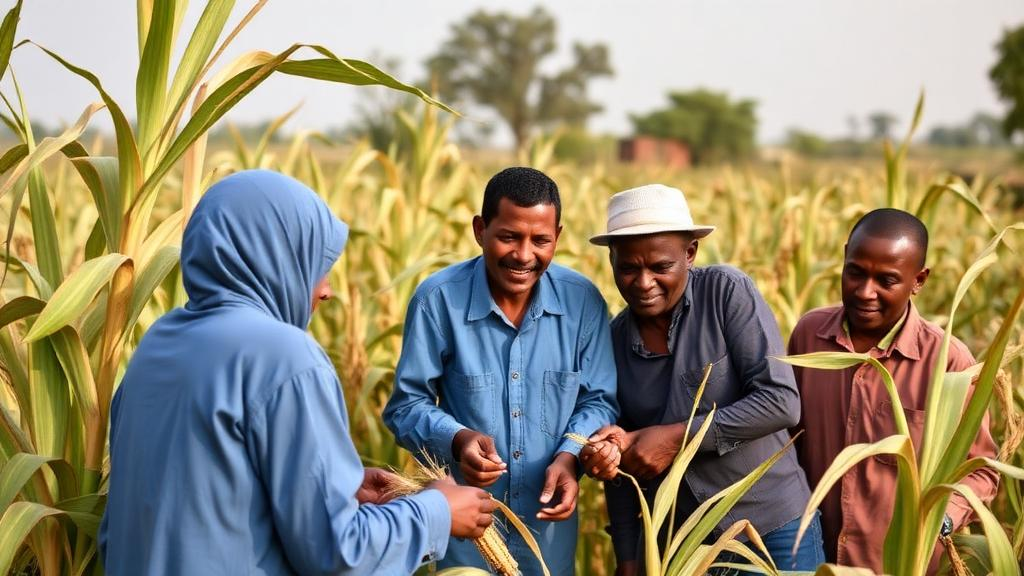
In the smallholder fields of southern Ethiopia, where the average maize plot covers less than a hectare and is often split into even smaller parcels, a quiet policy experiment is producing striking results. A new study published in BMC Agriculture finds that farmers who grow maize collectively through cluster farming are substantially more efficient than those who farm alone, converting a larger share of their land, labor, and fertilizer into actual grain. The research, led by Mulugeta Fola of the Sidama Agricultural Research Institute with colleagues from the South Ethiopia Agricultural Research Institute, offers some of the most rigorous evidence yet that Ethiopia’s cluster-based production strategy is delivering on its promise.
The stakes are high. Maize is the cheapest source of calories among Ethiopia’s major cereals, dominating household diets and providing roughly twice as many calories per dollar as other staples. Yet Ethiopian farmers harvest only about 30 percent of the crop’s potential yield, held back by limited access to improved technologies, market imperfections, liquidity constraints, and technical inefficiency on the farm itself. Earlier efficiency studies have estimated efficiency gaps of 14 to 28.3 percent, meaning producers lose more than a quarter of their potential output to avoidable waste. Closing even part of that gap could translate into meaningful gains for food security across the region.
Cluster farming, introduced nationally through the agricultural commercialization cluster initiative in 2010, is designed to overcome precisely these barriers. The approach groups farmers geographically around a commodity’s production potential and encourages them to coordinate land preparation and planting, share improved seeds, fertilizers, and crop protection chemicals, and receive concentrated support from extension agents. The idea is to shift smallholders from subsistence production toward market-oriented farming by pooling resources and standardizing agronomic practice. In principle, a farmer embedded in a cluster can apply recommended input rates, time sowing within a narrow window alongside neighbors, and tap into collective bargaining power that an isolated plot owner cannot.
To test whether the strategy actually improves efficiency rather than merely raising yields, the researchers surveyed 421 randomly selected smallholder maize farmers during the 2021 production season across the Halaba, Wolaita, Gamo, and Gofa zones. Half of the sample, 206 farmers, produced maize within clusters, while 215 farmed outside them. The team used a two-stage sampling design, first selecting six districts with strong maize potential, three cluster districts and three non-cluster districts, and then randomly drawing households from kebeles within each. A structured questionnaire captured everything from household demographics and land use to input quantities, agronomic practices, and institutional variables such as credit access and extension contact.
The analytical machinery behind the study is where its technical rigor lies. The researchers estimated a stochastic frontier model using a flexible translog production function, chosen over the more restrictive Cobb-Douglas form after a likelihood ratio test decisively rejected the simpler specification. Because smallholder farmers operate under wildly varying socioeconomic and institutional conditions, the team employed a heteroscedastic frontier model, allowing the variance of inefficiency itself to depend on factors such as cluster participation, oxen ownership, income, and extension contact. Ignoring this heterogeneity, the authors note, can seriously bias efficiency estimates. Inputs and outputs were scaled by their sample means so that first-order coefficients could be read directly as elasticities evaluated at the mean.
The frontier results paint a clear picture of what drives maize output. Land is by far the most responsive input, with an estimated output elasticity of 36 percent, followed by labor at 27 percent and fertilizer at 16 percent. Oxen power and seed contributed smaller elasticities of 8 and 6 percent respectively, and the returns to scale estimate of 0.81 indicated decreasing returns overall. Notably, the second-order effect of fertilizer significantly increased returns to output, which the authors attribute to the very low baseline application of inorganic fertilizer, itself a consequence of liquidity and institutional constraints. The second-order terms for oxen and labor were negative, signaling diminishing returns as these inputs intensify.
The headline finding is the efficiency gap between the two groups. Farmers producing maize in clusters achieved an average technical efficiency of 74 percent, while non-cluster farmers reached only 60 percent. A kernel density analysis of the efficiency distributions confirmed that cluster farmers’ scores were skewed toward higher values. Because farmers who join clusters may differ systematically from those who do not, the team went a step further, applying an endogenous switching regression model that accounts for both observable and unobservable differences between participants and non-participants. The frequency of extension contact served as the instrumental variable identifying the model, since extension agents actively promote cluster participation but do not directly determine efficiency.
The counterfactual analysis sharpened the conclusion considerably. Cluster farmers would have lost 18 percent of their technical efficiency had they not participated in cluster production, the average treatment effect on the treated. Conversely, non-cluster farmers would have gained 33 percent in efficiency had they joined, the average treatment effect on the untreated. In other words, the farmers most likely to benefit from clustering are precisely those currently standing outside it. The first-stage probit model, which fit the data well, identified male household headship, oxen ownership, frequent extension contacts, greater market distance, credit access, and household income as significant drivers of cluster participation, with the market distance result suggesting that farmers far from markets see cooperation as a way to cut transaction costs.
The study’s authors argue that the findings carry direct policy weight for a region where land fragmentation is more severe than elsewhere in Ethiopia. They recommend that policymakers and development organizations promote clustering in crop production while addressing the socioeconomic factors that gate participation, including gender gaps in access to extension advice and liquidity constraints that limit input purchase. Strengthening the improved seed system, modernizing extension through digital communication technologies, and promoting climate-smart practices are flagged as complementary priorities. The authors also emphasize that collective action among farmers, government, the private sector, and donors will be essential to scale the model.
For a country where agriculture anchors employment and output but productivity remains stubbornly suboptimal, the message from southern Ethiopia is unusually concrete: farming together measurably reduces the waste that has long eroded smallholder potential. With maize efficiency gaps of this magnitude, the difference between a 60 percent and a 74 percent efficient harvest is not an academic abstraction but the equivalent of several additional weeks of food for a farming household. If the cluster approach can be extended to the non-participants who stand to gain the most, the study suggests, Ethiopia’s staple grain system may be able to squeeze far more nutrition and income from the same scarce land.
Subject of Research: The effect of maize cluster farming on the technical efficiency of smallholder farmers in southern Ethiopia
Article Title: Effect of maize cluster farming on smallholder farmers’ technical efficiency: evidence from Southern Ethiopia
Article References: Fola, M., Tsegaye, G., Zawde, S., & Matsalo, M. (2025). Effect of maize cluster farming on smallholder farmers’ technical efficiency: evidence from Southern Ethiopia. BMC Agriculture, 1(1), Article 4. https://doi.org/10.1186/s44399-025-00006-w
Image Credits: AI Generated
DOI: 10.1186/s44399-025-00006-w
Keywords: cluster farming, maize, technical efficiency, smallholder farmers, Ethiopia, stochastic frontier analysis, endogenous switching regression, agricultural policy, land fragmentation, extension services, food security, agricultural economics
Cite Scienmag News
Alan Morgan. (October 4, 2026). Farming Together Pays: Cluster Maize Cuts Inefficiency in Southern Ethiopia. Scienmag. https://scienmag.com/farming-together-pays-cluster-maize-cuts-inefficiency-in-southern-ethiopia/
Alan Morgan. "Farming Together Pays: Cluster Maize Cuts Inefficiency in Southern Ethiopia." Scienmag, 4 October 2026, https://scienmag.com/farming-together-pays-cluster-maize-cuts-inefficiency-in-southern-ethiopia/. Accessed 4 October 2026.
Alan Morgan. "Farming Together Pays: Cluster Maize Cuts Inefficiency in Southern Ethiopia." Scienmag. October 4, 2026. https://scienmag.com/farming-together-pays-cluster-maize-cuts-inefficiency-in-southern-ethiopia/


