


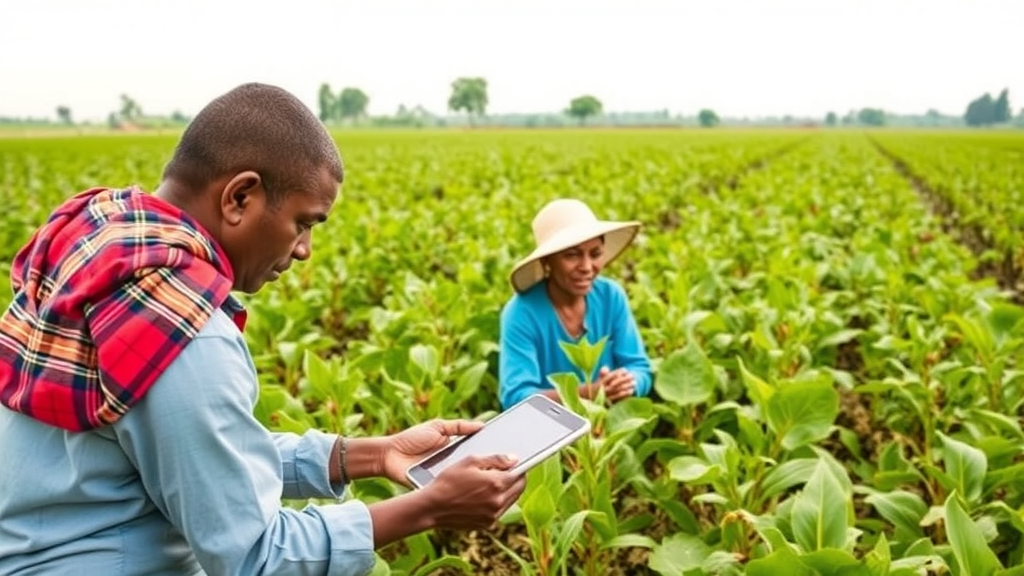
Agricultural extension, the backbone of how farming knowledge reaches the world’s smallholders, is undergoing a structural transformation, according to a new systematic review published in BMC Agriculture. For decades, extension services in the Global South were conceived as one-way pipelines that delivered research outputs from laboratories to fields. The new evidence suggests that model is obsolete. Instead, the most effective programs now treat farmers as co-creators of knowledge, blending participatory face-to-face learning with digital advisory tools in hybrid systems that measurably strengthen farmers’ skills, decision-making, and resilience to climate and market shocks.
The review, led by Wycliffe Ongachi of Sher-e-Kashmir University of Agricultural Sciences and Technology of Kashmir and the University of Nairobi, synthesized 47 peer-reviewed and high-quality institutional documents published between 2019 and 2024. The team followed the PRISMA 2020 reporting standard, searching five major academic databases—Scopus, Web of Science, ScienceDirect, Dimensions, and Semantic Scholar—alongside gray literature from organizations such as the UN Development Programme, IFAD, and the CGIAR network. From 321 initial records, duplicates were removed and full texts screened down to the final 47 studies, which were appraised using a modified Critical Appraisal Skills Programme checklist and assessed for review-level bias with the ROBIS framework.
Geographically, Africa dominated the evidence base, contributing 43 percent of documented initiatives, followed by South Asia at 30 percent and Latin America at 17 percent. Publication activity peaked in 2021, a pattern the authors attribute to the post-COVID policy pivot toward resilient food systems and targeted international funding from bodies such as the FAO and IFAD. The pandemic itself acted as an accelerant: with face-to-face extension disrupted, remote and digital advisory methods expanded rapidly, cementing a convergence between social learning and digital delivery that the review identifies as the defining shift in the field.
Two platforms emerged as the dominant engines of farmer capacity development. Farmer field schools, which build human and social capital through hands-on, participatory learning in the field, were the most frequently reported intervention. Reported yield improvements for farmer field schools ranged from 18 to 30 percent, although the authors caution that this evidence is largely case-based and context-specific. Digital platforms, by contrast, showed a smaller but more rigorously aggregated effect: a meta-analysis of seven programs across Asia and Africa cited in the review found an average yield increase of 4 percent and a 22 percent improvement in farmers’ access to recommended inputs. The two figures reflect different evidence structures and intervention intensities, and the reviewers urge caution against direct comparison.
The case evidence is striking in its specificity. In Malawi, the Feed the Future Innovative Lab supported 114,000 peanut farmers, raising adoption of climate-smart practices from 5 percent at baseline to 83 percent. In Colombia, the AgroTIC platform connected farmers to agronomists and merchants through smartphones and machine learning; of 142 participants, 74 reported reduced crop losses and 102 successfully marketed their produce. In South Asia, farmer field schools strengthened women’s participation in farm decision-making through gender-responsive design, while in Colombia programs integrating indigenous knowledge into cacao agroforestry training were associated with cocoa yield gains of up to 30 percent. India’s Digital Green platform, delivering localized video-based learning in local languages, reaches millions of farmers at low cost.
The review anchored its synthesis in two complementary theoretical lenses: the sustainable livelihoods framework, which assesses how initiatives build farmers’ five capital assets—human, social, financial, physical, and natural—and diffusion of innovation theory, which explains how new practices spread through social systems from initial awareness to sustained adoption. Read through these frameworks, the most successful initiatives were those that bundled capitals together. Farmer producer organizations in India, Uganda, and Peru built social and financial capital through collective bargaining and market linkages, while conservation agriculture programs improved natural capital through better water-use efficiency and soil fertility. Climate information services in Bangladesh even outperformed purely scientific forecasts when women farmers blended indigenous indicators with formal data, achieving a probability-of-detection score of 0.74 versus 0.62 for scientific forecasts alone.
Yet the review is equally clear about the constraints. Chronic underinvestment remains fundamental: funding for agricultural research, education, and training rarely exceeds 1 percent of agricultural GDP, averaging just 0.7 percent—well below the World Bank’s 2 percent benchmark. Digital infrastructure lags severely in Africa, where access remains below 30 percent, limiting the scalability of digital tools. Gender inequalities in South Asia and weak institutional continuity in Latin America further restrict inclusivity. During COVID-19 lockdowns, 57 percent of women farmers in Nepal reported productivity declines as training sessions were disrupted and private-sector support evaporated. Extension officers themselves often lack the digital literacy and pedagogical skills to adapt programs to local contexts, and donor-funded projects frequently operate on short cycles that mismatch the longer timelines farmers need to confirm and sustain adoption of new practices.
A particularly stubborn gap separates skill acquisition from economic empowerment. Even where willingness to adopt digital platforms reaches 70 percent, actual use of mobile financial services remains as low as 15 percent in some contexts, meaning programs risk producing skilled but financially excluded farmers. Similarly, physical investments such as irrigation systems and mechanization often prioritize hardware over training for operation and maintenance, weakening the link between physical and human capital and undermining long-term sustainability. The authors argue that without deliberate engagement of microfinance institutions, savings groups, and insurance mechanisms, capacity building stalls short of livelihood transformation.
In response, the review proposes an integrative capacity-building and innovation diffusion framework built on three design principles: dual-channel delivery that pairs farmer field schools with digital tools; institutional continuity mechanisms that outlast individual project cycles; and concurrent bundling of human, social, financial, and physical capital, supported by recursive feedback loops rather than one-time interventions. The policy implications point away from short-term, discrete projects toward system-oriented approaches—multi-year financing horizons, maintenance training embedded in infrastructure investments, digital platforms linked to existing savings groups, and gender-disaggregated targets with dedicated budgets. Programs targeting women and youth, the authors stress, should be institutionalized within national agricultural policies and financial systems rather than left as donor-driven pilots.
The review acknowledges limitations, including its restriction to English-language publications, the potential for language and reporting bias, and heterogeneity across study designs that precluded formal meta-analysis. Future research, the authors argue, should prioritize experimental and quasi-experimental designs, standardized outcome reporting, and coverage of fragile and conflict-affected regions. Key open questions include the minimum intensity of farmer field school and digital integration required for sustained adoption, how outcomes vary by gender and farm size, and which institutional arrangements allow scaling without sacrificing local relevance. What is already clear, the authors conclude, is that agricultural extension is no longer a delivery channel but a catalytic system—one whose hybrid, innovation-driven future may determine how effectively the Global South’s hundreds of millions of smallholders weather the converging pressures of climate change, market volatility, and demographic change.
Subject of Research: A systematic review of agricultural extension services and capacity-building initiatives enhancing smallholder farmers' resilience in the Global South.
Article Title: Strengthening agricultural extension services to enhance farmers’ capacity and resilience for sustainable development; a systematic review
Article References: Ongachi, W., Belinder, I., Bhat, B., Hussain, S., & Dub, R. (2026). Strengthening agricultural extension services to enhance farmers’ capacity and resilience for sustainable development; a systematic review. BMC Agriculture, 2(1), Article 17. https://doi.org/10.1186/s44399-026-00039-9
Image Credits: AI Generated
DOI: 10.1186/s44399-026-00039-9
Keywords: agricultural extension, farmer field schools, digital advisory platforms, smallholder farmers, resilience, capacity building, sustainable livelihoods, diffusion of innovation, Global South, climate-smart agriculture, gender inclusion, systematic review
Cite Scienmag News
Alan Morgan. (September 20, 2026). Farmer Field Schools and Digital Tools Reshape Agricultural Extension in the Global South. Scienmag. https://scienmag.com/farmer-field-schools-and-digital-tools-reshape-agricultural-extension-in-the-global-south/
Alan Morgan. "Farmer Field Schools and Digital Tools Reshape Agricultural Extension in the Global South." Scienmag, 20 September 2026, https://scienmag.com/farmer-field-schools-and-digital-tools-reshape-agricultural-extension-in-the-global-south/. Accessed 4 October 2026.
Alan Morgan. "Farmer Field Schools and Digital Tools Reshape Agricultural Extension in the Global South." Scienmag. September 20, 2026. https://scienmag.com/farmer-field-schools-and-digital-tools-reshape-agricultural-extension-in-the-global-south/


