


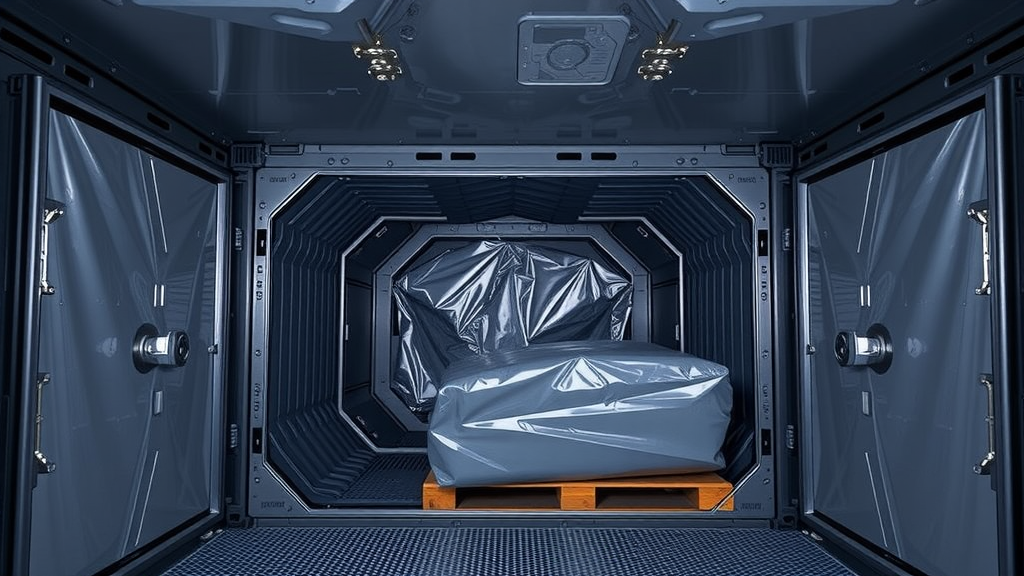
A new study published in npj Advanced Manufacturing presents a sealed flexible containment strategy designed to solve one of the most stubborn logistics problems facing the emerging field of in-space manufacturing: how to store highly reactive polymerizable materials for long periods without degrading them, and then activate them on demand in orbit with minimal outgassing. The research, published under the title describing a sealed flexible containment approach for long-term storage and low-outgassing to fuel in-space manufacturing of frontally polymerizable composites, addresses a challenge that has quietly limited what astronauts and autonomous systems can build beyond Earth.
In-space manufacturing has moved rapidly from concept to demonstration in recent years. Space agencies and commercial companies have printed tools on the International Space Station, produced fiber-optic materials in microgravity, and explored ways to fabricate large structures such as antennas, solar arrays, and habitat components directly in orbit. The economic logic is compelling: launching finished hardware is expensive and volume-constrained, while launching compact raw materials that can be transformed into large structures in space promises far greater returns per kilogram of payload. Yet the raw materials themselves pose their own problems, and that is where this new work focuses its attention.
The materials at the heart of the study are frontally polymerizable composites. Frontal polymerization is a process in which a localized trigger, typically heat applied at a single point, initiates a self-propagating reaction wave that travels through the material, converting liquid or semi-solid monomer resin into a solid polymer as it goes. Because the reaction sustains itself, only a small initial energy input is needed to cure an entire part, which makes the technique attractive for space applications where power is scarce and equipment must be simple. The cured products can be fiber-reinforced composites, combining a polymer matrix with reinforcing fibers to produce rigid, strong structures suitable for booms, panels, and other structural elements.
However, the very chemistry that makes frontal polymerization so appealing also makes its precursor materials difficult to store. The resin formulations typically contain monomers, initiators, and other reactive components that can begin to react slowly at ambient temperatures, a phenomenon known as premature or background polymerization. Over weeks or months, this slow reaction can thicken the resin, alter its composition, and ultimately ruin its ability to undergo a clean frontal cure. A mission to Mars or a multi-year orbital platform operation cannot rely on materials that spoil like perishable cargo, so long-term storage stability becomes a mission-critical requirement rather than a convenience.
The second major problem is outgassing. In the vacuum and closed-atmosphere conditions of spacecraft, volatile compounds that escape from materials can condense on sensitive surfaces such as optics, thermal radiators, solar cells, and sensors, degrading their performance. Space agencies therefore impose strict outgassing limits on materials used in spacecraft, particularly in payload volumes. Reactive resin systems are especially prone to releasing volatile monomers, additives, and reaction byproducts, both during storage and during the curing process itself. A container that vents these compounds into a cabin or payload bay creates contamination risks that could compromise an entire mission’s scientific instruments.
The containment strategy described in the study tackles both problems simultaneously by sealing the frontally polymerizable composite precursor within a flexible barrier package. The flexibility of the containment is not a cosmetic choice. Rigid containers add mass and volume, both of which are at a premium on any launch, and they can complicate the handling and activation steps in microgravity. A flexible package can conform to the material, be stowed efficiently, and potentially be integrated into the manufacturing process itself, serving as both the storage vessel and part of the reaction setup. The sealed nature of the package is designed to prevent the escape of volatile species into the surrounding spacecraft environment while also protecting the reactive contents from atmospheric contaminants such as oxygen and moisture that could degrade them over time.
According to the study, this dual function, containment of outgassing species and protection of the reactive formulation, is what enables the long-term storage that in-space manufacturing demands. By keeping the precursor material in a controlled, sealed environment, the approach suppresses the pathways through which resin formulations normally age: evaporation of volatile components, ingress of inhibiting contaminants, and gradual background reaction. The result is a material that can sit in storage for extended periods and still perform when it is finally triggered, a property the authors connect directly to the logistical realities of missions where resupply is infrequent or impossible.
The implications for mission architecture are significant. If frontally polymerizable composites can be stored reliably for the duration of a long mission, spacecraft designers can treat them as a versatile feedstock rather than a liability. A compact package of resin-impregnated material could be transformed into a rigid structural element with minimal equipment: a heat source to initiate the frontal wave, a support fixture to hold the geometry, and little else. This stands in contrast to traditional composite manufacturing on Earth, which relies on autoclaves, controlled ovens, and energy-intensive processes that are impractical to fly. The low energy demand of frontal polymerization, combined with storage-stable precursors, points toward manufacturing systems that are light, simple, and robust enough for autonomous operation far from Earth.
The low-outgassing aspect of the strategy also matters for crewed operations. On the International Space Station and future commercial stations, air quality is carefully managed, and any process that releases volatile organic compounds into the cabin must be controlled or avoided. A containment approach that captures volatiles during both storage and cure reduces the burden on life support systems and environmental monitoring, making polymer-based in-space fabrication more compatible with human presence. For uncrewed platforms, the same containment protects optics and electronics from contamination films that could otherwise accumulate over months of manufacturing activity.
The work arrives at a moment when interest in orbital and lunar manufacturing is accelerating. Programs across government space agencies and private companies are investing in technologies to fabricate structures in space, driven by ambitions for large space telescopes assembled in orbit, expansive solar power systems, deep-space habitats, and rapidly deployable spacecraft components. Frontally polymerizable composites have been identified as a leading candidate material system for several of these applications precisely because they combine high structural performance with a manufacturing process that is forgiving of the space environment. What has been missing is a practical answer to the storage and contamination questions, and the sealed flexible containment strategy presented in npj Advanced Manufacturing offers a direct response to that gap.
As with any materials technology transitioning from laboratory to spaceflight, the path forward will involve qualification testing under launch vibration, thermal cycling, radiation exposure, and vacuum conditions, along with demonstrations on parabolic flights or orbital platforms. The study’s contribution lies in establishing a storage and handling framework that addresses the failure modes most likely to derail such demonstrations: degraded resin, contaminated cabins, and unreliable curing. By packaging the solution into a form that is flexible, sealed, and compatible with the frontal polymerization process itself, the researchers have outlined a practical route for turning reactive chemistry from a mission risk into a mission asset, bringing the vision of building large, strong structures in space one step closer to routine reality.
Subject of Research: Sealed flexible containment for long-term storage and low-outgassing of frontally polymerizable composites used in in-space manufacturing.
Article Title: Sealed flexible containment strategy for long-term storage and low-outgassing to fuel in-space manufacturing of frontally polymerizable composite
Article References: Wu, I. C. L., Zheng, Z., Perakalapudi, U., Abdullah, A., Rahman, M. A., Rasheed, N., Tindall, B. J., Lee, M., Shanmugam, L., Sottos, N., Tawfick, S., & Baur, J. W. (2026). Sealed flexible containment strategy for long-term storage and low-outgassing to fuel in-space manufacturing of frontally polymerizable composite. npj Advanced Manufacturing. https://doi.org/10.1038/s44334-026-00115-7
Image Credits: AI Generated
DOI: 10.1038/s44334-026-00115-7
Keywords: in-space manufacturing, frontal polymerization, frontally polymerizable composites, long-term storage, low-outgassing, sealed flexible containment, polymer composites, space materials, orbital fabrication, spacecraft contamination, resin curing, space technology
Cite Scienmag News
Denise Maddox. (September 20, 2026). Sealed Flexible Containment Could Unlock Long-Term Storage of In-Space Manufacturing Materials. Scienmag. https://scienmag.com/sealed-flexible-containment-could-unlock-long-term-storage-of-in-space-manufacturing-materials/
Denise Maddox. "Sealed Flexible Containment Could Unlock Long-Term Storage of In-Space Manufacturing Materials." Scienmag, 20 September 2026, https://scienmag.com/sealed-flexible-containment-could-unlock-long-term-storage-of-in-space-manufacturing-materials/. Accessed 5 October 2026.
Denise Maddox. "Sealed Flexible Containment Could Unlock Long-Term Storage of In-Space Manufacturing Materials." Scienmag. September 20, 2026. https://scienmag.com/sealed-flexible-containment-could-unlock-long-term-storage-of-in-space-manufacturing-materials/


