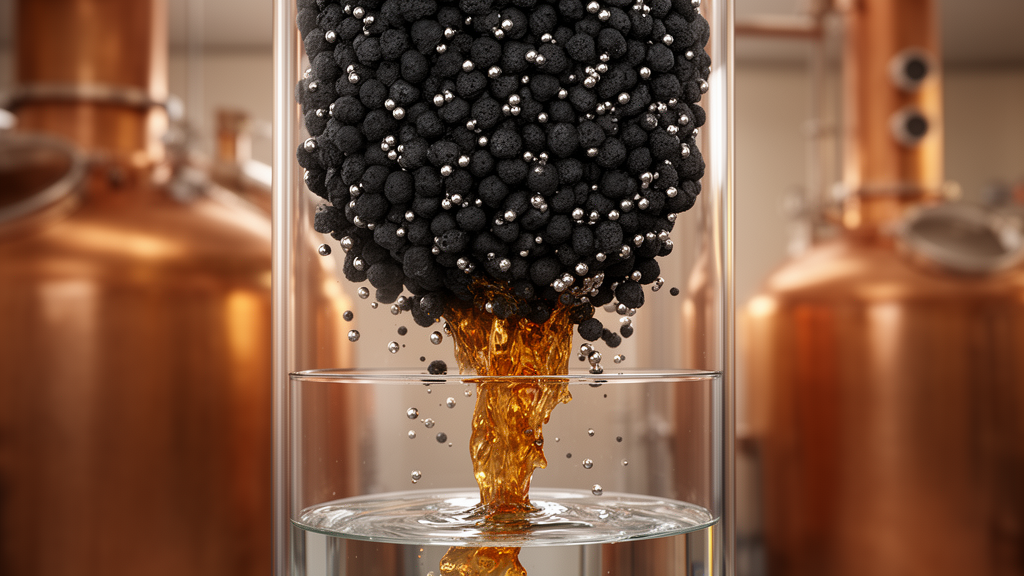
Vinasse, the dark, acidic effluent left over from distilleries, is one of the most polluting by-products in the agro-industrial world. Its corrosivity, low pH and heavy load of organic matter make it roughly 100 times more polluting than household sewage, yet it also carries dissolved nutrients such as potassium, calcium and magnesium that give it value as a fertilizer. A new open-access study in Discover Sustainability, published on 10 September 2026 by Chitsanzo Damazio and Ephraim Vunain, reports a way to tackle both sides of that paradox: turning agricultural waste into activated carbons that clarify vinasse itself.
The researchers produced activated carbons from three residues that are abundant in many farming economies: sugarcane bagasse, baobab shells and tamarind seeds. Each material was activated with phosphoric acid at temperatures ranging from 400 to 700 degrees Celsius. The resulting carbons were characterized with FTIR spectroscopy and proximate analysis to confirm their surface chemistry and composition before any adsorption testing began.
Batch adsorption experiments then tested how well the three carbons removed potassium, calcium and magnesium ions from vinasse under varying conditions of pH, adsorbent dose, contact time, ion concentration and agitation speed. The optimum performance emerged at alkaline conditions, with maximum removal of the three ions occurring at pH values between 10 and 12. The removal efficiencies reported at those optimum conditions were high and remarkably consistent across the three feedstocks: 98.22 percent for the bagasse-derived carbon, 97.21 percent for the baobab shell carbon and 97.63 percent for the tamarind seed carbon.
Those figures describe laboratory batch tests on the ions studied, not full-scale treatment of raw vinasse, but they demonstrate that all three agricultural residues can yield carbons capable of near-complete removal of the target ions. To understand the mechanism, the team fitted the equilibrium data to standard isotherm models. The Freundlich model described the data best, followed by Temkin and then Langmuir, while the adsorption kinetics followed a pseudo-first-order mechanism.
The study also set the new approach against conventional treatment. Chemical coagulation with alum, ferric chloride, sodium aluminate, aluminum chloride and ferric sulfate is widely applied to effluents like vinasse, but these methods leave hazardous chemical residues, raise treatment costs and can degrade soil and water quality where the treated waste is discharged or reused. Plant-based activated carbons, by contrast, are produced from residues that would otherwise need disposal, and the authors argue that their use enhances the economic value of agricultural by-products while reducing waste-handling burdens.
The authors frame the work in the language of the United Nations Sustainable Development Goals, noting contributions to clean water and sanitation (SDG 6), responsible consumption and production (SDG 12), climate action (SDG 13), decent work and economic growth (SDG 8) and life on land (SDG 15). The researchers themselves are careful about the limits of the evidence. The findings come from batch laboratory experiments under controlled pH, dose, contact time, concentration and agitation conditions, and the published version notes that the record is subject to further editorial updates before the final Version of Record.
The study explicitly recommends pilot-scale trials to validate the laboratory results and to assess whether the performance holds up under real-world conditions of flow, variable effluent composition and continuous operation. If those trials succeed, the approach could offer distilleries a treatment route built from the same agricultural landscapes that generate their feedstock, closing a loop between two waste streams at once.
Subject of Research: Phosphoric-acid-activated carbons from agricultural wastes for removing calcium, magnesium and potassium ions from vinasse distillery effluent
Article Title: Sustainable valorization of vinasse through plant based adsorbents for removing calcium, magnesium and potassium from waste
Article References: Damazio, C., & Vunain, E. (2026). Sustainable valorization of vinasse through plant based adsorbents for removing calcium, magnesium and potassium from waste. Discover Sustainability. https://doi.org/10.1007/s43621-026-04610-x
Image Credits: AI Generated
DOI: 10.1007/s43621-026-04610-x
Keywords: vinasse, activated carbon, adsorption, bagasse, baobab shells, tamarind seeds, phosphoric acid activation, wastewater treatment, Freundlich isotherm, pseudo-first-order kinetics, agricultural waste valorization, sustainable development goals
Cite Scienmag News
Alan Morgan. (October 28, 2026). Farm waste turned into carbon filters that strip metals from distillery effluent. Scienmag. https://scienmag.com/farm-waste-turned-into-carbon-filters-that-strip-metals-from-distillery-effluent/
Alan Morgan. "Farm waste turned into carbon filters that strip metals from distillery effluent." Scienmag, 28 October 2026, https://scienmag.com/farm-waste-turned-into-carbon-filters-that-strip-metals-from-distillery-effluent/. Accessed 28 October 2026.
Alan Morgan. "Farm waste turned into carbon filters that strip metals from distillery effluent." Scienmag. October 28, 2026. https://scienmag.com/farm-waste-turned-into-carbon-filters-that-strip-metals-from-distillery-effluent/