


Preschool classrooms are places where play comes naturally, yet science instruction often does not. A new study from Greece has put numbers and narratives to a problem long suspected by researchers: early childhood teachers overwhelmingly believe in the power of play, but they lack the confidence, content knowledge and practical scaffolding to weave concrete science learning into their playful routines. In a two-month professional development programme grounded in the Conceptual PlayWorlds model, 28 in-service kindergarten teachers from six Greek preschools worked alongside university researchers to design and deliver play-based science activities, and the way that support was tailored to each group of teachers may reshape how teacher education is conceived worldwide.
The study, published open access in the Early Childhood Education Journal, draws on the Conceptual PlayWorlds (CPW) framework proposed by Marilyn Fleer, an intervention model rooted in Vygotsky’s cultural-historical theory of play, imagination and creativity. In a CPW, teachers and children together enter an imaginary story world driven by a dramatic problem. A fairytale is introduced, an imaginary space is collectively created where objects take on new meanings, and both children and adults move in and out of that space as they investigate scientific phenomena. Crucially, the model does not ask teachers to abandon their expertise in play; instead it positions them as play partners in role and, simultaneously, as agentic science learners who resurface their own conceptual knowledge through the activity. As the research team notes, the model is deliberately adaptable: it is not the teachers who must adjust to the model, but the model that adjusts to the teachers.
That adaptability was the engine of the study. The programme, part of a 24-month state-funded research project coordinated by Aristotle University of Thessaloniki and funded by the Hellenic Foundation for Research and Innovation, began with whole-group sessions introducing theoretical principles and examples of play-based science. It then shifted to small-group sessions held in situ at each of the six kindergartens, where researchers collaborated with teachers on designing their own CPW activities. Classroom implementation followed over a one-month window, with sessions lasting between one and four hours, and the programme closed with individual post-interviews, focus group discussions and post-session questionnaires. Methodologically, the team followed Hedegaard’s educational experiment tradition, treating both the process and the outcome as equally important, and analysed the rich video and textual record through qualitative content analysis, with independent coders reaching a 90 percent agreement rate.
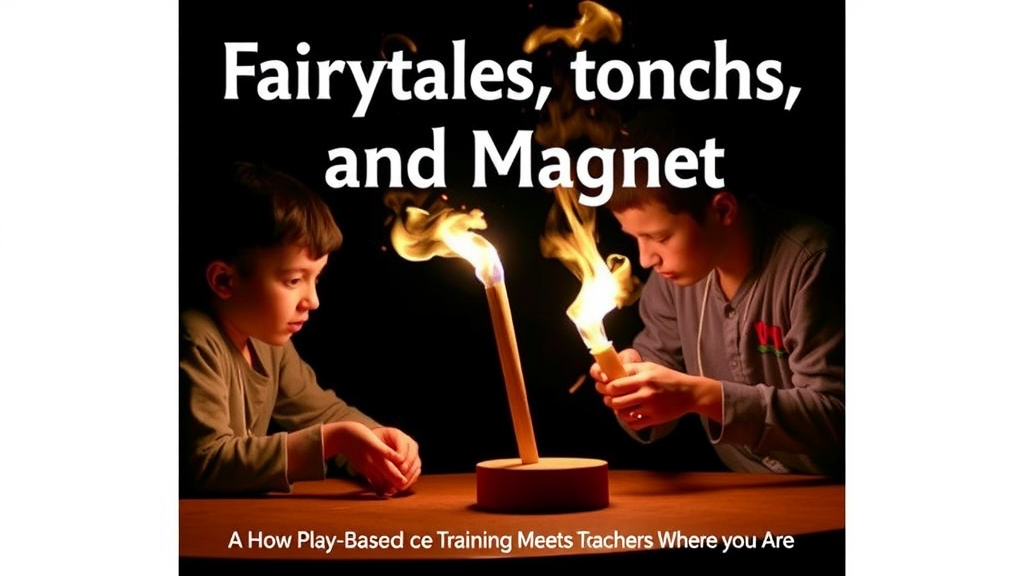
The findings revealed striking diversity in how teachers responded to the challenge. One group, dubbed the Prep Squad by the researchers, described acute insecurity about their science knowledge; the two teachers in this kindergarten rehearsed their torch-and-shadows activity privately before trying it with children, with one admitting that her greatest fear was saying something scientifically incorrect. Here, the researchers provided extended content support, sharing research findings on children’s misconceptions about light and shadow, proposing implementation examples, and offering psychological encouragement by discussing their own past experiences as kindergarten teachers. At the opposite end of the spectrum stood the Engineering Enthusiasts, teachers already confident in science and STEM who wanted to design construction activities. For them, the researchers deliberately stepped back, gave space for brainstorming, and engaged in deeper epistemological discussion about what engineering is and how it connects to science.
Other cases exposed different idiosyncrasies. The Awareness Collective comprised experienced, proactive teachers who questioned the programme’s structure, preferred flexible scheduling, and were galvanised when gender equity entered the discussion; they shared classroom examples of gendered behaviour and worked with researchers on disrupting stereotypical images of scientists through play. In the Teacher Mentor Circle, a dominant kindergarten administrator exercised agency over scheduling and discussion, an early-career teacher on a temporary contract remained peripheral, and the researchers deepened the theoretical treatment of play via Vygotsky, connected the topic to recent local wildfires to make the science tangible, and suggested using the school’s outdoor space as part of the imaginary world. The Balance Board group, with eight participants spanning veteran and mid-career teachers, revealed a generational divide in openness to the innovation, widespread anxiety about science concepts, and practical worries about crowded classes, cameras and consent forms.
The sixth group, the Next Gen Teachers, was largely young and academically accomplished, with several holding science-related master’s degrees, yet none had ever implemented play-based science approaches. Their participation in discussions was notably low, likely reflecting group size and the absence of a peer leader, so researchers took a more directive role, helped formulate the science problem, and enriched the content for older kindergarten classes by extending magnetic attraction into magnetic repulsion and suggesting riddles and artefact construction. Across all six cases, researchers also acted as brokers, carrying ideas between groups, such as the suggestion from one kindergarten to rewrite the fairytale with children based on their own inferences, mirroring the iterative engineering design cycle.
Synthesis across the cases produced a set of guiding principles for what the authors call adaptive professional development. Support included resourcing teachers’ science content knowledge through literature, curriculum connections and implementation examples; facilitating the delicate balance between play and science learning goals; deepening pedagogical theory while promoting inclusivity and equity; contextualising activities in each kindergarten’s infrastructure and real-world contingencies; fostering collaboration within and across groups; assisting with research practices such as data collection and communicating ethics to hesitant parents; and even taking on roles inside the CPW when teachers requested it. Critically, none of this followed a preset, authoritative script. Support emerged responsively, in the moment, allowing teachers to develop agency while remaining backed by expert collaborators working within a democratic, non-hierarchical partnership.
The implications ripple outward. The study confirms what earlier research has long documented: preschool teachers consistently report low confidence in science, and they teach science less frequently than language arts, a gap tied to both content knowledge and pedagogical approach. Yet it also demonstrates that when play-based science methods are introduced with personalised, in-situ support, teachers not only adopt them but celebrate them by the end of the programme. The researchers suggest policymakers should design professional development as adaptive rather than one-size-fits-all, and teacher educators should anticipate contextual obstacles such as large class sizes, limited space and heavy schedules, which the Greek teams navigated through rotating groups and parallel researcher support. The study also extends theory, showing that stories need not be pre-selected for their scientific content; choosing a fairytale first and then identifying the science within it widens the possibilities of storytelling-based teaching.
The authors are candid about limitations, including researcher influence that varied somewhat across groups, the possibility of socially desirable responses shaped by group norms, and the situated Greek context, whose transferability awaits future study. Still, the central message is resonant and practical: teachers with diverse backgrounds, preferences and needs can successfully design play-based science instruction when the professional development around them bends to fit them, rather than the reverse. In an era when early STEM engagement is increasingly linked to later achievement and equity, and when policy reports from Europe to Australia champion play-based learning, this Greek experiment offers a concrete, testable blueprint: meet teachers in their own classrooms, listen to their fears and passions, and let the science emerge through the story everyone builds together.
Subject of Research: Adaptive professional development for play-based preschool science teaching using the Conceptual PlayWorlds model
Article Title: Teaching Science Through Play: An Adaptive Professional Development Programme to Provide Tailored Support to Preschool Teachers
Article References: Nipyrakis, A., Stavropoulou, E., Zachariadi, I., Kakana, D., Christidou, V., & Fragkiadaki, G. (2026). Teaching Science Through Play: An Adaptive Professional Development Programme to Provide Tailored Support to Preschool Teachers. Early Childhood Education Journal. https://doi.org/10.1007/s10643-026-02336-z
Image Credits: AI Generated
DOI: 10.1007/s10643-026-02336-z
Keywords: Conceptual PlayWorlds, professional development, preschool teachers, early childhood education, play-based learning, science education, STEM, Greece, teacher support, Vygotsky, qualitative research, kindergarten
Cite Scienmag News
Courtney Benton. (September 24, 2026). Fairytales, Torches and Magnets: How Play-Based Science Training Meets Teachers Where They Are. Scienmag. https://scienmag.com/fairytales-torches-and-magnets-how-play-based-science-training-meets-teachers-where-they-are/
Courtney Benton. "Fairytales, Torches and Magnets: How Play-Based Science Training Meets Teachers Where They Are." Scienmag, 24 September 2026, https://scienmag.com/fairytales-torches-and-magnets-how-play-based-science-training-meets-teachers-where-they-are/. Accessed 4 October 2026.
Courtney Benton. "Fairytales, Torches and Magnets: How Play-Based Science Training Meets Teachers Where They Are." Scienmag. September 24, 2026. https://scienmag.com/fairytales-torches-and-magnets-how-play-based-science-training-meets-teachers-where-they-are/


