


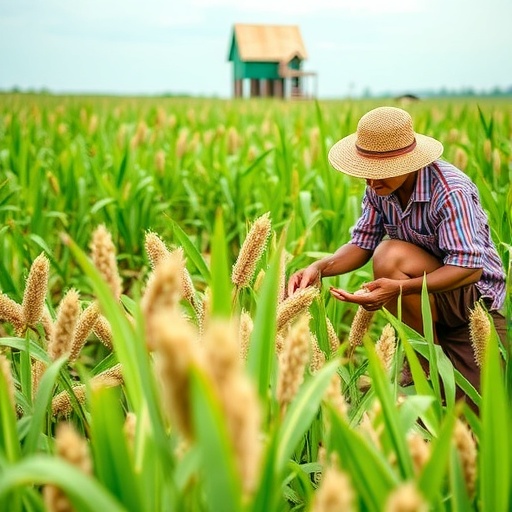
In the face of climate change, agricultural practices must evolve to ensure food security and livelihoods, especially in vulnerable regions like northern Uganda. Recent research has highlighted the factors influencing finger millet farmers’ choices regarding adaptation strategies to the increasingly volatile climate. These insights are vital as they navigate a landscape characterized by erratic rainfall, shifting temperatures, and unpredictable weather patterns that threaten their yields and financial stability.
The research focuses on finger millet, a crop that has gained prominence due to its resilience in arid environments and high nutritional value. Traditionally cultivated in northern Uganda, finger millet possesses unique qualities that make it a staple food source for local populations. However, with climate change affecting agricultural productivity, farmers are compelled to seek adaptive measures to sustain their livelihoods.
By examining the determinants that shape farmers’ decision-making in the face of climate-related challenges, the study identifies several critical factors. Access to information, education levels, and the availability of resources significantly influence how farmers perceive and respond to climate risks. This relationship underscores the importance of support systems and knowledge dissemination in fostering effective adaptation strategies.
Interestingly, the study also found that socio-economic factors play a pivotal role in decision-making processes. Farmers’ income levels, household sizes, and even varying degrees of exposure to market forces can dictate their readiness to adopt new farming techniques. Such insights emphasize that adaptation is not solely about climate literacy but also about the economic realities that farmers face daily.
The complexities of climate adaptation are also intertwined with cultural perceptions and historical practices. Farmers’ beliefs about traditional agricultural methods can either hinder or facilitate adaptation efforts. Those who strictly adhere to time-honored techniques may resist adopting new strategies, regardless of the potential benefits. Conversely, communities that embrace change and innovation tend to experience improved resilience to climate impacts.
Furthermore, policy interventions and governmental roles are crucial in shaping adaptation pathways for finger millet farmers. The study advocates for collaborative efforts among various stakeholders, including agricultural extension services, NGOs, and the government, to create an enabling environment for adaptive practices. This approach ensures that farmers have access not only to relevant information but also to financial assistance and technological innovations that can enhance productivity.
Another noteworthy aspect of the research is the identification of specific adaptation strategies employed by farmers. These strategies range from diversifying crop varieties to implementing water conservation techniques. By understanding which methods are most effective, researchers can better inform policy frameworks and agricultural programs aimed at supporting farmers in their adaptation journeys.
Moreover, the role of community-driven initiatives cannot be overlooked. Communities that unite to share knowledge and resources often find greater success in adapting to climate challenges. Such collective action fosters a sense of solidarity and shared purpose, generating solutions tailored to local needs and conditions. This grassroots approach amplifies the voices of farmers, ensuring that their experiences and insights inform broader agricultural policies.
In conclusion, the determinants of finger millet farmers’ adaptation strategies are multifaceted, reflecting a complex interplay of environmental, socio-economic, and cultural variables. Addressing these determinants is essential for enhancing the resilience of agricultural systems in northern Uganda. By prioritizing education, fostering collaboration, and supporting community initiatives, stakeholders can create a robust framework for sustainable adaptation strategies in the face of mounting climate challenges.
Ultimately, this research emphasizes the urgent need for a paradigm shift in how we view agricultural resilience. As climate change continues to pose significant threats, understanding the nuanced determinants of farmers’ choices becomes critical. It is within these insights that pathways for sustainable agriculture and food security can be found, resonating far beyond the borders of northern Uganda.
Atube, F., Christopher, O.B., Labeja, R.L. et al. Determinants of finger millet farmers’ choice of adaptation strategies to climate change in northern Uganda.
Discov Agric 3, 105 (2025). https://doi.org/10.1007/s44279-025-00277-6
Cite Scienmag News
Sloane Callahan. (September 2, 2025). Factors Influencing Finger Millet Farmers’ Climate Adaptation. Scienmag. https://scienmag.com/factors-influencing-finger-millet-farmers-climate-adaptation/
Sloane Callahan. "Factors Influencing Finger Millet Farmers’ Climate Adaptation." Scienmag, 2 September 2025, https://scienmag.com/factors-influencing-finger-millet-farmers-climate-adaptation/. Accessed 5 September 2026.
Sloane Callahan. "Factors Influencing Finger Millet Farmers’ Climate Adaptation." Scienmag. September 2, 2025. https://scienmag.com/factors-influencing-finger-millet-farmers-climate-adaptation/


