


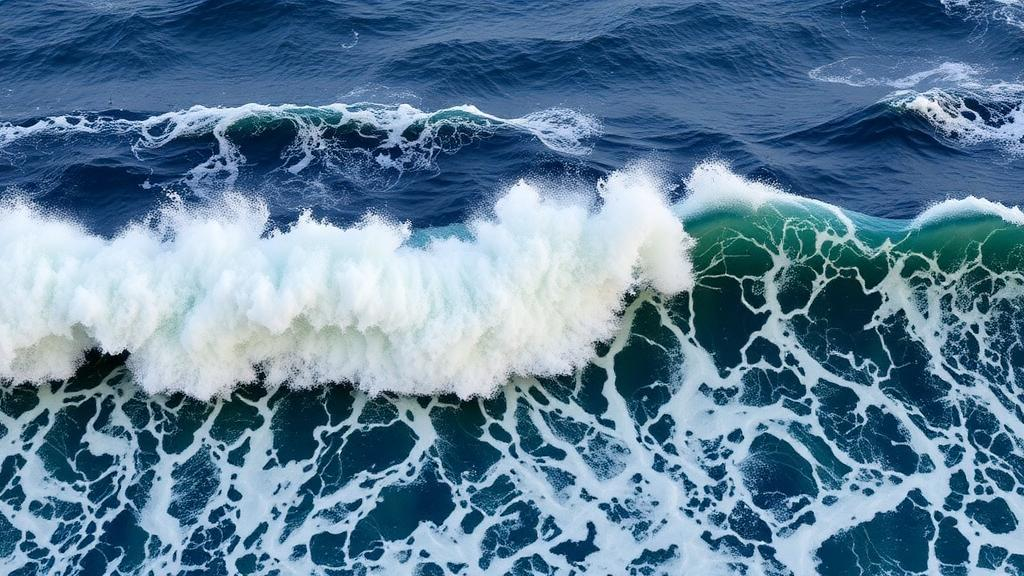
The North Indian Ocean is one of the most violent stretches of water on Earth, a basin where the seasonal monsoon and a near-annual parade of tropical cyclones whip the sea surface into walls of water that menace coastal cities, cargo ships, and offshore oil platforms. A new study published in the journal Ocean Dynamics has now mapped, with unprecedented seasonal and spatial detail, how the most extreme waves in this region have behaved over the past 46 years — and where the next century’s most dangerous seas are likely to strike. The research, led by Cui Shen and Qiyan Ji of Zhejiang Ocean University together with colleagues at Chinese marine research institutions, combines satellite observations with a state-of-the-art reanalysis dataset to build the most complete picture yet of extreme wave climate in a basin home to hundreds of millions of coastal residents.
At the heart of the study is a deceptively simple question: how tall do the biggest waves actually get, and are they getting taller? The researchers focused on extreme significant wave height, defined as the 98th percentile of wave heights — a statistical threshold that captures the waves that matter most for engineering design and hazard planning, rather than the everyday chop that dominates the record. Before trusting any long-term dataset, however, the team had to verify that their primary data source could be believed. They turned to the Chinese-French Oceanography Satellite, known as CFOSAT, which carries a novel radar instrument called SWIM capable of measuring ocean wave spectra from orbit.
The validation exercise delivered a striking verdict. Comparing ERA5, the European Centre for Medium-Range Weather Forecasts’ flagship reanalysis product, against CFOSAT observations, the researchers found a correlation coefficient of 0.9685 — an extraordinarily tight agreement that confirms ERA5 reliably captures the variability of wave heights across the North Indian Ocean. This matters because reanalysis datasets, which blend historical observations with numerical weather models, are the only practical way to reconstruct four and a half decades of ocean conditions at every point in a vast basin. Without a trustworthy anchor in real observations, any trend analysis built on such data would be built on sand. With that anchor secured, the team could confidently interrogate the full 46-year record.
The seasonal picture that emerged is one of dramatic swings driven by the monsoon cycle. Extreme significant wave heights across the North Indian Ocean peak in summer, reaching 4 to 5 meters, when the southwest monsoon drives powerful winds across the Arabian Sea and the Bay of Bengal. In winter, by contrast, the same metric falls to a comparatively placid 1 to 3 meters. Perhaps most intriguingly, the strongest fluctuations in extreme wave heights occur in spring — the transition season when the monsoon winds reverse direction and the ocean’s wave climate is at its most volatile. For coastal engineers and maritime planners, this means the shoulder seasons, often overlooked in hazard assessments, may deserve far more attention than they typically receive.
The long-term trends tell an even more consequential story. The most significant spatial increases in extreme wave heights occur in spring, with a particularly pronounced signal in the northern Bay of Bengal — a region whose low-lying, densely populated coastline, spanning Bangladesh and eastern India, is already among the most vulnerable on the planet to storm surge and coastal flooding. Meanwhile, the fastest temporal growth rate appears in autumn, when extreme wave heights have been climbing at a rate of 0.0169 meters per year. Over the 46-year record, that compounds to a substantial rise in the waves that offshore platforms, ports, and coastal defenses must be designed to withstand. The finding adds the North Indian Ocean to a growing list of basins where extreme wave climates are shifting, consistent with broader evidence that oceanic warming is amplifying wave energy worldwide.
Why are the waves changing? The study points squarely at the wind. When the researchers analyzed extreme wind speeds, again defined at the 98th percentile, they found distributions and variability across the North Indian Ocean that were highly consistent with the patterns in extreme wave heights. This coherence confirms the fundamental physical link: waves are generated by wind stress on the sea surface, so where and when extreme winds intensify, extreme waves follow. The modulating effect of wind on the sea surface, long established in wave theory, is now documented in detail for this basin across nearly half a century. Any future change in the region’s wind climate — whether from shifting monsoon dynamics, changing cyclone behavior, or large-scale atmospheric circulation adjustments — will therefore be written directly into the wave record.
Beyond trends, the study tackled the question that keeps marine engineers awake at night: how bad can it get? Using extreme value analysis across different return periods, the researchers identified two high-risk core regions where the statistics turn genuinely alarming. In the central-western Arabian Sea and the northern Bay of Bengal, the extreme significant wave height associated with a 100-year return period exceeds 10 meters. A wave field of that magnitude, were it to coincide with a cyclone landfall or peak monsoon conditions, would exceed the design thresholds of much existing coastal infrastructure. Pinpointing these two hotspots gives regional governments and the offshore industry a concrete, data-driven basis for prioritizing where reinforced structures, upgraded early-warning systems, and revised navigation protocols are most urgently needed.
The researchers also examined how the El Niño-Southern Oscillation and the Indian Ocean Dipole — the two dominant climate modes of the Indo-Pacific region — leave their fingerprints on extreme wave behavior. Anomalies in extreme wave heights were found to accompany both phenomena, extending previous work that has linked these oscillations to wave climate variability across the Indian Ocean. Because ENSO and the IOD are predictable months in advance, their influence on extreme waves offers a potential pathway toward seasonal wave hazard outlooks, giving coastal managers a head start on the years when the odds of dangerous seas are elevated. The study’s authors note that these insights into long-term changes and potential high-risk areas are important for local marine management throughout the basin.
What makes the work especially timely is the convergence of pressures on the North Indian Ocean’s coastlines. The northern Bay of Bengal, flagged in the study for its pronounced springtime increase in extreme waves, is home to one of the world’s largest concentrations of people living within a few meters of sea level. The Arabian Sea, meanwhile, has in recent years drawn scientific attention for an apparent increase in cyclone intensity, and the new wave-height trends in its central-western waters add another layer of concern for the region’s busy shipping lanes and energy infrastructure. As global temperatures continue to rise, projections published elsewhere suggest that extreme wind-wave events will intensify further through the twenty-first century, making the baseline and trend estimates from this 46-year analysis a critical reference point for the decades ahead.
The study also demonstrates the power of pairing modern satellite technology with mature reanalysis products. CFOSAT, launched as a joint mission between the Chinese and French space agencies, has proven its worth as an independent check on modeled wave climates, and the near-perfect agreement with ERA5 documented here gives researchers across the Indian Ocean region a validated foundation for future studies of wave climate, coastal erosion, and offshore design criteria. For the millions of people who live and work along the shores of the Arabian Sea and the Bay of Bengal, the message of this research is clear: the ocean’s most extreme waves are not a fixed hazard but a moving target, and the target is drifting upward fastest in the seasons and places where preparation has historically been weakest.
Subject of Research: Spatio-temporal variability of extreme significant wave heights in the North Indian Ocean
Article Title: Spatio-temporal variability of extreme significant wave heights over the North Indian Ocean
Article References: Shen, C., Ji, Q., Chen, H., Jiang, L., Ma, Z., & Han, G. (2026). Spatio-temporal variability of extreme significant wave heights over the North Indian Ocean. Ocean Dynamics, 76(10), Article 106. https://doi.org/10.1007/s10236-026-01861-0
Image Credits: AI Generated
DOI: 10.1007/s10236-026-01861-0
Keywords: extreme wave height, North Indian Ocean, significant wave height, monsoon, tropical cyclones, ERA5, CFOSAT, Bay of Bengal, Arabian Sea, ENSO, Indian Ocean Dipole, return period
Cite Scienmag News
Violet Maxwell. (October 1, 2026). Extreme Waves in the North Indian Ocean Are Growing Fastest in Autumn, 46-Year Study Finds. Scienmag. https://scienmag.com/extreme-waves-in-the-north-indian-ocean-are-growing-fastest-in-autumn-46-year-study-finds/
Violet Maxwell. "Extreme Waves in the North Indian Ocean Are Growing Fastest in Autumn, 46-Year Study Finds." Scienmag, 1 October 2026, https://scienmag.com/extreme-waves-in-the-north-indian-ocean-are-growing-fastest-in-autumn-46-year-study-finds/. Accessed 5 October 2026.
Violet Maxwell. "Extreme Waves in the North Indian Ocean Are Growing Fastest in Autumn, 46-Year Study Finds." Scienmag. October 1, 2026. https://scienmag.com/extreme-waves-in-the-north-indian-ocean-are-growing-fastest-in-autumn-46-year-study-finds/


