


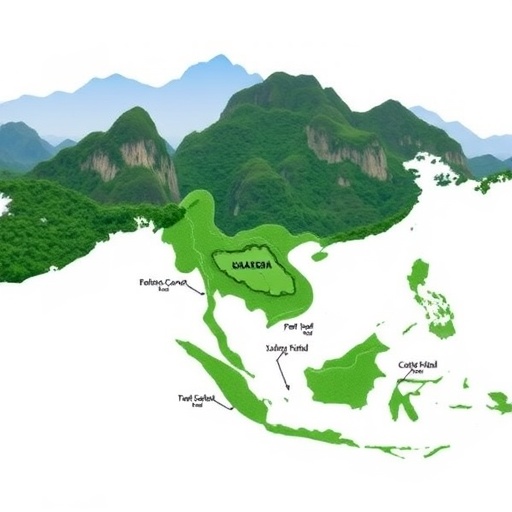
In the realm of archaeology, the interplay between environmental factors and human settlement patterns has long captivated researchers. In a groundbreaking study published in Asian Archaeology, a trio of scholars, Foe, Hills, and Sulistyowati, delve into land suitability modeling and monumentality in Southeast Asia, focusing on Indonesia and Cambodia. Their work provides an innovative lens through which to understand how ancient civilizations chose their landscapes and the implications of these decisions on cultural monumentality.
The research begins by addressing a crucial question: What makes a specific piece of land suitable for human habitation and monument construction? The authors argue that a multitude of ecological and geographical factors, including soil fertility, water sources, and climate stability, play significant roles in this determination. By synthesizing advanced modeling techniques with empirical data, the study reveals patterns that were previously obscured in archaeological records.
Utilizing Geographic Information Systems (GIS) and remote sensing technologies, the researchers mapped out different land characteristics across chosen sites in Indonesia and Cambodia. This high-tech approach not only enhances the accuracy of land analysis but also broadens the scope of research, allowing for comparative studies across various landscapes. The findings suggest that ancient societies had a keen understanding of their natural environments, enabling them to make informed decisions that would later influence monumental architecture and urban planning.
A particularly striking aspect of the study is its examination of the monuments themselves. The authors delve into how environmental adaptations influenced the scale and style of structures erected by these early civilizations. In regions where resources were abundant, larger monuments, such as temples and fortifications, were constructed, reflecting both the societal values of power and religious dedication. In other instances, the limitations imposed by the landscape urged smaller, more functional designs.
Foe and colleagues also emphasize the importance of sociopolitical dynamics in monument construction. As they dissect historical records, it becomes evident that leadership and governance played crucial roles in deciding where and how major structures were built. The allocation of resources, workforce, and the significance of communal identity all come into play, weaving a complex tapestry of factors that define monumentality in Southeast Asia.
Connecting the dots between environment and society, the authors illustrate how ancient communities adapted their agricultural practices to enhance their resilience against challenges such as climate change and natural disasters. These adaptive strategies not only ensured survival but also laid the groundwork for social stratification and the eventual rise of centralized powers, which were often marked by monumental architecture.
The study’s implications extend far beyond the land suitability for construction. It suggests that understanding the factors influencing ancient societies’ choices can provide valuable lessons for modern urban planning and disaster preparedness. As cities today grapple with climate change and population growth, the research advocates for a more integrative approach that considers both environmental sustainability and cultural heritage.
Additionally, the authors urge for a reevaluation of existing archaeological methodologies. The integration of land suitability modeling into archaeological research could lead to more comprehensive interpretations of ancient societies. For instance, where traditional archaeologists might focus on excavations and artifact recovery, this new approach encourages a broader view that encompasses environmental factors and their intertwined relationship with human activity.
Highlighting specific case studies, the research uncovers patterns of settlement that suggest a deeper understanding of temporal shifts in land use. By integrating historical data with modern modeling techniques, the study captures fluctuations in land productivity and sociocultural responses to these changes. Such an approach not only enriches archaeological narratives but also makes them more relevant to contemporary societal challenges.
Moreover, the article emphasizes the collaborative nature of archaeology, calling for interdisciplinary partnerships. The convergence of archaeology, ecology, and geography fortifies the study’s conclusions and encourages further research. It advocates for a collaborative model that includes local communities, acknowledging their insights and knowledge as essential components in understanding historical landscapes.
Ultimately, Foe, Hills, and Sulistyowati’s research paves the way for future explorations in archaeological science. They provide a roadmap that encourages scholars to think holistically about the environmental context of human settlement and monumentality. Their findings address not only historical implications but also offer crucial insights for understanding our contemporary relationship with the environment and monumental heritage.
As such, this study represents a significant contribution to the field of Southeast Asian archaeology, prompting a rethinking of land use, cultural values, and environmental sustainability in both the past and present. Through their innovative research, the authors effectively bridge the gap between archaeology and contemporary relevance, highlighting the enduring impact of historical land use practices on today’s challenges.
By merging past insights with modern methodologies, the research invites the global archaeological community to engage in meaningful discussions about the preservation and interpretation of our shared heritage, ensuring that lessons from history are not lost in the ever-evolving tapestry of human civilization.
Through these lenses, the monumental past of Southeast Asia shines a light not only on what has been but also on what can be achieved moving forward, in both archaeological practice and societal development.
Cite Scienmag News
Courtney Benton. (January 20, 2026). Exploring Land Suitability and Monumentality in Southeast Asia. Scienmag. https://scienmag.com/exploring-land-suitability-and-monumentality-in-southeast-asia/
Courtney Benton. "Exploring Land Suitability and Monumentality in Southeast Asia." Scienmag, 20 January 2026, https://scienmag.com/exploring-land-suitability-and-monumentality-in-southeast-asia/. Accessed 7 September 2026.
Courtney Benton. "Exploring Land Suitability and Monumentality in Southeast Asia." Scienmag. January 20, 2026. https://scienmag.com/exploring-land-suitability-and-monumentality-in-southeast-asia/


