


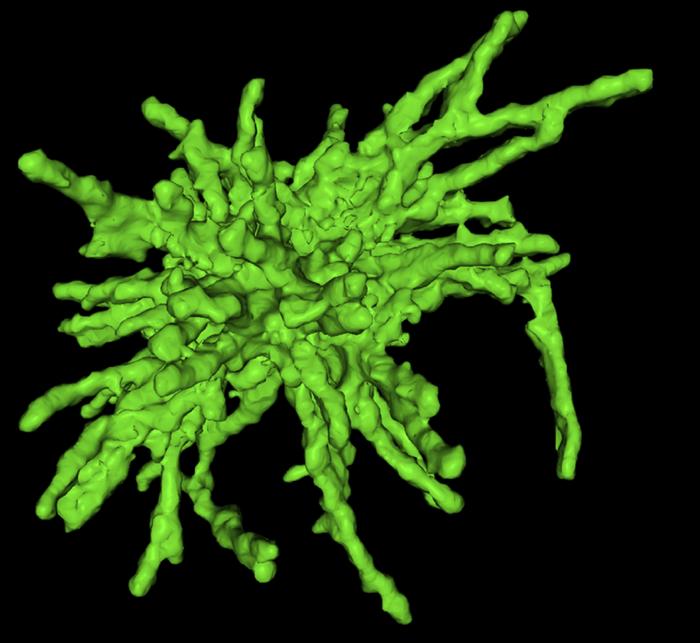
Researchers at Utrecht University in the Netherlands have identified a new way in which the toxic protein aggregates associated with Huntington’s disease may damage nerve cells and cause them to die. The study, to be published August 16 in the Journal of Cell Biology (JCB), suggests that the aggregates can poke holes in the membrane that separates the nucleus from the rest of the cell, damaging the DNA inside the nucleus and changing the activity of neuronal genes.

Credit: © 2024 Korsten et al. Originally published in Journal of Cell Biology.
Researchers at Utrecht University in the Netherlands have identified a new way in which the toxic protein aggregates associated with Huntington’s disease may damage nerve cells and cause them to die. The study, to be published August 16 in the Journal of Cell Biology (JCB), suggests that the aggregates can poke holes in the membrane that separates the nucleus from the rest of the cell, damaging the DNA inside the nucleus and changing the activity of neuronal genes.
Huntington’s disease is a devastating neurogenerative disorder caused by a mutation in the HTT gene that results in cells producing abnormally large versions of the huntingtin protein. These expanded huntingtin proteins aggregate inside cells and damage them in various ways, although exactly how this results in the death of nerve cells remains uncertain.
Spearheaded by graduate student Giel Korsten from the group of Lukas Kapitein, the researchers discovered a major new way in which huntingtin aggregates damage cells when they examined neurons expressing the expanded version of the protein. The researchers found that many of the nerve cells had breaks in the membrane that separates the nucleus from the rest of the cell. This barrier, known as the nuclear envelope, protects and regulates the chromosomes inside the nucleus, allowing them to turn genes on and off as needed.
Kapitein and colleagues found that huntingtin aggregates inside the nucleus disrupt the protein meshwork that underlies and strengthens the nuclear envelope, making the membrane more likely to rupture. Using a specialized technique known as expansion microscopy to visualize the nuclear aggregates in high detail, the researchers saw that tiny fibrils stick out from the aggregates and poke through the meshwork underlying the nuclear envelope. The aggregates may also impair the cell’s ability to reseal the envelope once it breaks, the researchers found.
“We have discovered that the aggregates associated with Huntington’s disease induce ruptures in the nuclear envelope that compromise its barrier function,” Kapitein says.
Over time, these disruptions in the nuclear envelope likely lead to damage of the nerve cell’s DNA and the misregulation of neuronal genes, cellular defects that have previously been linked to Huntington’s disease pathology.
Kapitein notes that several other neurogenerative diseases, including certain types of amyotrophic lateral sclerosis and frontotemporal dementia, are associated with the formation of protein aggregates inside the cell nucleus. “We speculate that nuclear aggregate–induced ruptures in the nuclear envelope represent a common contributor to neurodegeneration that initiates a cascade of deregulated processes culminating in neuronal death and neuroinflammation,” Kapitein says.
Korsten et al., 2024. J. Cell Biol.
# # #
About Journal of Cell Biology
Journal of Cell Biology (JCB) publishes peer-reviewed research in any area of basic cell biology as well as applied cellular advances in fields such as immunology, neurobiology, metabolism, microbiology, developmental biology, and plant biology. All editorial decisions on research manuscripts are made through collaborative consultation between professional editors with scientific training and academic editors who are active in the field. Established in 1955, JCB is published by Rockefeller University Press, a department of The Rockefeller University in New York. For more information, visit jcb.org.
Visit our Newsroom, and sign up for a weekly preview of articles to be published. Embargoed media alerts are for journalists only.
Follow JCB on Twitter at @JCellBiol and @RockUPress.
Journal
Journal of Cell Biology
Method of Research
Experimental study
Subject of Research
Cells
Article Title
Nuclear poly-glutamine aggregates rupture the nuclear envelope and hinder its repair
Article Publication Date
16-Aug-2024
Cite Scienmag News
Drew Townsend. (August 16, 2024). Exploring Huntington’s disease, researchers discover that protein aggregates poke holes in nuclear membrane. Scienmag. https://scienmag.com/exploring-huntingtons-disease-researchers-discover-that-protein-aggregates-poke-holes-in-nuclear-membrane/
Drew Townsend. "Exploring Huntington’s disease, researchers discover that protein aggregates poke holes in nuclear membrane." Scienmag, 16 August 2024, https://scienmag.com/exploring-huntingtons-disease-researchers-discover-that-protein-aggregates-poke-holes-in-nuclear-membrane/. Accessed 4 September 2026.
Drew Townsend. "Exploring Huntington’s disease, researchers discover that protein aggregates poke holes in nuclear membrane." Scienmag. August 16, 2024. https://scienmag.com/exploring-huntingtons-disease-researchers-discover-that-protein-aggregates-poke-holes-in-nuclear-membrane/

