


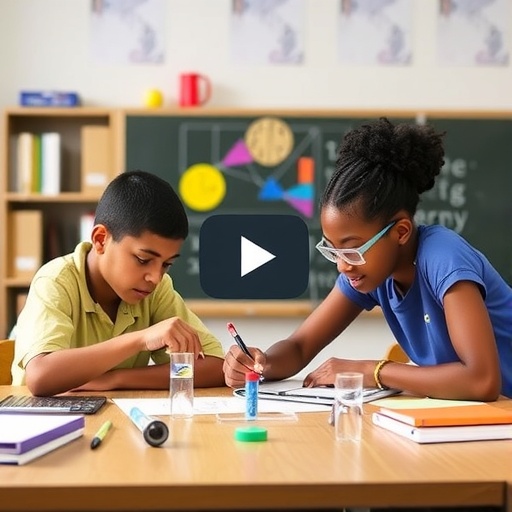
In the evolving landscape of STEM education, addressing inequities in how historically marginalized learners engage with complex scientific and mathematical concepts stands as a key challenge. A pioneering study by Kaldaras and Wieman, recently published in the International Journal of STEM Education, delves into the intricate dynamics of math and science sensemaking among these learners through a uniquely blended instructional approach. This investigation not only sheds light on the multifaceted cognitive processes that underpin STEM learning but also offers a roadmap to cultivating more inclusive educational environments that empower underserved populations.
At the heart of this study lies the concept of “blended math-science sensemaking,” an innovative pedagogical framework designed to interweave mathematical reasoning seamlessly with scientific inquiry. Traditional STEM education models often compartmentalize these disciplines, potentially hindering deep integrative understanding critical to solving real-world problems. By exploring how historically marginalized learners navigate and link mathematical structures with scientific phenomena, the authors illuminate pathways to enhance conceptual coherence and foster profound comprehension.
The research is situated against the backdrop of persistent inequities in STEM participation and achievement. Historically marginalized groups—including students from underrepresented racial, ethnic, and socio-economic backgrounds—consistently face barriers that limit their access to high-quality STEM instruction and resources. These disparities often stem from systemic issues such as unequal funding, cultural biases, and pedagogical methods that fail to resonate with diverse learner experiences. Kaldaras and Wieman’s inquiry confronts these challenges directly, seeking to create educational models that transcend deficits and celebrate learners’ unique perspectives.
Methodologically, the study employs a mixed-methods approach, integrating qualitative observations with quantitative assessments to capture a holistic picture of learner engagement and understanding. Participants comprised students from marginalized communities immersed in curricula that strategically blended mathematics and science tasks, encouraging them to apply algebraic reasoning within physics contexts or geometric modeling alongside biological systems analysis. The authors carefully tracked shifts in problem-solving strategies, discourse patterns, and conceptual accuracies over the course of the intervention.
A striking finding emerges from these analyses: learners exhibit enhanced metacognitive skills when exposed to blended sensemaking environments. The interplay between mathematical formalism and scientific reasoning fosters reflective thought, prompting students to articulate their reasoning processes explicitly and to critically evaluate the validity of their approaches. These metacognitive gains suggest that blended instruction not only improves content mastery but also promotes higher-order thinking skills essential for lifelong learning and innovation.
Furthermore, the study highlights the role of culturally responsive pedagogy in mediating these outcomes. Educators who grounded math-science tasks in contexts relevant to the students’ lived experiences catalyzed engagement and motivation. For instance, situating algebraic modeling within local environmental issues or leveraging culturally familiar analogies to explain scientific mechanisms bridged abstract concepts with concrete realities, making learning more accessible and meaningful.
A particularly innovative aspect of the research is the use of collaborative learning communities. These dynamic groups allowed learners to negotiate meanings, challenge assumptions, and co-construct knowledge, fostering a social dimension of sensemaking often overlooked in individualized instruction. The authors document how peer interactions led to the emergence of alternative explanations and multiple solution pathways, contributing to a richer understanding of STEM content.
Importantly, Kaldaras and Wieman underscore the necessity of iterative feedback cycles in the blended learning environment. Real-time formative assessments coupled with individualized coaching empowered students to identify and address their own misconceptions. This adaptive feedback mechanism was instrumental in sustaining learner growth and confidence, particularly for those who had previously encountered discouragement in STEM classrooms.
The implications of this research reach far beyond classroom walls. By demonstrating that strategic integration of math and science, informed by culturally attuned pedagogy and collaborative structures, can markedly elevate the STEM sensemaking capacity of marginalized learners, the study presents actionable insights for policymakers, educators, and curriculum designers. Embracing these principles could drive systemic transformations that democratize STEM education and fulfill diversity and inclusion mandates with tangible impact.
Technically, the study leverages advanced analytical frameworks to dissect the complex cognitive interactions involved in blended sensemaking. Drawing on theories from cognitive science and educational psychology, the authors model how neural pathways associated with quantitative reasoning are activated in concert with scientific conceptual networks. This neurocognitive perspective enriches our understanding of how integrated STEM learning can rewire brain processes to foster innovation and problem-solving agility.
Moreover, the researchers examine the linguistic dimensions of sensemaking, analyzing discourse markers that signal shifts between math-specific language and science-specific rhetoric. This linguistic oscillation is posited as a critical mechanism through which learners scaffold new knowledge and negotiate interdisciplinary meaning. Insights from this dimension could inform the development of specialized instructional scaffolds that facilitate smoother conceptual transitions.
Critically, the study also addresses potential limitations and areas for future inquiry. The sample size, while robust enough for initial findings, calls for broader studies across diverse educational settings to validate generalizability. Additionally, longitudinal research tracking learners’ trajectories post-intervention would shed light on the durability of blended sensemaking benefits and their impact on STEM career pathways.
In an era where STEM fields are rapidly evolving and increasingly interdependent, equipping all students—particularly those historically marginalized—with the skills to seamlessly blend mathematical and scientific reasoning is imperative. Kaldaras and Wieman’s work exemplifies the kind of cutting-edge scholarship needed to break down disciplinary silos and build inclusive knowledge economies. Their findings resonate with educators and researchers committed to equity, excellence, and innovation.
As the educational community absorbs these revelations, the practical challenge turns to scaling blended math-science sensemaking models while retaining fidelity to their culturally responsive roots. This entails investments in teacher training, curriculum development, and technological infrastructures that support adaptive learning environments. Policymakers must also prioritize equity-driven reforms that ensure resource allocation aligns with these transformative goals.
Beyond formal education, the insights from this study hold promise for informal STEM learning spaces such as museums, afterschool programs, and online platforms. Designing experiences that integrate math and science sensibly and culturally relevantly can empower broader audiences, democratizing access to STEM literacy and fostering community engagement with science and technology.
Ultimately, the study invites a reimagining of STEM education where disciplinary boundaries dissolve and diverse learners thrive through authentic, context-rich meaning making. It calls for a commitment to nurturing curiosity, critical thinking, and creativity across all populations—foundations upon which the future of science and innovation rests. By centering equity and interdisciplinary coherence, Kaldaras and Wieman offer a blueprint for a more just and dynamic STEM ecosystem.
Cite Scienmag News
Courtney Benton. (November 28, 2025). Exploring Blended Math-Science Thinking in Marginalized STEM. Scienmag. https://scienmag.com/exploring-blended-math-science-thinking-in-marginalized-stem/
Courtney Benton. "Exploring Blended Math-Science Thinking in Marginalized STEM." Scienmag, 28 November 2025, https://scienmag.com/exploring-blended-math-science-thinking-in-marginalized-stem/. Accessed 7 September 2026.
Courtney Benton. "Exploring Blended Math-Science Thinking in Marginalized STEM." Scienmag. November 28, 2025. https://scienmag.com/exploring-blended-math-science-thinking-in-marginalized-stem/


