


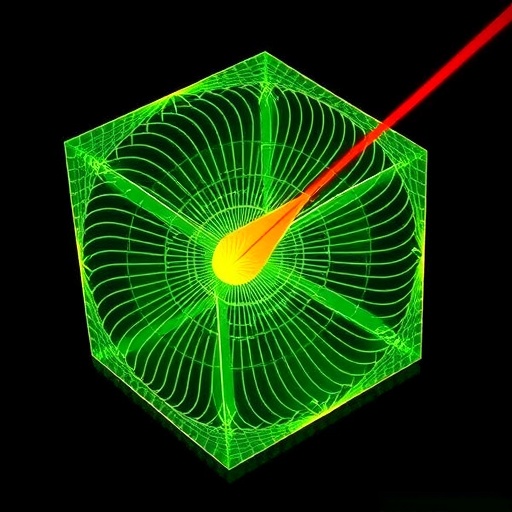
A single strand of optical fiber may soon do far more than carry data. Researchers have reported a new approach for sensing the full three-dimensional shape of a fiber by writing microscopic scattering structures directly into its glass core. The technique, described by P. Luo, F. Chen, T. Guo and colleagues in Light: Science & Applications, uses femtosecond laser inscription to create “orthogonal eccentric scatterers”—precisely positioned features that allow the fiber to reveal how it bends and twists along its length.
Shape sensing is becoming increasingly important in fields where conventional cameras, electrical sensors, or bulky tracking systems cannot operate easily. Medical instruments, robotic arms, aircraft components, industrial machines, and minimally invasive surgical tools may all need to know their exact position and curvature while moving through complex environments. A flexible fiber can reach places that are inaccessible to rigid sensors, but turning that flexibility into a reliable three-dimensional measurement has remained a demanding technical challenge.
Optical fibers are especially attractive because they are lightweight, immune to electromagnetic interference, and capable of carrying information over long distances. Standard shape-sensing methods often rely on fiber Bragg gratings, distributed scattering, or multiple sensing cores. These approaches can be powerful, but they may require complex fiber designs, multiple channels, specialized interrogation systems, or careful calibration. The new strategy instead focuses on engineering the scattering behavior of a single fiber so that its internal optical signal contains directional information about deformation.
The key innovation is the use of femtosecond laser pulses. These ultrashort bursts of light last only a tiny fraction of a second and can deposit energy inside transparent materials without cutting through their surfaces. By tightly focusing the laser into the fiber, researchers can modify selected regions of the glass with micrometer-scale precision. Such modifications can act as controlled scattering centers, redirecting a small portion of the light traveling through the fiber while leaving the overall waveguide functional.
The scatterers are described as eccentric because they are positioned away from the fiber’s central axis, and orthogonal because their orientations are arranged along different directions. This geometry gives the sensing system more information than a simple series of centrally located markers could provide. When the fiber bends, twists, or changes orientation, the optical response from these deliberately displaced structures changes. By analyzing those changes, the system can infer the fiber’s local deformation and reconstruct its overall three-dimensional path.
In practical terms, the fiber becomes a distributed optical measuring tape. Instead of sensing shape only at a few discrete points, the interrogator can examine signals generated by many engineered locations along the fiber. The pattern of light returning from or scattered by the structures encodes how different sections of the fiber have moved. Mathematical reconstruction then converts those optical measurements into a spatial curve, allowing the system to estimate position, curvature, and orientation along the sensing length.
This approach could be particularly valuable where a sensor must be extremely thin and flexible. A single fiber can potentially be integrated into catheters, endoscopes, surgical tools, wearable devices, and soft robots without significantly increasing their size or stiffness. In robotics, shape feedback could help a flexible manipulator navigate around obstacles or interact safely with delicate objects. In medicine, a shape-aware instrument could provide information about its position inside the body without relying entirely on X-ray imaging or external camera systems.
The method also highlights a broader trend in photonics: using laser fabrication to give ordinary optical fibers specialized functions. Rather than manufacturing an entirely new fiber with a complicated internal architecture, researchers can write functional structures after the fiber has been produced. Femtosecond processing offers the precision needed to tailor the location, orientation, and optical behavior of individual scatterers, potentially enabling sensors designed for specific applications and geometries.
Although the reported technology represents an important step toward compact three-dimensional shape sensing, real-world deployment will depend on issues such as calibration stability, signal interpretation, fabrication repeatability, temperature effects, and the ability to maintain accuracy during large or rapidly changing deformations. Even so, the concept offers an elegant route to extracting directional shape information from one slender optical strand. By combining engineered microscopic scatterers with distributed optical analysis, the researchers are moving fiber sensing closer to a future in which flexible tools can continuously report not only where they are, but also exactly how they are shaped.
Cite Scienmag News
Denise Maddox. (August 10, 2026). Single-Fiber 3D Shape Sensing Uses Femtosecond-Laser-Inscribed Orthogonal Eccentric Scatterers. Scienmag. https://scienmag.com/single-fiber-3d-shape-sensing-uses-femtosecond-laser-inscribed-orthogonal-eccentric-scatterers/
Denise Maddox. "Single-Fiber 3D Shape Sensing Uses Femtosecond-Laser-Inscribed Orthogonal Eccentric Scatterers." Scienmag, 10 August 2026, https://scienmag.com/single-fiber-3d-shape-sensing-uses-femtosecond-laser-inscribed-orthogonal-eccentric-scatterers/. Accessed 4 September 2026.
Denise Maddox. "Single-Fiber 3D Shape Sensing Uses Femtosecond-Laser-Inscribed Orthogonal Eccentric Scatterers." Scienmag. August 10, 2026. https://scienmag.com/single-fiber-3d-shape-sensing-uses-femtosecond-laser-inscribed-orthogonal-eccentric-scatterers/


