


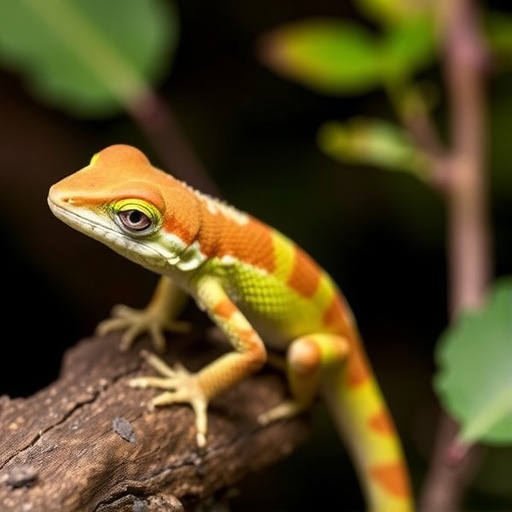
In a groundbreaking study published in Frontiers in Zoology, researchers have leveraged the power of community science data and advanced computer vision technologies to investigate thermoregulation as a critical driver of physiological color change in the green anole, Anolis carolinensis. This research uncovers not only the complexity of color adaptations within this species but also emphasizes the collaborative power of community-driven scientific endeavors in understanding ecological and physiological dynamics.
The term “thermoregulation” refers to the process by which organisms regulate their body temperature, an essential function that can significantly impact their survival and reproductive success. In ectothermic animals, like reptiles, color change plays a vital role in thermoregulation by influencing heat absorption. The green anole, exhibiting stunning variations in hue, provides an exemplary model for studying this phenomenon, making it an intriguing subject for scientists interested in physiological responses to environmental stimuli.
The study stands out due to its innovative use of large-scale community science data, which aggregates numerous individual observations from citizen scientists. These contributions help create a comprehensive dataset that enriches traditional scientific methodology by incorporating real-world variability and broad geographic coverage. This transition towards integrative research approaches exemplifies how modern science can harness large networks of volunteers to contribute to significant scientific inquiries, ultimately democratizing data collection and fostering public engagement in research.
Furthermore, advanced computer vision techniques are pivotal to this study’s success. These technologies allow researchers to capture, analyze, and interpret visual data with remarkable precision, transforming how biologists assess color variations in animals. The application of these tools not only enhances data accuracy but also enables researchers to analyze vast amounts of visual information efficiently, paving the way for more sophisticated studies on animal behavior and physiology.
The researchers meticulously analyzed the physiological color changes in Anolis carolinensis under varying environmental conditions, focusing specifically on temperature fluctuations. Their findings underscore a direct correlation between ambient temperatures and the color adaptations exhibited by these lizards. When exposed to higher temperatures, these reptiles displayed darker pigmentation, increasing their ability to absorb heat effectively. Conversely, cooler conditions prompted a lighter color shift, reflecting a thermoregulatory response aimed at minimizing heat absorption.
In addition to elucidating the relationship between color change and temperature regulation, the study also explores the underlying mechanisms driving these adaptations at the physiological level. The insights gained from examining the roles of pigments, skin structure, and environmental interactions provide a comprehensive understanding of how Anolis carolinensis navigates environmental challenges. This knowledge not only expands our comprehension of reptilian biology but also holds implications for understanding broader ecological patterns and evolutionary processes.
Moreover, the researchers emphasize the critical importance of understanding species’ responses to climate variations, particularly as global temperatures continue to rise. The findings of this study contribute to a growing body of evidence demonstrating how ectothermic species are likely to adapt or suffer due to climatic changes
Cite Scienmag News
Drew Townsend. (October 9, 2025). Evaluating Color Change in Anolis through Community Science. Scienmag. https://scienmag.com/evaluating-color-change-in-anolis-through-community-science/
Drew Townsend. "Evaluating Color Change in Anolis through Community Science." Scienmag, 9 October 2025, https://scienmag.com/evaluating-color-change-in-anolis-through-community-science/. Accessed 4 September 2026.
Drew Townsend. "Evaluating Color Change in Anolis through Community Science." Scienmag. October 9, 2025. https://scienmag.com/evaluating-color-change-in-anolis-through-community-science/


