


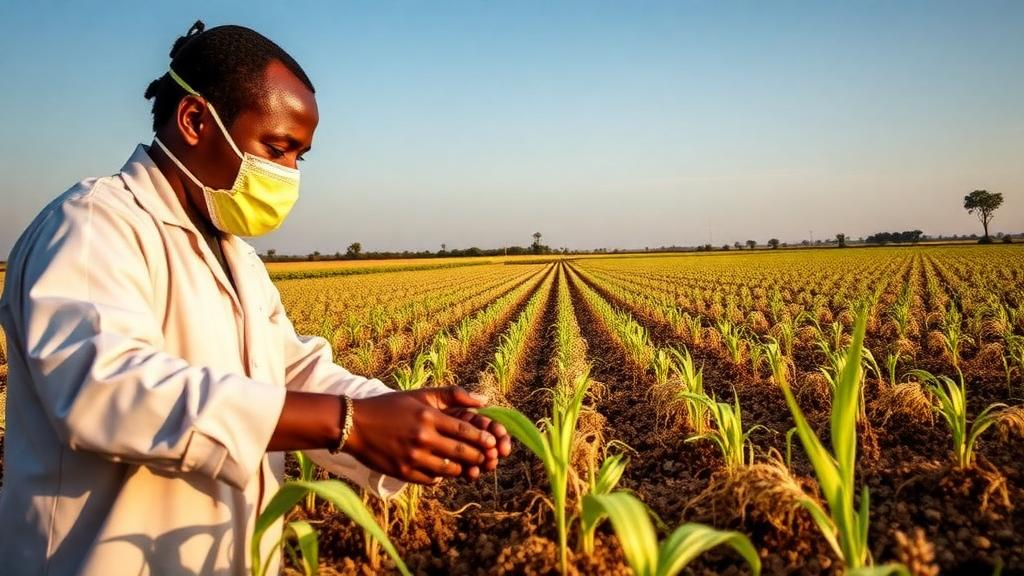
In the highland districts of South Wollo, Ethiopia, the pipeline that is supposed to carry scientific innovation from research stations to smallholder fields is leaking badly, according to a new study that measured the connections among the three groups that make or break agricultural progress: researchers, extension workers, and farmers. The research, published in Discover Global Society by a team from Mekdela Amba University, offers one of the most granular quantitative portraits yet of how the Agricultural Innovation System functions at the local level in Ethiopia, and its findings are sobering. While the country has built an impressive institutional architecture of research institutes, Farmers Training Centers, and village-level development agents, the study shows that the actual flow of knowledge among these actors is thin, uneven, and heavily dependent on informal personal contacts rather than structured collaboration.
The team surveyed 371 farm households, 36 extension workers, and 20 agricultural researchers across three randomly selected districts: Wegde, Tenta, and Jamma. These districts span a remarkable range of agro-ecological conditions, from elevations of 500 meters to over 4,000 meters, encompassing lowland, midland, highland, and even Wurch zones where frost-tolerant cropping dominates. The researchers supplemented the household surveys with focus group discussions in nine kebeles, two per kebele with farmers and one with extension workers, plus key informant interviews with farmers, development agents, and researchers. Sample sizes were calculated using Kothari’s finite-population formula at a 95 percent confidence level with a 5 percent margin of error, and households were drawn by simple random sampling, giving the results a solid statistical footing.
The headline finding is a stark asymmetry in perceived linkage strength. Using the non-parametric Mann–Whitney U-test to compare ordinal perception scores across independent groups, the authors found statistically significant disagreements between researchers and extension workers (U = 213, p = 0.005) and between researchers and farmers (U = 5252.5, p < 0.001), while extension workers and farmers saw their mutual relationship in statistically similar terms (p = 0.353). In plain terms: the extension worker–farmer bond, the daily workhorse of Ethiopian agricultural advisory services, is moderately strong. But the researcher–farmer connection, the direct channel through which science is supposed to meet the soil, was rated by most farmers as absent or weak, even as researchers painted a rosier picture of their own engagement.
This perception gap is not merely a matter of hurt feelings; it has mechanical consequences for how innovation spreads. The study categorized linkage mechanisms into three functional groups: training and demonstration-based mechanisms such as on-farm trials and method demonstrations; information and communication mechanisms including field days, coordination meetings, and internet platforms; and resource-sharing mechanisms such as extension materials and model farmers. Researchers and extension workers consistently rated training programs, on-farm trials, and demonstrations as highly effective, with 52.78 percent of extension workers and 45 percent of researchers scoring training programs as very high. Farmers, however, perceived most of these mechanisms as barely used or ineffective, and the statistical tests confirmed significant perception differences for nearly every mechanism, with p-values below 0.001 for training, on-farm trials, material distribution, model farmers, and coordination meetings.
The digital dimension of the story is particularly striking in an era when mobile agriculture is often touted as a leapfrog solution for the Global South. Internet-based platforms showed low usability among farmers, and the survey data explain why: only 37.47 percent of households owned a mobile phone and 37.20 percent owned a radio, while the average household head had just 3.85 years of schooling. Households sat an average of 6.65 kilometers from the nearest Farmers Training Center and 5.46 kilometers from local markets, with some as far as 16 kilometers from extension infrastructure. In this context, digital extension and even physical field days become mechanisms that serve the institutions that organize them more than the farmers they are meant to reach, a pattern the authors interpret as unequal accessibility rather than farmer disinterest.
What is blocking the system? For researcher–extension linkages, the dominant constraint was a lack of resources and incentives, cited by both groups, followed by the absence of regular joint planning meetings, weak inter-institutional communication, missing monitoring and evaluation systems, bureaucratic delays, and overlapping responsibilities. Extension workers described their interactions with researchers as infrequent, informal, and largely dependent on personal contacts, with structured collaboration and training having declined in recent years. Notably, the researchers themselves averaged 10.6 years of experience and 80 percent held MSc degrees, which the authors argue points to institutional and logistical failures rather than any deficit of professional competence on the research side.
For farmers, the single most important constraint was exclusion from setting research priorities, with 74.67 percent of respondents agreeing or strongly agreeing that they had little opportunity to influence what researchers and extension workers should study or promote. The second-ranked constraint was the absence of any established feedback mechanism through which farmers could report their experiences with introduced technologies back to researchers. Rare farm visits by researchers, limited access to suitable communication channels, the remoteness of farms, the cost of attending meetings, and the price of promoted inputs rounded out the barrier list. These constraints together describe a largely linear, top-down transfer model in which technologies are developed and pushed outward, rather than the interactive, co-creative model that innovation systems theory prescribes.
Gender emerges as a persistent structural fault line throughout the system. Male household heads made up 82.21 percent of the farmer sample, men held 80.6 percent of extension worker positions and 75 percent of researcher positions, and there were no female extension team leaders in any of the three study districts. The qualitative data revealed that female farmers, burdened with childcare, water fetching, cooking, and other reproductive labor, frequently could not attend trainings and demonstrations, leaving them with even less access to extension services than their male counterparts. The authors connect this to prior evidence that gender inequality reduces the adoption of improved crop varieties because women have systematically less access to training, advisory services, and productive resources. Any effort to strengthen the innovation system, the study implies, will fail a large share of its intended beneficiaries unless it confronts these barriers directly.
The study’s limitations are acknowledged candidly: it measured perceived linkage strength and effectiveness rather than hard outcomes such as adoption rates, yields, or incomes; the researcher sample was drawn from research centers; and the design did not permit analysis of variation by crop type, mechanization level, or gender-disaggregated linkage quality. Still, the picture it paints is coherent and consequential. The authors recommend institutionalized multi-stakeholder planning and feedback platforms, increased investment in field-based research and extension, participatory and gender-inclusive technology development, better rural communication infrastructure, and stronger local farmer organizations. The deeper message resonates far beyond South Wollo: agricultural innovation systems do not fail because of missing institutions, but because the connections between them are left to chance. Ethiopia has the buildings, the staff, and the expertise; what it lacks, this study shows, is the wiring.
Subject of Research: Research–extension–farmer linkages in Ethiopia's agricultural innovation system
Article Title: Evaluating research extension and farmer linkages in Ethiopia agricultural innovation system
Article References: Tariku, G. D., Abate, M. A., Kebede, S. A., Tesfaye, S. K., & Getahun, A. A. (2026). Evaluating research extension and farmer linkages in Ethiopia agricultural innovation system. Discover Global Society, 4(1), Article 222. https://doi.org/10.1007/s44282-026-00576-3
Image Credits: AI Generated
DOI: 10.1007/s44282-026-00576-3
Keywords: agricultural innovation system, Ethiopia, agricultural extension, research–extension–farmer linkages, smallholder farmers, technology adoption, South Wollo, Mann–Whitney U-test, gender inequality, digital extension, farmers training centers, rural development
Cite Scienmag News
Alan Morgan. (October 3, 2026). Ethiopia’s Farm Innovation Chain Is Breaking Down Between Lab and Field. Scienmag. https://scienmag.com/ethiopias-farm-innovation-chain-is-breaking-down-between-lab-and-field/
Alan Morgan. "Ethiopia’s Farm Innovation Chain Is Breaking Down Between Lab and Field." Scienmag, 3 October 2026, https://scienmag.com/ethiopias-farm-innovation-chain-is-breaking-down-between-lab-and-field/. Accessed 5 October 2026.
Alan Morgan. "Ethiopia’s Farm Innovation Chain Is Breaking Down Between Lab and Field." Scienmag. October 3, 2026. https://scienmag.com/ethiopias-farm-innovation-chain-is-breaking-down-between-lab-and-field/


