


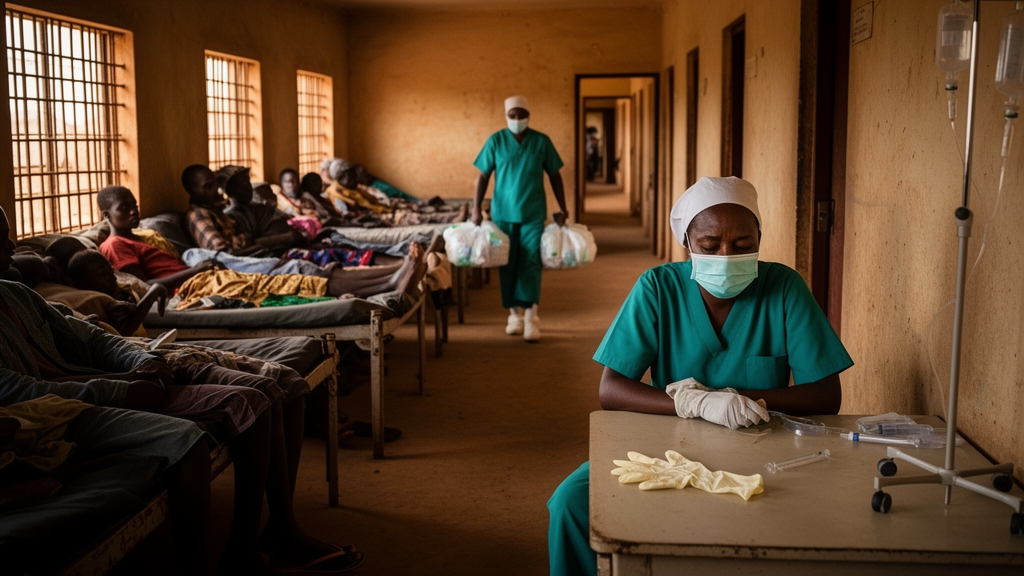
Every epidemic that sweeps through a country leaves a mark that outlasts the pathogen itself. A new modeling study published in PLOS Medicine suggests that outbreaks of infectious diseases are associated with measurable losses in the health workforce in the years that follow, and that these losses fall overwhelmingly on the countries least equipped to absorb them. Drawing on three decades of global data, researchers led by Manman Chen and colleagues estimated that epidemics may account for an average of roughly 17,500 health workers lost worldwide each year, with the burden concentrated in South Asia and sub-Saharan Africa.
The study addresses one of the most persistent problems in global health: the deeply unequal distribution of human resources for health, often abbreviated HRH. Doctors, nurses, midwives, and other trained personnel are the backbone of any health system, yet their density per capita varies enormously between wealthy and poor nations. Previous work has documented this inequity in detail, but far less attention has been paid to how disastrous emergencies, particularly epidemics, actively reshape the workforce over time. The new analysis set out to quantify that relationship on a global, regional, and national scale between 1990 and 2019.
To do so, the team combined two large data sources. The first was the Emergency Events Database, an international repository of disaster records, from which they extracted country-specific counts of epidemic events for each year across 194 countries and territories. The second was the Global Burden of Disease study, which provides statistics on the density of health workers, defined as the number of personnel per 10,000 population, broken down by professional cadre. Overlaying these datasets produced a thirty-year ecological picture of where and when epidemics occurred and how health workforce levels moved in their aftermath.
The statistical core of the study is a Generalized Estimating Equation model, a technique well suited to repeated measures data of this kind. Because the same countries contribute observations year after year, standard regression would violate assumptions of independence; the GEE framework accounts for that clustering while still estimating an average population-level effect. The researchers adjusted for geographic and socioeconomic status to reduce the chance that the observed association simply reflects poverty, geography, or other confounding factors that influence both epidemic frequency and workforce levels.
The headline finding is striking in its specificity. Across the full study period, 1,185 epidemic events were recorded in the 194 countries and regions analyzed. Globally, an increase of one epidemic event in the preceding year was associated with an average decrease of 0.0575 health workers per 10,000 population in the following year, with a 95 percent confidence interval spanning 0.0185 to 0.0964 and a p-value of 0.004. In other words, the association was statistically robust, though the effect size for any single country and single outbreak is modest, which is precisely why the authors aggregated their estimates to reveal the cumulative global toll.
Translating that statistical association into absolute numbers, the team estimated that, if the observed relationship were causal, epidemics would be attributable to an average loss of 17,549 health workers per year worldwide, with a 95 percent confidence interval of 5,661 to 29,437. Expressed relative to workforce size, that amounts to 2.57 health workers lost per 10,000 health workers annually. The authors are careful to frame these figures as estimates conditional on a causal interpretation of their ecological data, an important caveat, since ecological studies link population-level trends rather than tracking individuals, and unmeasured confounders or reverse causation could bias the results.
The regional pattern is where the study’s equity message becomes unmistakable. South Asia recorded the highest average attributable fraction over the observation period, at 20.52 health workers lost per 10,000, followed closely by sub-Saharan Africa at 18.03 per 10,000. When countries were grouped by income, the gradient was even sharper: low-income countries showed an average attributable fraction of 15.89 per 10,000 and lower-middle-income countries 12.76 per 10,000, compared with just 0.96 per 10,000 in upper-middle-income countries and a negligible 0.12 per 10,000 in high-income countries. The countries with the ten highest attributable fractions were concentrated in sub-Saharan Africa, including Niger at 57.06 per 10,000, Somalia at 44.19 per 10,000, and Ethiopia at 37.12 per 10,000.
These numbers describe a self-reinforcing cycle with profound implications. Epidemics strike hardest in regions that already have the fewest health workers, and by depleting that workforce they weaken the very systems needed to detect, contain, and treat the next outbreak. A country that loses a meaningful fraction of its nurses and physicians after one epidemic enters the next emergency with diminished surge capacity, longer waiting times, and higher baseline mortality from everyday conditions. The study’s findings suggest that epidemic disasters are not merely temporary shocks to health systems but contributors to a structural, widening gap in workforce equality between rich and poor nations.
The mechanisms behind the association are not directly measured in this study, but several plausible pathways are consistent with the evidence. Epidemics can drive health worker mortality through occupational infection, as seen historically with Ebola and other hemorrhagic fevers. They can accelerate emigration of clinicians from fragile systems, prompt early retirement or career exit due to burnout and trauma, and reduce the pipeline of new graduates as training institutions close or divert staff to emergency response. Disentangling these channels would require individual-level and longitudinal workforce data, which the authors identify as a priority for future research.
The study’s limitations deserve emphasis alongside its findings. As an ecological and modeling analysis, it cannot prove that epidemics caused the workforce losses; uncontrolled confounders and reverse causation remain possible, and countries with weaker disaster-surveillance systems may underreport epidemic events, potentially biasing estimates downward precisely where the burden is thought to be greatest. Even so, the consistency of the pattern across regions and income levels, and its alignment with documented experiences during outbreaks such as Ebola and COVID-19, lend weight to the conclusion that epidemics of infectious diseases are associated with health workforce losses globally, particularly in low- and middle-income countries, further aggravating the global inequity in the health workforce. For policymakers, the message is that investing in epidemic preparedness is also an investment in protecting the people who make health systems function at all.
Subject of Research: The impact of epidemic disasters on global health workforce density and equality from 1990 to 2019
Article Title: Global, regional, and national impact of epidemic disasters on health workforce equality between 1990 and 2019: An ecological and modeling study
Article References: Chen, M., Wang, W., Sha, F., Ye, Z., Zhao, Y., Yang, C., Liang, Z., Jiang, Y., Wang, X., & Tang, J. (2026). Global, regional, and national impact of epidemic disasters on health workforce equality between 1990 and 2019: An ecological and modeling study. PLOS Medicine, 23(9), e1005134. https://doi.org/10.1371/journal.pmed.1005134
Image Credits: AI Generated
DOI: 10.1371/journal.pmed.1005134
Keywords: health workforce, epidemics, global health equity, human resources for health, PLOS Medicine, ecological study, sub-Saharan Africa, South Asia, disaster modeling, low-income countries, Global Burden of Disease, health systems
Cite Scienmag News
Kristina Jarvis. (October 9, 2026). Epidemics Drive Global Losses of Health Workers, Hitting Poorest Nations Hardest. Scienmag. https://scienmag.com/epidemics-drive-global-losses-of-health-workers-hitting-poorest-nations-hardest/
Kristina Jarvis. "Epidemics Drive Global Losses of Health Workers, Hitting Poorest Nations Hardest." Scienmag, 9 October 2026, https://scienmag.com/epidemics-drive-global-losses-of-health-workers-hitting-poorest-nations-hardest/. Accessed 9 October 2026.
Kristina Jarvis. "Epidemics Drive Global Losses of Health Workers, Hitting Poorest Nations Hardest." Scienmag. October 9, 2026. https://scienmag.com/epidemics-drive-global-losses-of-health-workers-hitting-poorest-nations-hardest/


