


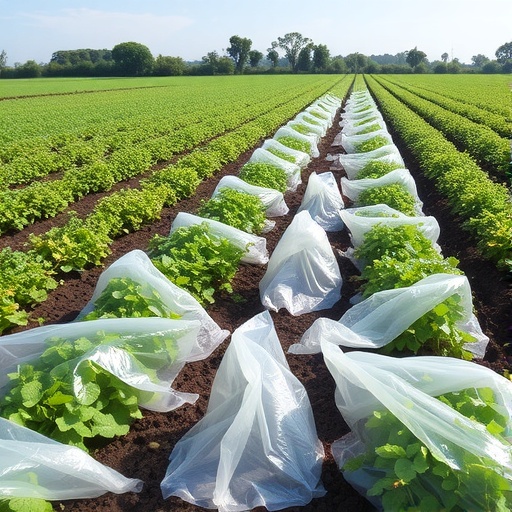
Plastic agricultural films (PAFs) are a quiet workhorse of modern farming, but new research warns they are also quietly reshaping soils. Global deployment of these films is projected to climb to 9–14 million tonnes (Mt) per year by 2030, driven by strong agronomic payoffs.
According to the Review, PAFs can boost crop yields by 7–48% and improve soil water retention by 9–25%, helping growers stabilize production under variable weather and drought risk. But once installed, films are not truly “temporary.” They fragment and degrade under abrasion, ultraviolet exposure, heat, humidity, and biological activity from microbes and soil fauna.
As a result, PAF use is estimated to generate 3–5 Mt per year of largely unmanaged plastic waste. The paper emphasizes that much of this material persists in agricultural landscapes rather than being captured or returned to formal recycling systems.
The environmental consequence is microplastic (MP) contamination. Field concentrations can reach around 13,000 particles per kilogram, with PAFs contributing an estimated 10–30%. The dominant degradation pathway for conventional polyethylene films is physical fragmentation, producing MPs without full breakdown.
Biodegradable films change the timeline but not the problem entirely. They tend to fragment faster, and in some reported cases about 30% of material can convert to MPs within two years. Even when labeled biodegradable, complete mineralization appears limited under real-world conditions.
The Review also highlights an additional, less understood hazard: chemical additives. These include both intentionally added compounds and poorly characterized non-intentionally added substances, which may leach and transform differently depending on film type and environmental conditions.
The downstream effects extend beyond contamination. MPs and additives are linked to impacts on soil health, crop performance, and nutrient cycling—factors that could undermine sustainability goals even as films support yields.
To reduce harm, the authors point to a portfolio of solutions: safer additive formulations, development of biodegradable bio-based polymers designed to minimize MP formation, and conventional film recycling systems that increase collection rates.
Finally, the Review calls for urgent field monitoring and a global database tracking PAF use and composition, alongside policy innovations to enable truly sustainable film management. With better measurement and governance, the agricultural benefits of films could be retained without locking ecosystems into long-term plastic pollution.
Cite Scienmag News
Alan Morgan. (July 26, 2026). Environmental impacts and fate of plastic films used in agriculture. Scienmag. https://scienmag.com/environmental-impacts-and-fate-of-plastic-films-used-in-agriculture/
Alan Morgan. "Environmental impacts and fate of plastic films used in agriculture." Scienmag, 26 July 2026, https://scienmag.com/environmental-impacts-and-fate-of-plastic-films-used-in-agriculture/. Accessed 3 September 2026.
Alan Morgan. "Environmental impacts and fate of plastic films used in agriculture." Scienmag. July 26, 2026. https://scienmag.com/environmental-impacts-and-fate-of-plastic-films-used-in-agriculture/


