


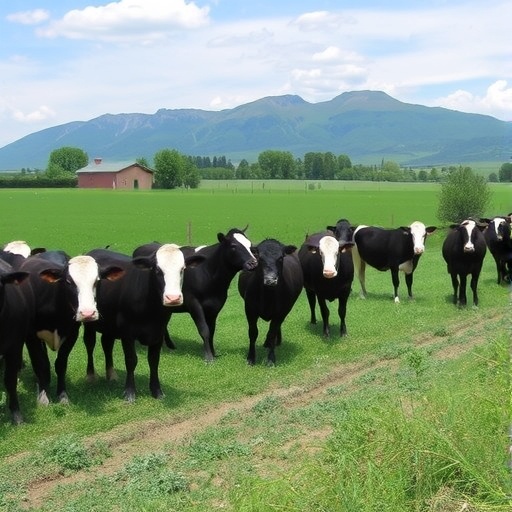
In a groundbreaking study published in npj Sustainable Agriculture, researchers have unveiled the profound environmental repercussions linked to intensive beef fattening within Italy’s Veneto region. This meticulous case study highlights not only the scale of resource consumption but also the extensive ecological strain imposed by high-density cattle farming aimed at maximizing beef production. The findings offer critical insights for the agriculture industry, policymakers, and environmental advocates seeking to reconcile food security with sustainable land management practices.
The Veneto region, known for its fertile plains and agricultural productivity, has increasingly adopted intensive beef fattening methods to cater to the growing demand for meat. While this approach boosts output, the research conducted by Martinić et al. underscores the substantial cost paid by ecosystems in terms of water use, land degradation, and greenhouse gas emissions. The study draws attention to the complex interplay between livestock management intensity and regional environmental health, revealing how intensified production systems may inadvertently exacerbate ecological vulnerabilities.
By analyzing the environmental footprint of beef operations, the research team employed advanced life cycle assessment techniques, capturing nuances often overlooked in broader agricultural surveys. These assessments measured inputs such as feed crop cultivation, water consumption, and energy used in animal housing, alongside outputs like methane emissions and nutrient runoff. The granular data illuminated how each phase of beef fattening contributes cumulatively to pollution and resource depletion, challenging assumptions that intensified systems necessarily offer environmental efficiencies.
The catalyst of emissions in these facilities largely stems from enteric fermentation—a digestive process in ruminants releasing methane, a potent greenhouse gas. The researchers noted that methane’s global warming potential is significantly higher than carbon dioxide, emphasizing that even moderate increases in cattle numbers can have disproportionate climatic effects. The study’s precise quantification of methane output in the Veneto region provides a vital benchmark for regional and national emission inventories related to agriculture.
Moreover, water consumption represents a critical facet of environmental impact. Intensive beef fattening requires not only direct water provision for animals but also indirect water embedded within feed crop irrigation. The study’s integrated hydrological models revealed that the water footprint of beef in Veneto far exceeds sustainable thresholds, exacerbating pressure on freshwater reserves already stressed by competing agricultural and urban demands. This highlights an urgent need for water resource management strategies tailored to agro-livestock systems.
Land use change associated with beef fattening is another area the paper scrutinizes in detail. Expansion of feed crop cultivation necessitates conversion of natural habitats and often leads to soil compaction, erosion, and nutrient leaching. These processes undermine soil fertility and biodiversity, contributing to long-term productivity losses. By mapping land use shifts in the Veneto region, the researchers were able to trace a clear link between intensified beef production and landscape fragmentation.
A particularly novel aspect of the study was its integration of socioeconomic factors to contextualize environmental impacts. The researchers conducted interviews with local farmers and agricultural stakeholders, uncovering how market pressures and regulatory frameworks influence farming practices. This socio-ecological approach reveals the multifaceted challenges in promoting sustainable intensification, indicating that technical solutions must be accompanied by institutional support and economic incentives.
The study also explored the potential for mitigation strategies within the industry. These include improving feed efficiency through dietary supplements that reduce methane emissions, implementing wastewater recycling to curtail freshwater use, and adopting rotational grazing to maintain soil health. However, the researchers caution that without systemic reforms, such as reducing overall herd sizes or transitioning to alternative protein sources, these measures provide limited relief.
Another area of technical interest involves the role of precision agriculture technologies in beef fattening operations. The study examined how real-time monitoring systems can optimize resource use and animal welfare, thereby diminishing environmental burdens. While promising, the adoption of such technologies in the Veneto region remains limited by cost and knowledge barriers, a gap the authors suggest needs policy intervention to address.
The environmental impacts detailed in this investigation extend beyond localized effects, implicating global efforts to meet sustainable development goals. The Veneto region’s beef fattening case serves as a microcosm reflecting broader challenges in balancing agricultural productivity with planetary boundaries. The results call for a paradigm shift in livestock management, highlighting how regional case studies can inform global sustainable agriculture strategies.
Importantly, Martinić and colleagues emphasize the interconnectedness of environmental and social dimensions, noting that intensive beef fattening affects rural livelihoods, public health, and cultural landscapes. The paper advocates for inclusive governance approaches that engage diverse stakeholders, fostering collaborative pathways toward more resilient food systems.
The research also underscores the value of cross-disciplinary collaborations, combining expertise in agronomy, environmental science, economics, and social studies. This holistic methodology provides a comprehensive understanding of intensive beef fattening’s multidimensional impacts, setting a new standard for future sustainability assessments in agriculture.
Beyond academic contributions, the study resonates with consumer awareness movements promoting ethical and environmentally responsible food choices. By highlighting specific regional impacts, the paper informs dialogues around carbon labeling, certification schemes, and local food sourcing, empowering consumers to participate in sustainability transitions.
In conclusion, this seminal research advances our understanding of how intensive beef fattening influences environmental systems within a key agricultural zone of Italy. The Veneto region case study exemplifies the urgent need for integrating scientific insights into actionable policies that ensure beef production becomes more sustainable without compromising economic viability or food security. As global populations and meat demand rise, such nuanced, data-driven investigations will be indispensable in guiding the path toward sustainable agriculture futures.
Cite Scienmag News
Alan Morgan. (April 13, 2026). Environmental Effects of Intensive Beef Farming in Veneto. Scienmag. https://scienmag.com/environmental-effects-of-intensive-beef-farming-in-veneto/
Alan Morgan. "Environmental Effects of Intensive Beef Farming in Veneto." Scienmag, 13 April 2026, https://scienmag.com/environmental-effects-of-intensive-beef-farming-in-veneto/. Accessed 5 September 2026.
Alan Morgan. "Environmental Effects of Intensive Beef Farming in Veneto." Scienmag. April 13, 2026. https://scienmag.com/environmental-effects-of-intensive-beef-farming-in-veneto/


