


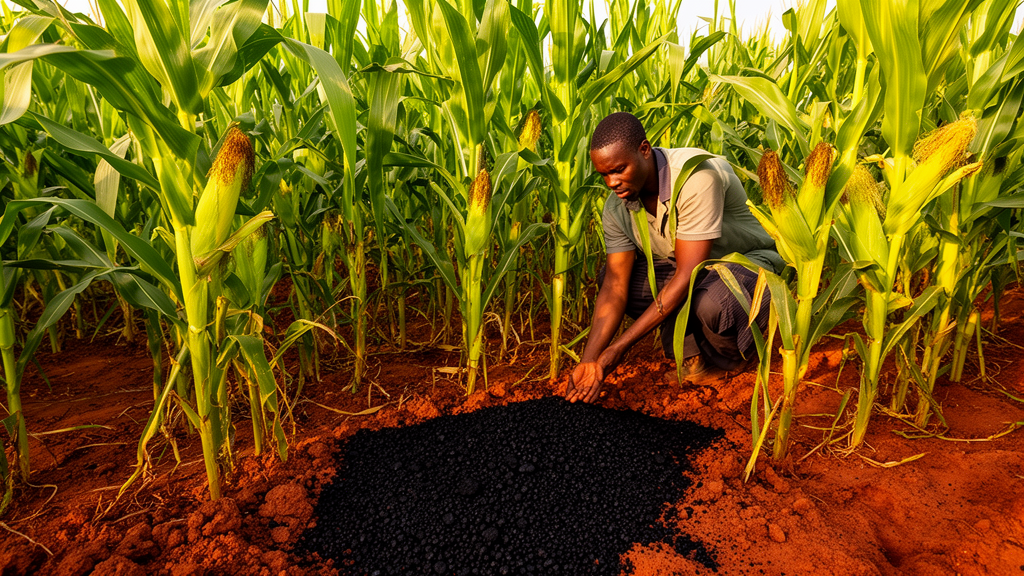
In randomized complete block field trials conducted across two contrasting agroecological environments in Cameroon, an innovative soil amendment formulated from pyrolyzed agricultural waste and insect manure substantially enhanced maize productivity while mitigating severe insect pest pressure. The experimental amendment, designated as biological nitrogen enriched biochar or BioNBiochar, combines biochar derived from cocoa pod husks with frass compost generated by black soldier fly larvae in an equal dry-weight ratio. Across experimental trials situated in both the humid tropical zone of Buea and the cooler, sub-humid western highlands of Mbouda, plots amended with this mixture produced an average maize grain yield of 7.3 tonnes per hectare. This harvest outcome significantly exceeded the 4.5 tonnes per hectare measured under unamended control conditions, while likewise outperforming conventional applications of synthetic mineral fertilizer and standalone organic treatments. Alongside these substantial yield gains, crops treated with the enriched biochar exhibited marked declines in larval infestations of fall armyworm and African maize stem borer, offering a promising dual-action strategy for resource-constrained smallholder farming systems.
Smallholder cereal cultivation throughout sub-Saharan Africa faces persistent structural hurdles, characterized by continuous cropping, depleted soil organic matter reserves, and chronic deficits in plant-available nutrients. In Cameroon, smallholder maize yields typically average between 1.5 and 2.6 tonnes per hectare, representing an estimated technical efficiency of roughly 35 percent and leaving an attainable yield gap of approximately 48 to 75 percent compared to research-station outputs of 5 to 6 tonnes per hectare. While inorganic fertilizers such as standard NPK formulations can supply immediate macronutrients, their high purchase costs and supply bottlenecks frequently prevent recommended application rates among local growers. Furthermore, heavy reliance on soluble synthetic inputs and chemical pesticides under high-rainfall tropical conditions often leads to rapid nutrient leaching, compromised soil microbial health, and progressive ecological degradation. Agricultural scientists have therefore prioritized the development of affordable, locally sourced soil amendments capable of stabilizing nutrient delivery, rehabilitating soil physicochemical structure, and bolstering innate crop resistance against devastating herbivorous insect pests under realistic smallholder production constraints.
To evaluate whether integrated biological amendments could address these interlocking challenges, researchers established replicated field trials during the 2024 cropping season at two geographically and environmentally distinct sites. The southern trial was situated in Buea, located in the Southwest Region at 870 meters above sea level within agroecological zone four, a humid tropical environment receiving upwards of 3,000 millimeters of annual precipitation and characterized by moderately acidic volcanic soils. The northern comparative trial was established in Mbouda, situated in the West Region at 1,400 meters elevation within agroecological zone three, marked by cooler seasonal temperatures, 1,500 to 2,000 millimeters of rainfall, and strongly acidic ferrallitic soils. Baseline soil sampling executed across both sites revealed distinct initial fertility profiles prior to amendment application: Buea soils exhibited a baseline pH of 5.80, loamy clay texture, 3.15 percent organic carbon, 0.22 percent total nitrogen, 17.8 milligrams per kilogram of available phosphorus, and 0.41 centimoles of charge per kilogram of exchangeable potassium, whereas Mbouda soils displayed a baseline pH of 5.51, sandy loam texture, 2.47 percent organic carbon, 0.18 percent total nitrogen, 14.4 milligrams per kilogram of available phosphorus, and 0.35 centimoles of charge per kilogram of exchangeable potassium.
The field experiment was arranged in a randomized complete block design at each location, utilizing four replicate blocks containing five distinct management treatments applied across individual experimental units measuring 16 square meters. Researchers prepared the BioNBiochar formulation by subjecting air-dried cocoa pod husks collected in Mbouda to oxygen-limited pyrolysis, generating a highly porous, carbon-dense biochar carrier. Concurrently, black soldier fly frass was harvested from Hermetia illucens larvae reared under controlled conditions on discarded broiler chicken feathers gathered from local poultry markets in Buea. The resulting BioNBiochar mixture, combined at a one-to-one dry weight ratio, was applied at a rate of 10 tonnes per hectare, corresponding to approximately 400 grams per planting stand or 200 grams per plant after thinning. Parallel treatments evaluated for comparison included standalone black soldier fly frass applied at 10 tonnes per hectare, locally procured poultry manure applied at 10 tonnes per hectare, synthetic mineral NPK 20:10:10 applied at 200 kilograms per hectare divided into basal and top-dressing applications, and an unamended control plot. All amendments were manually incorporated into the top 20 centimeters of soil two weeks prior to sowing the certified open-pollinated maize variety CMS8704 at a standardized density of 50,000 plants per hectare, with plots maintained under ambient rainfall without chemical pesticide applications.
Agronomic assessments conducted at physiological maturity revealed that maize vegetative growth and reproductive yield metrics responded strongly to the biological soil amendments across both ecological zones. Mean maize plant height across all treatments reached 209.0 centimeters in Mbouda compared to 202.6 centimeters in Buea, with BioNBiochar plots producing the tallest plants overall at 235.9 centimeters, significantly taller than plants receiving black soldier fly frass alone at 216.4 centimeters, synthetic NPK at 201.3 centimeters, poultry manure at 197.0 centimeters, and the unamended control at 178.5 centimeters. A significant interaction between agroecological zone and amendment was detected for plant height, with BioNBiochar stimulating maximum elongation in Mbouda at 240.0 centimeters. Stem girth reached an average of 8.7 centimeters under BioNBiochar compared to 6.2 centimeters in control plots, while leaf counts averaged 16 leaves per plant under BioNBiochar versus 11 leaves in control plantings. In terms of reproductive performance, thousand-grain weight peaked at 391.0 grams with BioNBiochar compared to 307.8 grams in the control. Average grain yield differed modestly by zone, reaching 5.8 tonnes per hectare in Mbouda and 5.6 tonnes per hectare in Buea, with BioNBiochar generating a uniform yield superiority of 7.3 tonnes per hectare across both locations without a statistically significant interaction effect.
Post-harvest laboratory analyses demonstrated that incorporating BioNBiochar exerted profound, persistent improvements across multiple soil physicochemical properties measured within the top 20 centimeters of the soil profile. Across all experimental plots, BioNBiochar maintained significantly superior organic carbon concentrations, reaching a mean of 4.3 percent compared to 3.6 percent under standalone frass, 3.2 percent under poultry manure, 2.8 percent under mineral NPK, and 2.4 percent in the untreated control. A statistically significant interaction between agroecological zone and soil treatment was confirmed for organic carbon, driven by an exceptional concentration of 4.5 percent recorded in the Buea BioNBiochar plots. Furthermore, BioNBiochar elevated mean soil pH to 6.3 relative to the control baseline, while increasing soil moisture retention to 27 percent, total nitrogen to 0.3 percent, available phosphorus to 31 milligrams per kilogram, and exchangeable potassium to 0.66 centimoles of charge per kilogram. Buea maintained generally higher overall post-harvest moisture, available phosphorus, and exchangeable potassium than Mbouda, but no significant interaction terms were observed for these chemical variables, illustrating that the nutrient-enriching capacity of the biochar-frass composite remained broadly uniform regardless of baseline soil texture and local climatic differences.
Pest surveillance conducted under ambient field conditions demonstrated that the application of organic amendments, and BioNBiochar in particular, was associated with marked reductions in both pest density and cumulative plant damage. Natural populations of fall armyworm, Spodoptera frugiperda, and the maize stem borer, Busseola fusca, were quantified by direct larval counts on ten randomly selected plants per plot, paired with foliar and stem injury evaluations utilizing a standardized one-to-nine visual severity scale. Overall ambient pest pressure proved significantly higher in Mbouda than in Buea across all measured indicators, with baseline fall armyworm counts averaging 2.2 larvae per plant in Mbouda versus 1.4 in Buea, stem borer counts averaging 1.9 versus 1.1, and damage severity averaging 3.6 versus 2.8. Despite elevated regional pest pressure, BioNBiochar maintained the lowest fall armyworm larval densities at 0.4 larvae per plant compared to 1.3 in the control, and recorded a stem borer density of only 0.3 larvae per plant compared to 1.0 in the control, 1.5 under standalone frass, 2.3 under NPK, and 2.4 under poultry manure. Composite feeding damage severity dropped to 1.6 under BioNBiochar, contrasting sharply with the severe score of 5.1 registered in untreated control plots, with significant treatment-by-zone interactions indicating that relative suppression was especially pronounced in Buea.
To explore the multivariate relationships connecting soil chemical status, nutrient availability, and crop harvest outputs, the researchers conducted principal component analysis across the complete post-harvest dataset comprising 40 experimental units across both zones. The resulting ordination demonstrated that the first two principal component axes accounted for 97.6 percent of total variance, with the primary dimension explaining 95.0 percent and the secondary dimension accounting for 2.6 percent. Maize grain yield aligned closely along the primary axis, displaying strong positive co-variation with exchangeable potassium, available phosphorus, total nitrogen, soil organic carbon, and soil pH vectors. In contrast, soil moisture exhibited an orthogonal vector that was not strongly associated with either nutrient indicators or final grain yield, identifying moisture as an independent site-level hydrological factor rather than a direct correlate of amendment chemistry. This descriptive clustering emphasizes that maize yield gains were driven by integrated, multi-nutrient enhancement and soil structural rehabilitation rather than an isolated response to any single chemical element, underscoring the structural value of combining a recalcitrant, high-surface-area biochar matrix with biologically active insect frass compost.
Economic viability assessments executed through partial budget modeling confirmed that the agronomic superiority of BioNBiochar translated into substantial financial advantages for smallholder producers. Under 2024 market conditions, the market procurement and preparation costs for BioNBiochar, standalone frass, and mineral NPK fertilizer were identical at 100,000 CFA francs per hectare, whereas poultry manure incurred double that expense at 200,000 CFA francs per hectare. Incorporating fixed baseline cultivation expenditures of 250,000 CFA francs per hectare common to all treatments, total production costs ranged from 250,000 CFA francs for the control up to 450,000 CFA francs for poultry manure, with BioNBiochar, frass, and NPK totaling 350,000 CFA francs per hectare. BioNBiochar generated the highest total revenue at 1,460,000 CFA francs per hectare and delivered a net profit of 1,110,000 CFA francs per hectare, far surpassing all alternative amendments. Consequently, BioNBiochar achieved the highest benefit-cost ratio at 4.17, compared to 2.31 for poultry manure, while posting a marginal rate of return of 460 percent relative to the control, greatly exceeding the standard 100 percent economic adoption threshold established by agricultural economists for recommending novel practices to smallholder farmers.
While these experimental findings demonstrate clear multi-faceted agronomic advantages, the investigators outlined several key methodological and interpretative boundaries inherent to the study. First, because post-harvest soil sampling occurred at the conclusion of a single cropping cycle, the research captures short-term fertility responses rather than long-term amendment mineralization kinetics or multi-season residual persistence, highlighting the necessity of longitudinal monitoring across multiple cultivation cycles to determine optimal reapplication schedules. Second, the trials relied entirely on ambient pest infestations without physical exclusion cages or paired insecticide-treated control subplots, meaning the experimental design cannot statistically disentangle the proportion of yield gains attributable directly to soil nutrient enrichment from indirect benefits arising from reduced pest damage. Furthermore, the absence of molecular assays, gene expression profiles, or secondary metabolite measurements precludes confirming the precise physiological mechanism responsible for pest suppression, leaving hypotheses regarding induced systemic defense pathways or altered tissue quality as plausible literature-grounded interpretations rather than proven causal mechanisms. Finally, the partial budget calculations reflect prevailing input prices and crop values from one agricultural season, warranting caution when extrapolating long-term profitability under shifting commodity market dynamics.
Subject of Research: Agronomic, soil chemical, and pest-suppressive impacts of biological nitrogen enriched biochar on smallholder maize cultivation in Cameroon
Article Title: Biological nitrogen enriched biochar enhances maize productivity, soil fertility and pest management in the humid tropical zone of Buea and the sub humid western highlands of Mbouda, Cameroon
Article References: Tanyi, C. B., Agbor, D. T., Dzoyem, C. U. D., & Okolle, N. J. (2026). Biological nitrogen enriched biochar enhances maize productivity, soil fertility and pest management in the humid tropical zone of Buea and the sub humid western highlands of Mbouda, Cameroon. Discover Soil, 3(1), Article 215. https://doi.org/10.1007/s44378-026-00363-1
Image Credits: AI Generated
DOI: 10.1007/s44378-026-00363-1
Keywords: BioNBiochar, maize yield, Cameroon agriculture, black soldier fly frass, cocoa pod husk biochar, Spodoptera frugiperda, Busseola fusca, fall armyworm, stem borer, soil organic carbon, agroecological zones, Buea, Mbouda, soil fertility, partial budget analysis, integrated pest management, circular bioeconomy
Cite Scienmag News
Alan Morgan. (November 12, 2026). Enriched Biochar Boosts Cameroon Maize Yield While Suppressing Major Crop Pests. Scienmag. https://scienmag.com/enriched-biochar-boosts-cameroon-maize-yield-while-suppressing-major-crop-pests/
Alan Morgan. "Enriched Biochar Boosts Cameroon Maize Yield While Suppressing Major Crop Pests." Scienmag, 12 November 2026, https://scienmag.com/enriched-biochar-boosts-cameroon-maize-yield-while-suppressing-major-crop-pests/. Accessed 17 November 2026.
Alan Morgan. "Enriched Biochar Boosts Cameroon Maize Yield While Suppressing Major Crop Pests." Scienmag. November 12, 2026. https://scienmag.com/enriched-biochar-boosts-cameroon-maize-yield-while-suppressing-major-crop-pests/




