


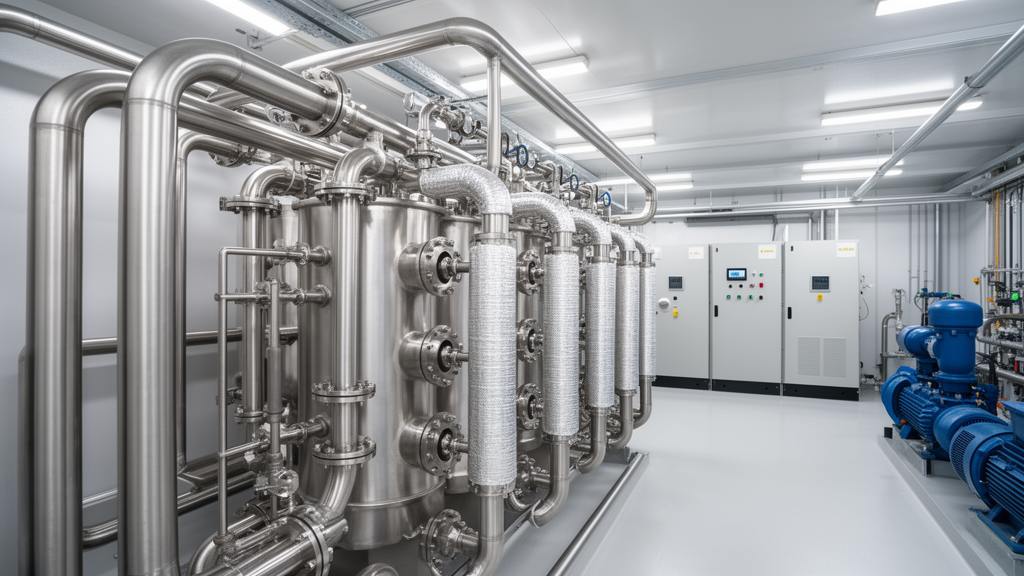
Integrating an electro-thermal-mass prediction model with an adaptive model predictive control algorithm enables proton exchange membrane water electrolyzers to maintain precise thermal stability during fluctuating solar and wind power generation. Experimental and numerical investigations conducted on an industrial-scale one-hundred-kilowatt electrolysis platform demonstrate that this predictive control architecture reduces the temperature rise settling time by 0.55 hours compared with conventional proportional-integral-derivative feedback control. When subjected to simulated fluctuating renewable power profiles, the adaptive model predictive controller adjusted the operating temperature of the electrolyzer stack to its target setpoint within 10.7 minutes, keeping temperature overshoot 4.2 degrees Celsius lower than traditional control loops. By anticipating internal state shifts and updating system matrices in real time, the online regulation framework resolves long-standing control delays and thermal overshoots that degrade solid polymer membranes during variable-load green hydrogen production.
However, direct electrical coupling with photovoltaic arrays and wind turbines introduces severe operational challenges stemming from rapid and unpredictable power fluctuations. When electrical current surges through an electrolysis stack, charge conduction generates substantial internal ohmic heat while electrochemical reactions simultaneously release dense streams of oxygen and hydrogen gas. If auxiliary cooling units fail to extract this thermal energy promptly, localized hot spots emerge across the membrane electrode assemblies, deactivating catalytic layers and inducing irreversible structural pinholes. Conversely, sluggish thermal response times limit reaction rates during cold conditions. Traditional automated regulation in industrial plants relies heavily on conventional proportional-integral-derivative controllers that track simple sensor errors without anticipating internal multiphase dynamics, frequently inducing persistent temperature oscillations.
A complete proton exchange membrane electrolysis facility functions as a tightly coupled thermal and fluid network composed of an electrolysis stack, gas-liquid separators, circulating water pumps, electric heaters, and external heat exchangers. Engineering analysis confirmed that pump friction induces an enthalpy elevation of only 0.32 to 0.65 degrees Celsius in the four-cubic-meter-per-hour water stream, rendering auxiliary power fluctuations a minor thermal disturbance relative to stack waste heat. Consequently, regulating the temperature of the circulating cooling water entering the stack inlet provides an effective, smooth control handle, preventing the severe pressure and voltage shocks triggered by rapid adjustments to fluid flow rates.
To establish an accurate control model, researchers constructed a cross-scale mass transfer framework that couples pore-scale gas transport with macroscale system dynamics. Gaseous oxygen generated at the anode catalyst layer must migrate through the microscale pores of the fibrous porous transport layer into the bipolar plate flow channels. Because the fluid volume in the channels exceeds the pore volume of the transport layer, gas distributions differ substantially across these physical zones. The researchers formulated a one-dimensional pressure equation governing two-phase transport across the porous transport layer, applying the Leverett-J capillary function with a hydrophilic contact angle of eighty degrees. Gas coverage at the catalyst layer interface was directly linked to flow-channel velocity through an exponential formulation containing an empirical bubble transport resistance coefficient.
Total cell voltage was expressed as the sum of thermodynamic reversible voltage, activation overpotential, ohmic resistance, product diffusion losses, and bubble coverage overpotential. Reversible voltage was dynamically adjusted using stack outlet temperature and the partial pressures of hydrogen, oxygen, and water vapor. Activation overpotential incorporated inverse hyperbolic sine functions accounting for anode and cathode charge-transfer kinetics, while ohmic loss was calculated from membrane thickness and temperature-dependent ionic conductivity. Significantly, mass transfer losses combined classic logarithmic diffusion limitations with an exponential bubble coverage correction governed by local water velocity. This multiphysics formulation captured how accumulating gas bubbles increase overpotential by up to 0.1 volts at two amperes per square centimeter, an effect routinely overlooked in simplified zero-dimensional models.
System-level mass and thermal conservation equations completed the predictive architecture by tracking fluid evolution across auxiliary components and connecting pipelines. Dynamic liquid saturation within the stack flow channels was calculated through source terms accounting for convective fluid inflow, electrochemical water consumption, and liquid-vapor phase transitions. Gas partial pressures were tracked using four interrelated source mechanisms capturing gas advection, fluid saturation shifts, thermal expansion, and electrochemical generation. In the thermal domain, energy balance equations modeled heat capacity and convective transport across the stack, the circulating water cooling unit, and the secondary cooling water coils of the counter-flow heat exchanger. Logarithmic mean temperature differences quantified thermal transfers between circulating water and external cooling fluid, while pipeline friction and local resistance coefficients accounted for pressure drops between the electrolyzer and the oxygen separator.
Experimental validation of the electro-thermal-mass performance prediction model was conducted on a specialized one-hundred-kilowatt test platform situated at the Daxing Hydrogen Energy Park in Beijing. The experimental installation utilized an industrial electrolysis stack manufactured by CSSC Peric Hydrogen Technology, consisting of thirty series-connected cells with an active reaction area of one thousand square centimeters per cell. Operating under a balanced cathode and anode backpressure of 0.5 megapascals and a nominal operating temperature of sixty degrees Celsius, the system was subjected to multiple electrical step changes over a 2.5-hour operational run. High-precision sensors logged temperature, voltage, and pressure measurements every ten seconds. Comparative analysis demonstrated that the multiphysics model tracked actual stack temperature with a maximum relative error of 5.3 percent, while successfully reproducing cell voltage curves and dynamic pipeline pressure fluctuations under variable current loading.
To translate this validated predictive capability into real-time temperature regulation, the nonlinear governing equations were linearized into a discrete-time state-space system. The chosen state vector tracked four central physical quantities: stack outlet temperature, stack liquid saturation, oxygen partial pressure, and water vapor partial pressure. Because liquid saturation and internal gas partial pressures cannot be measured directly inside commercial electrolysis stacks, an embedded Kalman filter reconstructed these unobserved internal states using measurable stack outlet temperature and anode backpressure. At each ten-second sampling step, the adaptive controller re-evaluated the four-by-four state Jacobian matrix and input vector around the current operating state. A constrained quadratic programming solver then executed rolling optimization over a defined prediction horizon, selecting an optimal sequence of commanded inlet temperatures while enforcing operational boundaries between 25 and 90 degrees Celsius for coolant inputs.
Benchmarking tests evaluated temperature regulation during a transient warm-up sequence from an initial steady state of 48.05 degrees Celsius to a setpoint of sixty degrees Celsius under a constant circulating water flow of four cubic meters per hour. The proposed adaptive model predictive controller attained the specified setpoint within 0.206 hours, operating without any detectable temperature overshoot. In contrast, a standard model predictive controller running with static offline matrices required 32 percent longer to settle, while a fuzzy proportional-integral-derivative controller produced a large overshoot of 9.8 degrees Celsius accompanied by prolonged oscillations. A conventional proportional-integral-derivative controller exhibited a 5.6-degree overshoot and required 0.590 hours to stabilize within the two-percent error tolerance band. The adaptive framework shortened total settling time by 65.1 percent relative to conventional feedback, demonstrating that real-time Jacobian updating effectively eliminates model mismatch across extensive temperature swings.
The control schemes were subsequently evaluated under realistic dynamic renewable generation by applying a 35-minute photovoltaic power curve comprising rising, fluctuating, and falling current intervals. As electrical current ramped up while the temperature setpoint shifted from sixty to seventy degrees Celsius, the proportional-integral-derivative controller experienced a 4.2-degree temperature overshoot and persistent thermal cycling. In sharp contrast, the adaptive model predictive controller maintained the stack temperature within the two-percent tolerance band within 8.5 minutes. Furthermore, the analysis illuminated fundamental efficiency trade-offs: when current density jumped from 1.28 to 1.57 amperes per square centimeter, rapid ohmic heating decreased voltage efficiency from 0.675 to 0.651, proving that immediate electrical losses temporarily outweigh the efficiency gains of elevated operating temperatures.
Extensive parameter sensitivity evaluations confirmed that the adaptive predictive framework maintains robust performance when plant characteristics deviate from baseline assumptions. Introducing simultaneous twenty-percent perturbations to both input current density and circulating coolant flow rate caused conventional proportional-integral-derivative settling times to widen from 0.608 to 0.884 hours with severe thermal overshoots. Conversely, the adaptive controller maintained zero overshoot and converged within 0.163 to 0.180 hours, settling between 3.6 and 5.2 times faster across all perturbed operating conditions. Future developments will explore multi-variable optimization coupling coolant temperatures with variable-speed pumping to further enhance renewable hydrogen operations.
Subject of Research: Adaptive thermal regulation of proton exchange membrane electrolyzers under fluctuating renewable power inputs
Article Title: Adaptive temperature regulation method for PEM electrolyzer based on electro-thermal-mass parameter prediction of electrolysis system
Article References: Zhang, J., Fu, J., Qu, Z., Liu, C., Wan, Y., Liu, W., & Fu, P. (2026). Adaptive temperature regulation method for PEM electrolyzer based on electro-thermal-mass parameter prediction of electrolysis system. Carbon Neutrality, 5(1), Article 36. https://doi.org/10.1007/s43979-026-00188-5
Image Credits: AI Generated
DOI: 10.1007/s43979-026-00188-5
Keywords: Proton exchange membrane electrolysis, Adaptive model predictive control, Temperature regulation, Hydrogen production, Renewable energy integration, Multiphase mass transfer, Porous transport layer, Bubble overpotential, State-space modeling, Kalman filter, Thermal management, Cell voltage efficiency, Ohmic heat dissipation, System parameter prediction, Dynamic load response, Receding horizon optimization, Photovoltaic power fluctuations, Counter-flow heat exchanger
Cite Scienmag News
Denise Maddox. (November 12, 2026). Adaptive Model Predictive Control Stabilizes Hydrogen Electrolyzer Temperatures Under Fluctuating Power. Scienmag. https://scienmag.com/adaptive-model-predictive-control-stabilizes-hydrogen-electrolyzer-temperatures-under-fluctuating-power/
Denise Maddox. "Adaptive Model Predictive Control Stabilizes Hydrogen Electrolyzer Temperatures Under Fluctuating Power." Scienmag, 12 November 2026, https://scienmag.com/adaptive-model-predictive-control-stabilizes-hydrogen-electrolyzer-temperatures-under-fluctuating-power/. Accessed 12 November 2026.
Denise Maddox. "Adaptive Model Predictive Control Stabilizes Hydrogen Electrolyzer Temperatures Under Fluctuating Power." Scienmag. November 12, 2026. https://scienmag.com/adaptive-model-predictive-control-stabilizes-hydrogen-electrolyzer-temperatures-under-fluctuating-power/




