

Thursday, July 9, 2026
Science
No Result
View All Result
  • Login
  • HOME
  • SCIENCE NEWS
  • CONTACT US
  • HOME
  • SCIENCE NEWS
  • CONTACT US
No Result
View All Result
Scienmag
No Result
View All Result
Home Science News Medicine

Enhancing Person-Centred Care with Saliency and Tacit Knowledge Insights

July 8, 2026
in Medicine
Reading Time: 2 mins read
0
Enhancing Person-Centred Care with Saliency and Tacit Knowledge Insights

Enhancing Person-Centred Care with Saliency and Tacit Knowledge Insights

65
SHARES
587
VIEWS
Share on FacebookShare on Twitter
ADVERTISEMENT

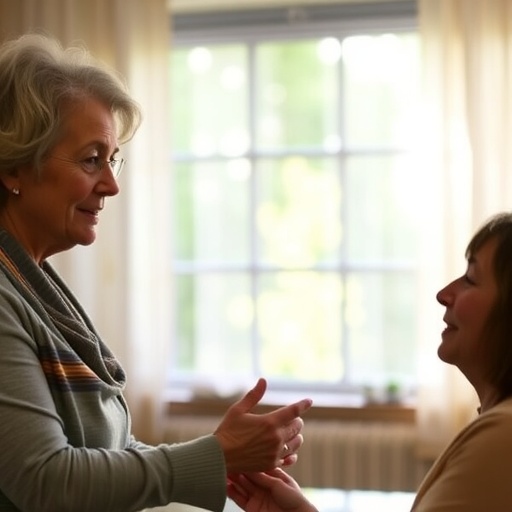
In a groundbreaking study poised to transform residential care, researchers have unveiled a novel approach that harnesses both saliency and tacit knowledge to enhance person-centered care through active patient and family involvement. This innovative two-phased qualitative investigation sheds new light on the subtle yet powerful factors that influence care quality in geriatric settings.

Person-centered care has long been championed as a gold standard in residential care, focusing on the unique preferences, needs, and values of individual patients. However, effectively operationalizing this ideal remains a significant challenge. Traditional models often overlook the nuanced interpersonal dynamics and unspoken understandings that shape day-to-day caregiving experiences. Addressing this gap, the study introduces saliency—highlighting what care participants implicitly prioritize—and tacit knowledge, which encompasses the experiential, often unarticulated know-how residing in both care providers and families.

The study employed a rigorous two-phased design, involving deep qualitative interviews and observations with residents and their families across multiple care facilities. During the initial phase, researchers identified key care elements that stood out as most salient to patients and relatives, revealing insights that conventional surveys might miss. The second phase delved into how caretakers incorporate tacit knowledge into their routines, adapting care practices based on subtle cues and family feedback.

Crucially, findings indicate that when care teams actively integrate saliency-driven priorities and tacit insights, they foster significantly improved communication and trust. This synergy creates a more responsive environment where the personal dignity and autonomy of residents are visibly respected. Family members reported feeling more engaged and reassured, which in turn positively influenced residents’ emotional wellbeing.

From a technical perspective, the study highlights the importance of developing frameworks and training programs that enhance caregivers’ sensitivity to both overt cues and the often overlooked undercurrents shaping care interactions. Integrating such qualitative dimensions into care protocols could drastically reduce the mismatch between prescribed care plans and actual patient experiences.

Moreover, the research underscores the potential use of emerging technologies such as advanced natural language processing and machine learning to identify salient themes and tacit patterns automatically from care narratives. This could allow for scalable and real-time adaptation of care plans, ensuring that the personalized needs of residents evolve continuously with input from families and caregivers.

As health systems worldwide grapple with aging populations and complex care demands, this innovative approach offers a promising roadmap. Embracing saliency and tacit knowledge as formal components of care strategies may revolutionize person-centered care, offering a finer-grained and more humanized understanding of what truly matters in residential care settings.

With these insights, healthcare providers and policymakers have a powerful new tool to reimagine care delivery, emphasizing empathy, communication, and nuanced understanding, all critical for enhancing the quality of life in senior residential care.


Subject of Research: Patient and family involvement in person-centred residential care using saliency and tacit knowledge.

Article Title: Using saliency and tacit knowledge for person-centred care: a two-phased qualitative study on patient and family involvement in residential care.

Article References: Plantinga, A., Landman-Peeters, K. & van der Cingel, M. Using saliency and tacit knowledge for person-centred care: a two-phased qualitative study on patient and family involvement in residential care. BMC Geriatr (2026). https://doi.org/10.1186/s12877-026-07927-4

Image Credits: AI Generated

DOI: 10.1186/s12877-026-07927-4

Tags: enhancing person-centered practicesexperiential knowledge in caregivingimproving care quality through tacit knowledgeinterpersonal dynamics in residential settingspatient and family involvement in residential careperson-centered carequalitative research in elder caresaliency in geriatric caretacit knowledge in healthcaretwo-phased qualitative study in healthcareunderstanding implicit priorities in careunspoken factors influencing elder care
Share26Tweet16
Previous Post

NEP89 enables universal neuroevolution for 89 inorganic and organic elements

Next Post

MFAP2 from Cancer-Associated Fibroblasts Drives Gastric Cancer Spread via Src-STAT3-PTK7

Related Posts

Seafloor Spreading Event Revealed by In Situ Seismogeodesy
Medicine

Seafloor Spreading Event Revealed by In Situ Seismogeodesy

July 8, 2026
Immune Profiling Predicts Response to Radiation and Anti-PD-1 in Kidney Cancer
Medicine

Immune Profiling Predicts Response to Radiation and Anti-PD-1 in Kidney Cancer

July 8, 2026
MFAP2 from Cancer-Associated Fibroblasts Drives Gastric Cancer Spread via Src-STAT3-PTK7
Medicine

MFAP2 from Cancer-Associated Fibroblasts Drives Gastric Cancer Spread via Src-STAT3-PTK7

July 8, 2026
Kidney Disease Rates Stable, Increasing Among Diabetes and Heart Patients in US
Medicine

Kidney Disease Rates Stable, Increasing Among Diabetes and Heart Patients in US

July 8, 2026
Reinforcement Learning Advances Quantum Error Correction Control
Medicine

Reinforcement Learning Advances Quantum Error Correction Control

July 8, 2026
Linoleic Acid Promotes Osteoarthritis via Ferroptosis in Male Rat Cartilage
Medicine

Linoleic Acid Promotes Osteoarthritis via Ferroptosis in Male Rat Cartilage

July 8, 2026
Next Post
MFAP2 from Cancer-Associated Fibroblasts Drives Gastric Cancer Spread via Src-STAT3-PTK7

MFAP2 from Cancer-Associated Fibroblasts Drives Gastric Cancer Spread via Src-STAT3-PTK7

  • Mothers who receive childcare support from maternal grandparents show more

    Mothers who receive childcare support from maternal grandparents show more parental warmth, finds NTU Singapore study

    27656 shares
    Share 11059 Tweet 6912
  • University of Seville Breaks 120-Year-Old Mystery, Revises a Key Einstein Concept

    1061 shares
    Share 424 Tweet 265
  • Bee body mass, pathogens and local climate influence heat tolerance

    682 shares
    Share 273 Tweet 171
  • Researchers record first-ever images and data of a shark experiencing a boat strike

    546 shares
    Share 218 Tweet 137
  • Groundbreaking Clinical Trial Reveals Lubiprostone Enhances Kidney Function

    531 shares
    Share 212 Tweet 133
Science

Embark on a thrilling journey of discovery with Scienmag.com—your ultimate source for cutting-edge breakthroughs. Immerse yourself in a world where curiosity knows no limits and tomorrow’s possibilities become today’s reality!

RECENT NEWS

  • Public Universities Lead in Scientific Output, IUNE 2026 Reports
  • Educational Mobility Drives Breakthroughs in Innovation
  • Scientists Uncover Evolutionary Origins of Ant Parenting Behavior
  • ECNP Notes Growing Citations Highlight Interest in Mental Health Biology

Categories

  • Agriculture
  • Anthropology
  • Archaeology
  • Athmospheric
  • Biology
  • Biotechnology
  • Blog
  • Bussines
  • Cancer
  • Chemistry
  • Climate
  • Earth Science
  • Editorial Policy
  • Marine
  • Mathematics
  • Medicine
  • Pediatry
  • Policy
  • Psychology & Psychiatry
  • Science Education
  • Social Science
  • Space
  • Technology and Engineering

Subscribe to Blog via Email

Enter your email address to subscribe to this blog and receive notifications of new posts by email.

Join 5,147 other subscribers

© 2025 Scienmag - Science Magazine

Welcome Back!

Login to your account below

Forgotten Password?

Retrieve your password

Please enter your username or email address to reset your password.

Log In
No Result
View All Result
  • HOME
  • SCIENCE NEWS
  • CONTACT US

© 2025 Scienmag - Science Magazine

Discover more from Science

Subscribe now to keep reading and get access to the full archive.

Continue reading
