


Tumour protein P53 (TP53) plays an important role in suppressing the growth of tumours. Mutations in the gene for TP53 can have a disastrous effect, hampering the body’s ability to fight tumours and even encouraging their growth. Because these are the most common mutations in cancers, TP53 has long been an interesting therapeutic target. However, efforts to destroy the mutant protein have been hampered by the difficulty of finding a way to bind to it.

Credit: National Cancer Institute (NCI), via Wikimedia Commons
Tumour protein P53 (TP53) plays an important role in suppressing the growth of tumours. Mutations in the gene for TP53 can have a disastrous effect, hampering the body’s ability to fight tumours and even encouraging their growth. Because these are the most common mutations in cancers, TP53 has long been an interesting therapeutic target. However, efforts to destroy the mutant protein have been hampered by the difficulty of finding a way to bind to it.
Now, a team of researchers from Xi’an Jiaotong-Liverpool University (XJTLU) and other research institutes across China have published a study in which they engineered a short sequence of artificial DNA to target a particular mutant version of TP53. This mutation, called p53-R175H, is linked with lung, colorectal, and breast cancers, and tumours featuring the mutation are more likely to become resistant to chemotherapy treatments, such as cisplatin.
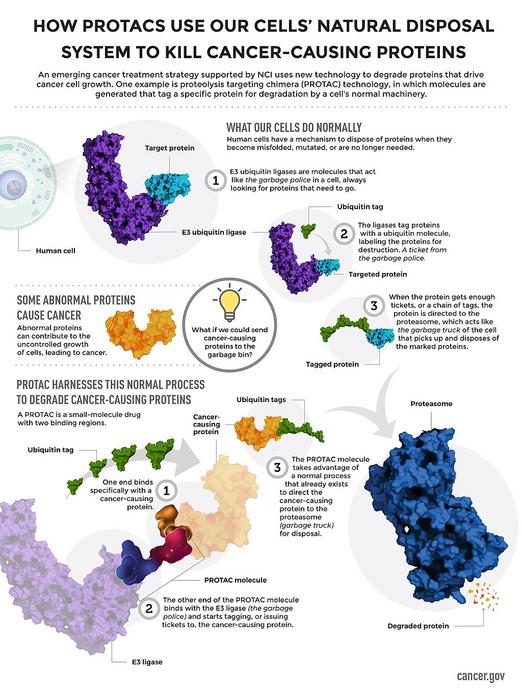
The new molecule, dp53m, is a proteolysis-targeting chimera (PROTAC), a type of molecule that consists of two components working together to recognise and degrade a target protein. In dp53m, the first component binds specifically to the mutant p53-R175H protein and does not interact with the non-mutant version of TP53. The second component engages an enzyme called ubiquitin ligase to break down the target mutated protein.
“The magic of PROTACs lies in their ability to recruit enzymes to the target protein, which then starts the process of breaking it down,” says Dr Sijin Wu from the XJTLU Wisdom Lake Academy of Pharmacy.
Potential treatment
In their paper, published in Science Bulletin, Dr Wu and co-authors report the results of laboratory tests using dp53m against lung cancer cell cultures and in mice with cancer. The molecule inhibited the growth of cancer cells with the p53-R175H mutation while having no effect on cancer cells with other p53 mutations or with unmutated TP53.
Mice treated with dp53m had much lower levels of tumour growth than mice given a saline injection as a control. The mice also didn’t lose weight, and their other organs were healthy, suggesting that the molecule is not toxic to healthy cells. The study also found that treatment with dp53m increased the sensitivity of mutant cancer cells to the chemotherapy agent cisplatin.
“The development of dp53m provides strong evidence for the feasibility of using short sequences of RNA or DNA as warheads for PROTACs,” Dr Wu says. “It also could lead to a new potential therapeutic strategy for diseases associated with the p53-R175H mutation.”
Journal
Science Bulletin
Method of Research
Experimental study
Subject of Research
Cells
Article Title
An engineered DNA aptamer-based PROTAC for precise therapy of p53-R175H hotspot mutant-driven cancer
Article Publication Date
18-May-2024
COI Statement
The authors declare that they have no conflict of interest.
Cite Scienmag News
Nathaniel Bowman. (May 30, 2024). Engineered DNA ‘warhead’ targets a common cancer mutation. Scienmag. https://scienmag.com/engineered-dna-warhead-targets-a-common-cancer-mutation/
Nathaniel Bowman. "Engineered DNA ‘warhead’ targets a common cancer mutation." Scienmag, 30 May 2024, https://scienmag.com/engineered-dna-warhead-targets-a-common-cancer-mutation/. Accessed 4 September 2026.
Nathaniel Bowman. "Engineered DNA ‘warhead’ targets a common cancer mutation." Scienmag. May 30, 2024. https://scienmag.com/engineered-dna-warhead-targets-a-common-cancer-mutation/

