


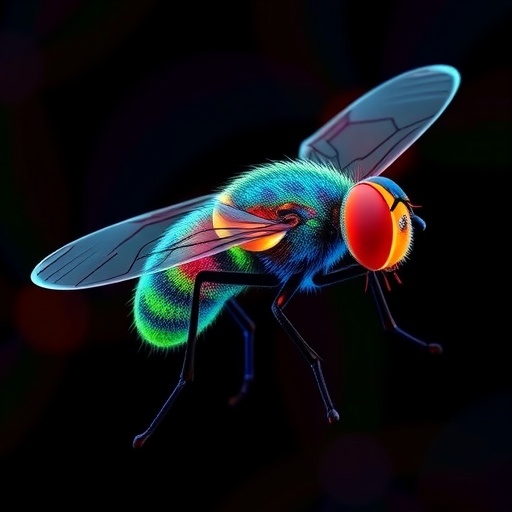
In a groundbreaking study set to redefine our understanding of neural efficiency, researchers N. Dhiman and S. Panwar have unveiled new insights into the energy dynamics and plasticity mechanisms within the optic lobe connectome of Drosophila melanogaster, the common fruit fly. Published in Scientific Reports in 2026, their work brings to light how neural circuits manage information in an extraordinarily energy-efficient manner, leveraging what they term eligibility-trace plasticity—a form of synaptic adaptability that promises broader implications in both biological and artificial intelligence systems.
The optic lobe of Drosophila has long served as a model system for neuroscientists owing to its comparatively simple yet highly organized architecture. This brain region processes visual information and thus is pivotal for the fly’s navigation and survival. However, until now, few studies have quantitatively dissected how energy is conserved during this complex information processing while simultaneously maintaining flexibility through synaptic plasticity.
Dhiman and Panwar’s research integrates advanced connectomics, computational modeling, and electrophysiological data, culminating in a comprehensive map of synaptic energy flow and plasticity-related signaling. Their findings suggest that the optic lobe optimizes energetic cost through a remarkable balancing act—minimizing metabolic load without sacrificing the intricacy of signal transmission essential for adaptive behaviors. This balance is achieved via eligibility-trace plasticity, a synaptic mechanism that temporally bridges neural activity and synaptic modifications, facilitating learning with minimal energy expenditure.
A noteworthy aspect of the study is the implementation of state-of-the-art algorithms to reconstruct the neural connectome at a resolution capable of revealing subtle synaptic features. By meticulously annotating synaptic contacts and their associated molecular markers, the researchers have identified specific pathways where eligibility traces modulate synaptic efficacy. These pathways appear to act as energy-saving conduits that allow the nervous system to update its connectivity selectively, only when necessary signals coincide within precise temporal windows.
The implications of this work extend far beyond insect neurobiology. Human brains, although orders of magnitude larger and more complex, also rely on analogous principles of synaptic plasticity to encode memories and adapt behaviors. Understanding how energy constraints shape synaptic rules in simpler circuits opens avenues to devise energy-efficient artificial neural networks, particularly relevant for the development of neuromorphic computing architectures that mimic brain-like processing with minimal power consumption.
Moreover, this elucidation of eligibility-trace mechanisms highlights a paradigm shift in how synaptic plasticity is modeled computationally. Traditional Hebbian theories emphasize coincidence detection but often neglect the metabolic costs associated with synaptic modification. Dhiman and Panwar’s approach, rooted in biophysical realism, incorporates energy budgets as a critical parameter, thereby providing a holistic view of learning that accounts for both functionality and sustainability.
An equally fascinating finding concerns the temporal dynamics of eligibility trace formation in the optic lobe. The researchers found that these traces persist over extended time scales, allowing the fly’s neural circuits to integrate information over seconds to minutes, a feature crucial for behavioral flexibility in fluctuating environments. This temporal persistence ensures that synaptic updates do not occur haphazardly but are tightly regulated to optimize behavioral outcomes while conserving energy.
In practical terms, the study’s insights could revolutionize the design of brain-machine interfaces and autonomous robotic systems. By embedding energy-efficient learning mechanisms inspired by Drosophila’s optic lobe, engineered devices could achieve sophisticated adaptability without compromising battery life or generating excessive heat—a significant hurdle in current AI hardware.
The meticulous methodology employed in this research stands as a testament to interdisciplinary collaboration. Utilizing high-resolution electron microscopy data alongside novel computational models, Dhiman and Panwar validated their findings through in vivo electrophysiological recordings. This triangulation assures that the theoretical frameworks proposed are firmly anchored in biological reality, enhancing the study’s credibility and impact.
Furthermore, the research provides new perspectives on neurological disorders where energy metabolism and synaptic plasticity are disrupted. By unravelling the fundamental principles governing efficient synaptic adaptation, scientists may develop targeted interventions for diseases such as Alzheimer’s and Parkinson’s, where energy deficits and plasticity impairments are prevalent.
The study also introduces a conceptual framework for understanding how molecular signaling cascades underpin eligibility traces. Dhiman and Panwar emphasize the role of intracellular second messengers and retrograde signaling molecules that sustain synaptic tags, serving as biochemical substrates for the temporal bridging of pre- and postsynaptic activity. This molecular insight adds depth to the electrophysiological findings, marrying structural and functional data into a cohesive narrative.
Intriguingly, the authors propose that energy-efficiency in synaptic plasticity is not merely a passive consequence of biochemical constraints but a selected evolutionary feature. In the frugal economy of the fruit fly’s nervous system, conservation of metabolic resources likely provided a survival advantage, shaping the evolution of sophisticated yet parsimonious neural learning rules.
As the field moves forward, Dhiman and Panwar’s work establishes a benchmark for future studies exploring the interplay between energy consumption and neural adaptability. The principles outlined in the optic lobe connectome could be extrapolated to other sensory modalities and species, offering a universal blueprint of how brains optimize resource allocation while maintaining cognitive flexibility.
This research is poised to trigger widespread interest across neuroscience, artificial intelligence, and bioengineering communities. It challenges established dogmas and opens new horizons where energy-efficient neural computation becomes the cornerstone for understanding brains and building intelligent machines. The implications for technology and medicine are profound, signaling an era where biologically inspired design principles could lead to revolutionary breakthroughs.
In sum, Dhiman and Panwar’s article not only elucidates fundamental processes in a model organism but also lays the groundwork for transformative advancements in computational neuroscience and engineered systems. Their innovative approach linking metabolic efficiency to synaptic plasticity enriches our toolbox for deciphering the brain’s mysteries and crafting next-generation technologies with unprecedented efficiency and adaptability.
Cite Scienmag News
Cassandra Pierce. (May 19, 2026). Energy-Efficient Processing and Plasticity in Fly Brain. Scienmag. https://scienmag.com/energy-efficient-processing-and-plasticity-in-fly-brain/
Cassandra Pierce. "Energy-Efficient Processing and Plasticity in Fly Brain." Scienmag, 19 May 2026, https://scienmag.com/energy-efficient-processing-and-plasticity-in-fly-brain/. Accessed 3 September 2026.
Cassandra Pierce. "Energy-Efficient Processing and Plasticity in Fly Brain." Scienmag. May 19, 2026. https://scienmag.com/energy-efficient-processing-and-plasticity-in-fly-brain/


