


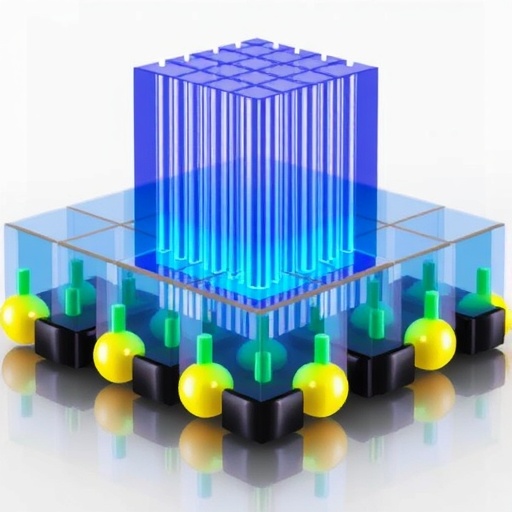
In a groundbreaking development poised to revolutionize the landscape of low-power electronics, researchers have unveiled a scalable synthesis method for two-dimensional (2D) transition metal dichalcogenide (TMDC) heterostructures. These atomically thin structures exhibit exceptional quality, uniformity, and allow for flexible patterning designs, making them a promising candidate for mass production of next-generation electronic devices. This advancement not only addresses the challenge of device scalability but also promises significant reductions in energy consumption through innovative material engineering.
At the heart of this research lies the fabrication of metal–semiconductor heterojunctions formed by stacking niobium disulfide (NbS₂), a metallic TMDC, with molybdenum disulfide (MoS₂), a well-known semiconducting TMDC. The fine-tuned interface between these materials enables unprecedented control over electrical properties, substantially lowering the contact resistance—a key bottleneck in the performance and energy efficiency of nanoelectronic devices. By reducing contact resistance, devices built on these heterostructures can operate with markedly lower power, heralding a new era of energy-conscious computing technologies.
The heterostructures fabricated via the novel method boast precise patterning capabilities, allowing for the creation of complex device architectures without sacrificing uniformity or quality. This flexibility is critical for integrating the TMDCs into existing semiconductor manufacturing workflows, potentially bridging the gap between emerging 2D materials and commercial electronics. The scalability of the synthesis process means that posterity is not limited to explorations in laboratory settings; rather, the mass production of high-performance 2D electronic components is now a feasible reality.
One of the most compelling applications demonstrated with these NbS₂–MoS₂ heterostructures is in non-volatile memory (NVM) devices. These memories retain information without power, which is essential for reducing standby power consumption in electronic systems. The researchers report exceptional programming capabilities, wherein the memory states can be switched reliably with high precision. The robust data storage performance of these devices ensures longevity and resilience, both critical factors for commercial adoption.
In contrast to 3D NAND flash memory, which achieves high storage density through vertical stacking of memory cells, this new 2D memory platform leverages an atomically thin, planar architecture. This planar integration offers seamless compatibility with logic devices, enabling combined transistor and memory functionalities on the same chip. Such integration is vital for the development of heterogeneous computing architectures, wherein different computing elements coexist closely to optimize performance and power efficiency.
Moreover, the potential to scale the gate length of these memory devices down to 10 nanometers represents a significant stride towards commercialization and miniaturization. As gate lengths shrink, the challenges of maintaining device integrity and performance intensify, making the demonstrated operation at these scales especially noteworthy. The planar NbS₂–MoS₂ platform holds promise for overcoming scaling limits that plague conventional semiconductor devices, enabling the continuation of Moore’s Law-like progression in device density and capability.
Fundamentally, this research underscores the transformative role of advanced materials design in overcoming traditional limitations of electronic components. The meticulous engineering of 2D metal–semiconductor interfaces not only optimizes electrical behavior but also introduces new paradigms for device architecture and energy consumption. This marriage of material science and device physics exemplifies the interdisciplinary approach needed to push the boundaries of computing technology.
The scalability aspect of the synthesis method is particularly remarkable, given the typical challenges in producing large-area 2D heterostructures with high uniformity. Traditional mechanical exfoliation techniques yield high-quality flakes but suffer from low yield and poor reproducibility. Chemical vapor deposition (CVD) methods have improved throughput but often compromise on uniformity and pattern precision. The new method strikes an ideal balance, harnessing the strengths of scalable fabrication while maintaining the stringent quality requirements necessary for electronic applications.
From an application perspective, the ability to create non-volatile memory elements with low contact resistance directly addresses the pressing need for energy-efficient memory technologies in modern electronics. Computing systems increasingly demand memories that consume less power without sacrificing speed or data retention capabilities. By enabling low-power operation and robust memory retention simultaneously, these TMDC-based devices could significantly contribute to reducing the overall energy footprint of electronics.
The implications extend beyond mere memory applications. The integration of metallic and semiconducting TMDC layers opens avenues for novel device concepts such as in-memory computing systems, which aim to merge logic and storage functions to minimize data movement and associated energy costs. This approach has the potential to vastly improve computational efficiency in applications ranging from artificial intelligence to edge computing, where low-power, high-density devices are paramount.
Critically, the planar architecture of the NbS₂–MoS₂ heterostructure provides advantages not only in device integration but also in thermal management and reliability. The atomically thin nature of the materials allows for efficient heat dissipation and reduces defect densities that typically emerge at interfaces in thicker, bulk structures. This contributes to the operational stability and longevity of devices built on this platform, addressing a major hurdle faced by many emerging nanoelectronic components.
From a broader scientific vantage, this work exemplifies the synthesis–structure–property relationship that underpins cutting-edge materials science. The precise control over heterostructure formation ensures that electronic transport across the metal–semiconductor boundary is optimized, propelling device performance to new heights. Such control is vital as the electronics industry moves towards complex, multifunctional nanosystems where every atomic layer can dramatically influence overall behavior.
Looking ahead, the demonstrated techniques open promising perspectives for addressing the critical challenges in the semiconductor industry, especially as traditional silicon technologies approach fundamental physical and economic limits. The ability to fabricate high-quality, scalable 2D TMDC heterostructures with tunable electronic properties aligns well with the industry’s quest for novel materials that can sustain Moore’s Law and meet the escalating demands for energy-efficient computation.
Furthermore, the inherent compatibility of these TMDC heterostructures with existing fabrication processes mitigates integration barriers. This smooth transition pathway from research to manufacturing could accelerate the adoption of 2D materials in commercial memory and logic devices. As industries increasingly embrace heterogeneous integration and system-on-chip approaches, innovations such as these will be pivotal in shaping the future semiconductor landscape.
In conclusion, the synthesis of patterned NbS₂–MoS₂ metal–semiconductor heterostructures marks a significant milestone in 2D materials research and its application in nanoelectronics. The union of high-quality, scalable fabrication with demonstrated device utility in non-volatile memory with low-power operation highlights a versatile platform poised to influence multiple domains within electronics. This work not only expands the horizons of materials science but also charts a pragmatic course towards realizing the next generation of ultra-efficient computing devices.
Cite Scienmag News
Denise Maddox. (May 19, 2026). Non-Volatile Memories from NbS2-MoS2 Heterostructures. Scienmag. https://scienmag.com/non-volatile-memories-from-nbs2-mos2-heterostructures/
Denise Maddox. "Non-Volatile Memories from NbS2-MoS2 Heterostructures." Scienmag, 19 May 2026, https://scienmag.com/non-volatile-memories-from-nbs2-mos2-heterostructures/. Accessed 5 September 2026.
Denise Maddox. "Non-Volatile Memories from NbS2-MoS2 Heterostructures." Scienmag. May 19, 2026. https://scienmag.com/non-volatile-memories-from-nbs2-mos2-heterostructures/


