


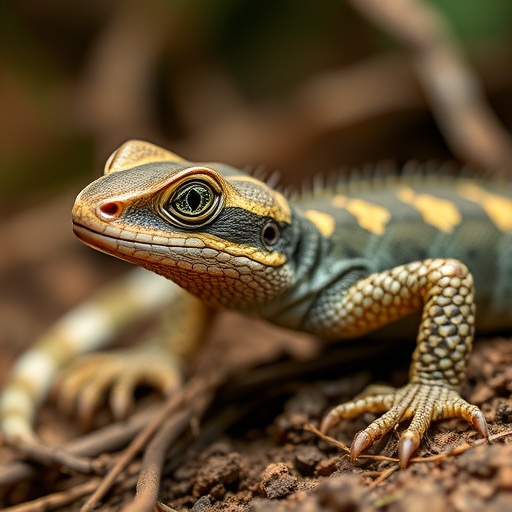
Climate change stands as a formidable driver behind the accelerating decline of numerous native reptile species in Australia, with groundbreaking research now elucidating the mechanisms by which these declines have unfolded over millennia. A newly published study in the prestigious journal Current Biology unveils how the endangered Australian Mountain Dragon (Rankinia diemensis) has been progressively corralled into shrinking, isolated highland refuges as an adaptive response to shifting climatic regimes since the Quaternary period. This comprehensive research embodies an intersection of paleobiology, genomics, and conservation science, underscoring the critical importance of museum collections and advanced imaging technologies in revealing the hidden histories of biodiversity loss.
The Mountain Dragon, a resilient yet vulnerable reptile native to the southeastern Australian bioregion, historically boasted a broad distribution during the last glacial maximum roughly 20,000 years ago. Fossil records, meticulously analyzed through cutting-edge micro-CT imaging techniques, demonstrate that these lizards once inhabited a swath of habitats extending from Kangaroo Island to Naracoorte and beyond. This extensive range abruptly contracted as fluctuating temperatures and environmental conditions favored retreat into cooler, mountainous zones. The species’ dwindling distribution highlights the profound sensitivity of ectothermic organisms to climate oscillations, illustrating an ecological pattern mirrored in diverse reptilian taxa.
By integrating genetic sequencing data from contemporary museum specimens with fossilized remains secured within renowned natural history repositories, the research team assembled a detailed chronicle of Rankinia diemensis’ demographic and genetic transformations. This fusion of paleontological and molecular data offers unprecedented insights into how long-term environmental pressures have sculpted the species’ population structure, genetic diversity, and potential resilience. Genetic isolation in the fragmented modern populations is correlated with a loss of allelic richness, pointing toward an erosion of evolutionary potential crucial for adapting to rapid environmental changes.
The employment of micro-CT imaging represented a methodological breakthrough, allowing researchers to identify and analyze minute fossil fragments that were previously inaccessible. This non-destructive imaging modality enables high-resolution, three-dimensional visualization of skeletal microstructures within fossil assemblages, facilitating precise taxonomic identification and morphological assessments. Such technological advancements have revolutionized paleobiology, enabling the extraction of rich ecological and evolutionary information from otherwise inscrutable remnants, and in this study, played a vital role in tracking the Mountain Dragon’s range contraction over tens of thousands of years.
The climatic narrative emerging from the data is stark: as global temperatures increased post-glaciation and continue to elevate in the Anthropocene epoch, the Mountain Dragon is increasingly relegated to marginal high-elevation habitats. These mountainous refugia offer respite through cooler microclimates but are spatially limited and subject to further climatic perturbations. The encroachment of warming temperatures threatens habitat suitability even in these refuges, signaling a forced altitudinal migration with eventual extinction risks as suitable niches vanish.
This phenomenon is not isolated to Rankinia diemensis alone. The study references parallel declines and genetic impoverishment in sympatric reptile species such as the blotched Blue-Tongue Lizard (Tiliqua nigrolutea), suggesting that the entire southeastern Australian reptilian assemblage faces convergent threats emitted by climate change. These ecological trends portend sweeping biodiversity losses, posing critical challenges for regional conservation agendas aimed at preserving herpetofaunal diversity and ecosystem integrity.
Reptiles’ ectothermic physiology intrinsically exacerbates their vulnerability to climate-induced habitat alteration. Unlike endotherms, reptiles rely heavily on ambient temperatures to regulate their metabolic processes, activity levels, and reproductive cycles. Sudden shifts in thermal landscapes can disrupt these key life-history traits, reduce survival rates, and undermine population viability. This physiological constraint, coupled with habitat fragmentation and isolation, compounds the extinction pressures on species like the Mountain Dragon.
The study unequivocally demonstrates the immense value of natural history museums as custodians of biodiversity knowledge. The assemblage of fossilized remains, bones, and preserved specimens curated over centuries at Museums Victoria and the Museum für Naturkunde Berlin offers irreplaceable temporal snapshots of species’ past distributions and evolutionary responses. By linking this historical archive with modern genomic tools and climate modeling, researchers unlock dynamic narratives that inform conservation strategies grounded in deep-time perspectives.
Dr. Till Ramm, lead author and former doctoral candidate at Museums Victoria Research Institute, advocates for an emergent interdisciplinary research domain termed ‘conservation paleobiology.’ This field leverages fossil records to anticipate how contemporary biodiversity might respond to ongoing anthropogenic stressors. The compelling evidence from this study underscores the urgency of incorporating paleobiological insights into conservation planning frameworks, thereby enabling proactive, rather than reactive, responses to habitat loss and species decline.
“The pace at which climate change can disrupt biodiversity is both alarming and unprecedented,” remarked Dr. Ramm. “Our integrated approach highlights the necessity of safeguarding not just species, but the habitats they depend upon, particularly those vulnerable mountain refuges that may serve as last bastions for threatened reptiles.” Such sentiments echo a growing consensus that effective conservation must be informed by historical baselines and extend beyond current ecological snapshots.
Echoing these views, Dr. Nurin Veis, Director of the Museums Victoria Research Institute, emphasized the critical role museum collections play in illuminating species’ past adaptations and vulnerabilities. “By bridging the past and present, we gain foresight—an essential asset in preserving the biodiversity that remains. These collections are not mere archives; they are active tools empowering science to confront extinction crises.”
Beyond academic insights, the public can engage with this research through immersive exhibits such as 3D models of the Mountain Dragon featured in Melbourne Museum’s Research Institute Gallery. These exhibits foster awareness and appreciation of Australia’s unique biodiversity and the terrestrial ancient heritage under threat. Museums Victoria’s latest initiative, Our Wondrous Planet, further inspires a collective commitment to safeguarding natural heritage for future generations in the face of climate adversity.
As global climate models consistently predict escalating temperatures and habitat degradation, the plight of Rankinia diemensis serves as both an early warning and a call to arms. The integration of paleontological, genetic, and ecological data presented by this study offers a blueprint for future research and conservation action—one that is rooted in understanding long-term ecological dynamics and the pressing need to maintain genetic diversity within vulnerable species.
In summary, this research embodies the evolving frontier of conservation science, where multi-disciplinary approaches unlock critical pathways to counteract biodiversity loss. The Australian Mountain Dragon’s contraction over millennia, exposed through innovative imaging and genomics, poignantly narrates the broader story of life’s fragility amid climate perturbations. Protecting these species requires harnessing the lessons encoded in their deep-time journeys and mobilizing concerted conservation efforts that recognize the intertwined destinies of climate and biodiversity.
News Publication Date: 28-Oct-2025
Web References:
https://doi.org/10.1016/j.cub.2025.09.067
Cite Scienmag News
Margaret Porter. (October 28, 2025). Endangered Reptiles Face Imminent Extinction Due to Environmental Changes. Scienmag. https://scienmag.com/endangered-reptiles-face-imminent-extinction-due-to-environmental-changes/
Margaret Porter. "Endangered Reptiles Face Imminent Extinction Due to Environmental Changes." Scienmag, 28 October 2025, https://scienmag.com/endangered-reptiles-face-imminent-extinction-due-to-environmental-changes/. Accessed 6 September 2026.
Margaret Porter. "Endangered Reptiles Face Imminent Extinction Due to Environmental Changes." Scienmag. October 28, 2025. https://scienmag.com/endangered-reptiles-face-imminent-extinction-due-to-environmental-changes/


