


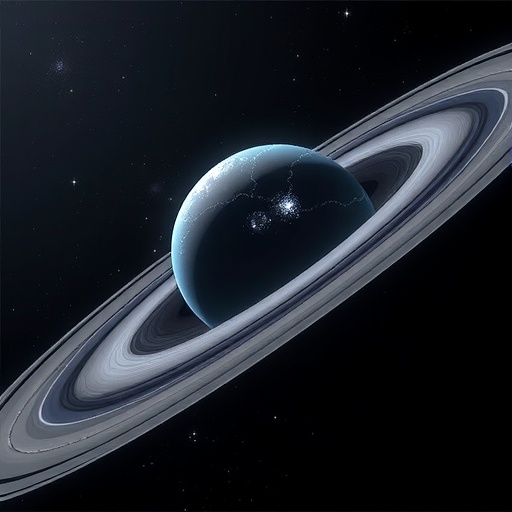
In a groundbreaking revelation, scientists have unveiled the intricate electromagnetic relationship between Enceladus, one of Saturn’s smallest moons, and the massive planet it orbits. This significant discovery arose from an extensive study conducted by a diverse team of international researchers utilizing a wealth of data gathered from the NASA/ESA/ASI Cassini spacecraft. The findings indicate that Enceladus is not just a frozen satellite spewing geysers of water vapor; it plays a pivotal role in shaping the electromagnetic environment of the greater Saturnian system.
The study sheds light on the seemingly ethereal but substantial wake of electromagnetic waves trailing behind Enceladus, which extends an astonishing half a million kilometers into space. The research reveals a complex, lattice-like structure of wave patterns that crisscross downstream from the moon within Saturn’s equatorial plane. This intricate geometry even infiltrates high-latitude regions, indicating that Enceladus significantly influences a broader area than scientists had previously suspected.
Prominent features of this electromagnetic interaction are the Alfvén wings—wave structures that propagate like vibrations on a string, aligning along the magnetic field lines that connect Enceladus to Saturn’s poles. Insights from the data indicate that the primary Alfvén wing and its reflections create a sophisticated system of waves that resonate throughout the Saturnian magnetosphere. Notably, this wave structure serves to circulate energy and momentum, providing a dynamic interplay between the moon and the massive gas giant.
At the heart of these electromagnetic influences are the plumes of water vapor and dust that erupt from the geysers in Enceladus’s southern hemisphere. Once the ejected water molecules and particles are exposed to radiation, they become ionized, thereby generating an electrically-charged plasma. This plasma does not merely float aimlessly; it interacts robustly with Saturn’s magnetic field, ultimately leading to the generation of waves that ripple out from Enceladus.
Lina Hadid, a leading researcher from the Laboratoire de Physique de Plasmas (LPP) in France, emphasized the importance of this research, stating, “Enceladus, Saturn’s small icy moon, is famous for its water geysers, but its actual impact and interaction with the giant planet has remained partly unknown. This result from Cassini transforms our vision of the moon’s role in the Saturnian system.” Hadid’s assertion highlights how the research challenges previous perceptions of Enceladus as merely a passive body in orbit around Saturn.
The research involved meticulous analysis of data collected over 13 years through four different instruments aboard the Cassini spacecraft. By leveraging a multi-instrumental approach, researchers meticulously investigated and characterized the electromagnetic wave and particle interactions that occur near Enceladus. Their findings revealed impressive signatures of Alfvén waves propagating at engaging distances—exceeding 504,000 kilometers—significantly surpassing the moon’s petite radius by more than 2,000 times.
One of the most exciting aspects of the research is the extent of the wave structures discovered. These Alfvén waves, which flow like ripples on a pond, travel vast distances while maintaining a significant electromagnetic influence. As Thomas Chust from LPP explains, “This is the first time such an extensive electromagnetic reach by Enceladus has been observed, proving that this small moon acts as a giant planetary-scale Alfvén wave generator.” Such conclusive findings suggest that Enceladus has the ability to shape the Saturnian magnetosphere, influencing phenomena far beyond its immediate vicinity.
While the large-scale wave structures were indeed noteworthy, the researchers also uncovered finer details revealing underlying turbulence that stretches waves into filaments nested within the primary Alfvén wing. This complexity allows the waves to bounce off the plasma torus encapsulating Enceladus’s orbit, facilitating their reach to high-latitude areas within Saturn’s ionosphere. It is in these high-latitude realms where auroral phenomena linked to Enceladus’s activity are generated, providing a spectacular display attributed to an otherwise unassuming moon.
The ramifications of these findings extend beyond just our understanding of Saturn and Enceladus. They set a crucial foundation for exploring similar spaces, such as the icy moons of Jupiter and distant exoplanets. By demonstrating how even a small moon equipped with an electrically conductive atmosphere can wield considerable influence over vast interplanetary landscapes, researchers have opened the door for future studies in planetary science and magnetosphere interactions.
Looking ahead, the criticality of these results is underscored by the call for future missions to Enceladus that will delve deeper into the electromagnetic interactions at play. As Hadid notes, the upcoming ESA orbiter and lander missions planned for the 2040s should be equipped with advanced instrumentation able to further scrutinize these findings. Gathering new data will not just cement our understanding of Enceladus’s role; it could revolutionize our comprehension of electromagnetic dynamics in the broader solar system.
The study’s innovative findings are documented in the Journal of Geophysical Research: Space Physics and underscore the collaborative effort behind this important scientific endeavor. With participation from various institutions around the world, including prominent laboratories in France, Sweden, Germany, and the United States, this research represents a global drive toward unraveling the complexities of our celestial neighbors.
Overall, this groundbreaking research has illuminated Enceladus not merely as a subject of scientific curiosity, but as a central actor in the intricate dance of Saturn’s magnetosphere. Through observation, analysis, and an interdisciplinary approach, scientists have begun to uncover the mysteries concealed within this distant moon and its considerable impacts on the cosmic landscape. The story of Enceladus is far from over, and as exploration continues in the following decades, we may discover even more remarkable truths about one of our solar system’s most enigmatic bodies.
Keywords
Enceladus, Saturn, Alfvén wings, Cassini, electromagnetic waves, plasma, magnetosphere, ice moons, planetary science, auroras
Cite Scienmag News
Grant Pearson. (February 10, 2026). Enceladus Exerts Powerful Electromagnetic Influence at Saturn. Scienmag. https://scienmag.com/enceladus-exerts-powerful-electromagnetic-influence-at-saturn/
Grant Pearson. "Enceladus Exerts Powerful Electromagnetic Influence at Saturn." Scienmag, 10 February 2026, https://scienmag.com/enceladus-exerts-powerful-electromagnetic-influence-at-saturn/. Accessed 3 September 2026.
Grant Pearson. "Enceladus Exerts Powerful Electromagnetic Influence at Saturn." Scienmag. February 10, 2026. https://scienmag.com/enceladus-exerts-powerful-electromagnetic-influence-at-saturn/


