


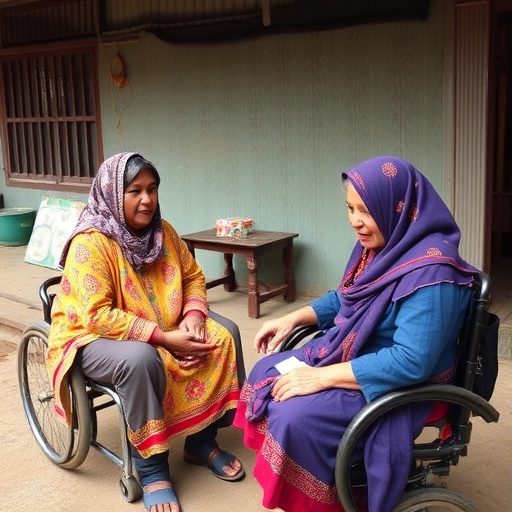
In a groundbreaking study poised to reshape the understanding of rural aging populations, researchers have employed advanced machine learning techniques to analyze empowerment among disabled elderly individuals in Henan Province, China. This work leverages the random forest algorithm, a powerful tool in data science, to uncover nuanced insights into the factors contributing to the empowerment of a demographic often marginalized in public health discourse. The innovative approach combines traditional survey methods with cutting-edge computational analysis, offering a multidimensional perspective on how disability intersects with age and geography in rural settings.
The study’s focus on Henan Province, an area with a significant rural population and substantial elderly demographic, underscores the urgency of addressing empowerment disparities amid rapid social and economic changes. Empowerment, in this context, encompasses not only physical and social autonomy but also psychological well-being and access to resources. By applying the random forest algorithm, the researchers could systematically identify and prioritize the determinants that most profoundly affect empowerment among disabled older adults, filtering through vast arrays of variables to isolate key influences with high predictive accuracy.
Random forest, a machine learning method known for its robustness and ability to handle complex, nonlinear relationships in data, was particularly well-suited for this research. Its ensemble nature—aggregating the predictions of multiple decision trees—allows it to manage heterogeneity within the population and variable interdependencies that traditional statistical methods might overlook. This methodological innovation marks a departure from more conventional analyses that often rely on linear regression or simpler classification techniques, thus enriching the toolkit available to gerontological and social researchers alike.
The survey component integrated with the random forest analysis entailed extensive data collection across diverse rural communities within Henan. Researchers gathered detailed information on socioeconomic status, health conditions, social support networks, access to healthcare and rehabilitation services, and psychological factors. This comprehensive dataset reflects the multifactorial nature of empowerment, acknowledging that the state of being empowered or disempowered is rarely attributable to a singular cause but to a confluence of interrelated variables.
One of the study’s key revelations pertains to the centrality of social connectedness in empowering disabled older adults. Rather than purely material conditions, the data suggests that robust social support networks—comprising family, neighbors, and community organizations—serve as critical buffers against isolation and helplessness. This insight resonates with broader gerontological research emphasizing the psychosocial dimensions of aging, yet it gains additional specificity and quantification through the machine learning approach that ranks these factors alongside others in predictive models.
Health status naturally emerged as a significant determinant, with physical and cognitive impairments exerting varying degrees of influence on empowerment outcomes. Interestingly, the analysis delineated subtle gradients of disability impact, revealing that not all impairments diminish empowerment uniformly. Some types of physical disabilities were mitigated more effectively through personal coping strategies and community resources than certain cognitive declines, which tend to more severely constrain autonomy and participation.
Economic factors, while undeniably important, displayed a more complex relationship with empowerment, mediated by local economic infrastructure and policy environments. The model identified that pockets within Henan where targeted social welfare programs and accessible health services were consistently available saw higher empowerment scores among disabled elders. This finding advocates for regionally tailored policymaking, as blanket economic interventions may fail to address nuanced local needs effectively.
The use of random forest also illuminated interactions among predictors that conventional analyses might obscure. For instance, the combined effect of poor health and limited social networks on disempowerment was found to be synergistic rather than additive, suggesting compounding vulnerabilities. Such findings emphasize the necessity for integrated intervention strategies that concurrently address multiple dimensions, rather than targeting isolated risk factors.
Importantly, the study contributes to the broader discourse on aging in developing and transition societies, where rural populations often confront infrastructural neglect and systemic inequities. The methodologies and findings from Henan Province have implications extending beyond regional borders. As many countries grapple with aging demographics combined with disability burdens, the model provides a framework for predicting empowerment outcomes and prioritizing intervention foci.
Moreover, adapting machine learning approaches like random forest for sociomedical research heralds a shift toward precision public health, where interventions can be better tailored to individual and community profiles. This study stands as a testament to the potential of computational tools to enhance the granularity and actionability of public health data. It sets a benchmark for future studies aiming to disentangle complex social phenomena through advanced analytics.
The ethical implications of applying artificial intelligence and machine learning in vulnerable populations are also noteworthy. The research team maintained rigorous standards for informed consent and data privacy, underscoring that technological innovation in health sciences must be accompanied by a commitment to ethical stewardship. The transparency in methodology and openness of data further strengthen the study’s credibility and reproducibility.
In conclusion, this pioneering research integrates sophisticated machine learning algorithms with robust survey data to redefine empowerment among disabled older adults in rural Henan Province. Its findings deliver actionable intelligence for policymakers, healthcare providers, and community leaders striving to enhance quality of life and autonomy for a demographic that often exists at the margins of societal support. As the global population ages, such interdisciplinary and technologically advanced studies will be crucial to crafting effective, empathetic, and sustainable aging strategies.
This advancement not only enriches scientific understanding but also carries the potential to inspire viral engagement and advocacy through compelling narratives about empowerment, resilience, and the transformative power of data-driven insights. By highlighting the convergence of gerontology, rural studies, and artificial intelligence, the study captures a zeitgeist of modern scientific inquiry poised at the intersection of human dignity and technological progress.
Cite Scienmag News
Blake Davidson. (March 18, 2026). Empowering Disabled Elders in Rural Henan via AI. Scienmag. https://scienmag.com/empowering-disabled-elders-in-rural-henan-via-ai/
Blake Davidson. "Empowering Disabled Elders in Rural Henan via AI." Scienmag, 18 March 2026, https://scienmag.com/empowering-disabled-elders-in-rural-henan-via-ai/. Accessed 4 September 2026.
Blake Davidson. "Empowering Disabled Elders in Rural Henan via AI." Scienmag. March 18, 2026. https://scienmag.com/empowering-disabled-elders-in-rural-henan-via-ai/


