


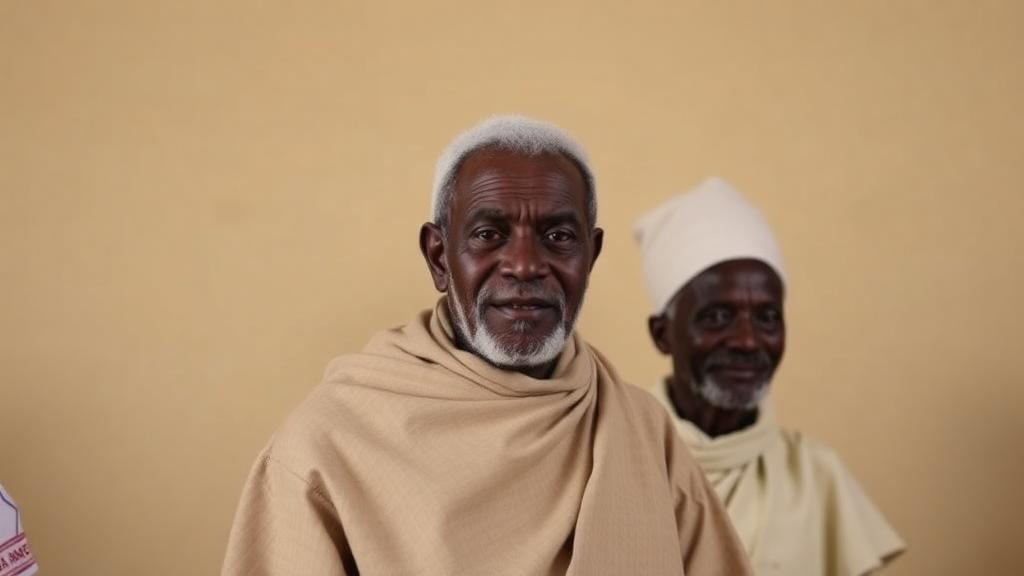
In the highland city of Dessie, in Ethiopia’s South Wollo zone, a quiet diplomatic institution has been working for generations without statutes, courtrooms, or official badges. It is called Shimglina, an elder-led mediation system rooted in Amharic customary practice, and according to a new qualitative study published in SN Social Sciences, it may be one of the most effective tools for defusing interreligious tension in a country battered by what researchers now call a poly-crisis: the simultaneous compounding of political instability, armed conflict, economic hardship, and social fragmentation. The study, conducted by Tinsae Ashagrie Dagnew, Sisay Sahile Beyene, and Bekele Melese Eshete of the University of Gondar, argues that this indigenous mechanism not only complements formal state institutions but, in the eyes of many residents, outperforms them.
The research team set out to answer a question that has received surprisingly little scholarly attention: how do indigenous conflict-management systems operate when the state around them is weakened by overlapping crises? Most existing literature on Ethiopian conflict resolution has centered on state-led mechanisms, courts, and formal peace processes. Yet in Dessie, a city where Muslim and Christian communities have long lived side by side, tensions that might otherwise escalate into open confrontation are frequently channeled through councils of respected elders. The researchers wanted to understand how this works in practice, why it commands trust, and what threatens its future.
Methodologically, the study relied on qualitative approaches. The authors conducted key informant interviews and focus group discussions with a total of 32 participants who had direct, lived experience of interreligious tensions and of Shimglina mediation practices. Participants were selected purposively, meaning the researchers deliberately sought out individuals whose positions gave them relevant knowledge: elders who mediate, community members who have brought disputes to them, and others embedded in the social fabric of the city. The study received ethical approval from the Institutional Research Ethics Review Committee at Debre Tabor University, and informed consent was obtained from all participants, all of whom were adults, with anonymity and confidentiality maintained throughout the research process.
To interpret what they heard, the researchers drew on three complementary theoretical lenses. Social capital theory, most closely associated with the work of Robert Putnam, helped explain how Shimglina generates two distinct but interlocking forms of trust. Bonding capital refers to the dense networks of reciprocity within a single community, while bridging capital describes the connections that span social and religious divides. Shimglina, the study finds, produces both: it consolidates solidarity within neighborhoods and, crucially, builds relationships of trust across the Muslim-Christian boundary that defines much of Dessie’s interreligious landscape.
The second lens, functionalist theory, situates Shimglina as a stabilizing force that sustains social order. From this perspective, the institution persists because it performs functions that society needs: it absorbs disputes before they harden into feuds, provides a legitimate arena for grievance, and reaffirms shared norms. The third framework, conflict transformation theory associated with peace-building scholars such as John Paul Lederach, goes further. It highlights that Shimglina does not merely resolve individual disputes; it works to reshape the fractured relationships underneath them, promoting reconciliation rather than simply closing cases. Where a court might issue a verdict that leaves one party resentful, an elder-led process aims to restore the social bond itself.
Finally, the authors frame the entire analysis through the concept of poly-crisis, a term gaining traction in global sustainability and political research to describe situations in which multiple crises interact and amplify one another. Ethiopia’s recent history offers a stark example: political instability and armed conflict have strained governance, economic hardship has sharpened competition over scarce resources, and social fragmentation has eroded the informal trust that once buffered communities against shocks. In such an environment, formal institutions often lose legitimacy and reach precisely when they are needed most. The poly-crisis lens, the authors argue, explains why a grassroots mechanism like Shimglina becomes not a relic but a lifeline.
The findings are striking in their consistency. Participants reported that they trusted Shimglina more than formal courts, a judgment rooted in accessibility, cultural fluency, and the perceived fairness of elder deliberation. Court proceedings are costly, slow, and adversarial; Shimglina is local, conversational, and oriented toward restoring coexistence. Perhaps most significantly, the study found that Shimglina actively depoliticizes and dereligionizes conflicts. Disputes that could be framed as Muslim-versus-Christian, or as proxies for national political struggles, are instead reframed as neighborhood problems between people who share markets, streets, and kinship ties. By stripping away the inflammatory labels, elders remove the fuel that turns a quarrel into a communal rupture.
The mechanisms through which this happens are both procedural and symbolic. The study describes dialogue, ritual practices, and the mobilization of collective wisdom as the core instruments of the system. Elders convene the parties, listen, invoke shared moral norms, and guide participants toward settlement and reconciliation. Rituals mark the restoration of relationships, giving disputes a socially recognized endpoint rather than a lingering legal residue. This human-centered, culturally grounded approach, the authors write, is what allows Shimglina to strengthen social cohesion in ways that formal adjudication rarely achieves. Its resilience, they suggest, lies in these deep cultural roots, which predate the modern Ethiopian state and have survived successive political orders.
Yet the study is candid about the pressures on the institution. Political interference threatens the neutrality that gives elders their authority; when actors with partisan agendas seek to co-opt mediation, the system’s legitimacy is at risk. Generational shifts are eroding deference to elder authority, as younger Ethiopians, shaped by different education and media environments, question whether customary councils should hold sway. Women’s voices remain underrepresented in a system dominated by male elders, limiting its inclusiveness. Religious extremism poses a direct ideological challenge to the syncretic, accommodationist ethos of Shimglina, and the absence of formal legal recognition leaves the institution operating in a gray zone, without institutional protection or resources.
The authors conclude that Shimglina is a culturally grounded, adaptive, and human-centered peace-building mechanism whose sustainability depends on addressing generational change, gender inclusion, and political neutrality. By situating the institution within Ethiopia’s poly-crisis, the study makes a broader contribution: it demonstrates that indigenous mediation systems are not museum pieces but living governance technologies, capable of conflict transformation and social resilience under conditions that overwhelm formal institutions. For scholars of peace and conflict studies, and for policymakers searching for hybrid models of peace governance, the message from Dessie is that some of the most effective instruments of stability may be the oldest ones, provided they are given the recognition and support to adapt without losing what makes them trusted in the first place.
Subject of Research: Indigenous elder-led mediation (Shimglina) and interreligious conflict management in South Wollo, Ethiopia
Article Title: Poly-crisis and interreligious tension management: the role of Shimglina in Southern Wollo, Ethiopia
Article References: Dagnew, T. A., Beyene, S. S., & Eshete, B. M. (2026). Poly-crisis and interreligious tension management: the role of Shimglina in Southern Wollo, Ethiopia. SN Social Sciences, 6(10), Article 537. https://doi.org/10.1007/s43545-026-01852-4
Image Credits: AI Generated
DOI: 10.1007/s43545-026-01852-4
Keywords: Shimglina, indigenous mediation, interreligious tension, Ethiopia, South Wollo, Dessie, poly-crisis, social capital, conflict transformation, peace-building, social cohesion, qualitative research
Cite Scienmag News
Courtney Benton. (October 13, 2026). Elders, Not Courts: How Ethiopia’s Shimglina Tradition Holds Peace Amid Crisis. Scienmag. https://scienmag.com/elders-not-courts-how-ethiopias-shimglina-tradition-holds-peace-amid-crisis/
Courtney Benton. "Elders, Not Courts: How Ethiopia’s Shimglina Tradition Holds Peace Amid Crisis." Scienmag, 13 October 2026, https://scienmag.com/elders-not-courts-how-ethiopias-shimglina-tradition-holds-peace-amid-crisis/. Accessed 13 October 2026.
Courtney Benton. "Elders, Not Courts: How Ethiopia’s Shimglina Tradition Holds Peace Amid Crisis." Scienmag. October 13, 2026. https://scienmag.com/elders-not-courts-how-ethiopias-shimglina-tradition-holds-peace-amid-crisis/


