


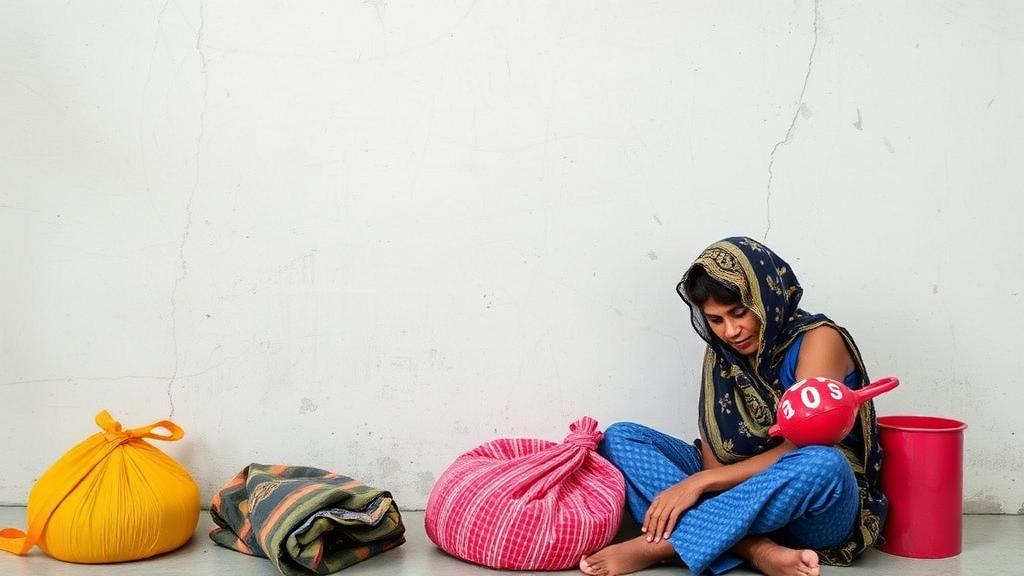
Domestic workers sweep, cook, and care for millions of Indian households, yet when statisticians try to measure the quality of their working lives, they find almost nothing designed for them. A new study published in SN Social Sciences by Griva Raval and Nausheen Nizami of Pandit Deendayal Energy University in Gandhinagar, Gujarat, tackles that blind spot head-on. The researchers built an exploratory Decent Work Index specifically for domestic workers in India, then used it to map how decent work is actually distributed across this vast and largely invisible workforce. Their results, drawn from 524 workers in three urban districts of Gujarat, paint a layered picture of vulnerability in which economic protection and employment security do not always travel together.
The starting point for the study is the International Labour Organization’s Decent Work Agenda, which for more than two decades has framed the global conversation about what makes a job fair, safe, and dignified. Since the ILO first articulated the concept in 1999, researchers have proposed families of decent work indicators and indexes, including landmark statistical work published in the International Labour Review in 2003. But those instruments were designed for formal economies and aggregate national statistics. India’s domestic workers, who number in the millions according to government registrations on the e-Shram portal, sit squarely in the informal economy, working inside private homes behind closed doors, often without contracts, fixed hours, or any institutional representation. No grounded, context-specific tool existed to capture what decent work means for them, which is the gap the new study set out to close.
Reaching the population at all required a carefully engineered sampling strategy. Domestic workers are a classic hard-to-reach group: they are dispersed across thousands of private households, many are women managing care responsibilities of their own, and some are migrants with precarious legal and social standing. The researchers therefore used a multistage design combining purposive and snowball sampling, in which initial contacts introduced the team to further participants through community networks. This approach, long established in social research on hidden populations, trades statistical randomness for access, and the authors acknowledge the exploratory character of the resulting instrument. Data were collected through a structured questionnaire, and the study received ethical approval from the researchers’ institution, with informed consent obtained verbally in the local language and all data anonymised.
The construction of the index followed a sequential exploratory methodology rooted in psychometrics. The team began with a broad pool of indicators reflecting the dimensions of decent work most salient to domestic employment, then used Exploratory Factor Analysis to discover which items actually cohered in workers’ lived experience. Two classic diagnostics confirmed the data were fit for the exercise: the Kaiser-Meyer-Olkin measure of sampling adequacy came in at 0.731, comfortably above the conventional threshold, and Bartlett’s Test of Sphericity was highly significant, with a chi-square value of 906.600 and a p-value below .001, indicating the correlation matrix contained genuine structure rather than noise. The extraction used Principal Axis Factoring with Direct Oblimin rotation, a combination chosen because it makes no assumption of orthogonality between underlying dimensions, an appropriate choice when aspects of job quality plausibly overlap.
The analysis retained seven indicators that grouped into three factors, and these factors give the index its architecture. The first, Working Time and Economic Protection, captures whether workers can rely on predictable hours and some cushion against economic shocks. The second, Employment Security, concerns the stability and continuity of the employment relationship itself. The third, Compensation and Work Autonomy, combines the adequacy of pay with the degree of control workers exercise over their own labour. Reliability of the emerging scale fell within an acceptable range for early-stage instrument development, which the authors present as sufficient for an exploratory tool rather than a finalised psychometric product. Factor scores were then combined to produce a single Decent Work Index score for each worker.
With the index in hand, the researchers turned to cluster analysis to see whether decent work arrives in bundles or in fragments. The answer was fragments. Three distinct groups emerged. One cluster experienced relatively decent work across the dimensions. A second, larger in implication if not in size, was economically protected but employment-insecure: these workers had some financial cushioning yet lived with the constant possibility of losing their positions, a precariousness familiar to anyone employed at the discretion of individual households. The third group was highly vulnerable across the board. A one-way analysis of variance confirmed that the differences in index scores between the clusters were statistically significant, with p below .001, meaning the grouping reflects real variation in working conditions rather than sampling artefacts.
Perhaps the most sobering finding came from the regression analysis. The researchers tested whether monthly payment level, social group, age, education, or migrant status predicted a worker’s index score, and none of these associations reached statistical significance. In other words, the conventional demographic markers that policy often uses to target support did not cleanly explain who experienced decent work and who did not. Vulnerability, on this evidence, is layered and socially patterned in ways that cut across simple categories, echoing scholarship that has long described domestic work in India as a confluence of gender, class, and caste hierarchies. The finding cautions against assuming that better-paid or more educated domestic workers are necessarily more secure, or that any single axis of disadvantage tells the whole story.
The study situates itself within a growing empirical literature on decent work deficits in India’s informal economy, from early case studies of Surat to more recent evaluations of decent work indexes for informal workers in West Bengal. It also connects to international efforts, including the ILO’s Domestic Workers Convention No. 189 of 2011, which established that domestic work deserves the same labour protections as other forms of employment, and to India’s own recent consolidation of its four labour codes. What distinguishes the new contribution is its grounding: rather than importing a framework built for factories or offices, the index distils its dimensions from the responses of domestic workers themselves, using factor analysis as a disciplined way of listening.
The practical ambitions of the tool are explicit. The authors propose the index as a basis for monitoring inequalities among domestic workers and for guiding policies that advance Sustainable Development Goal 8 on decent work and Goal 10 on reduced inequalities. Because the index separates economic protection from employment security and from compensation and autonomy, it can show policymakers precisely which dimension is failing for which group of workers, rather than collapsing everything into a single average. A household worker might have adequate pay but no protection against arbitrary dismissal; another might have steady employment but earnings too thin to absorb a single emergency. Diagnoses of that granularity are what targeted interventions require.
The authors are careful about the limits of what they have built. The sample comes from three urban districts of a single Indian state, gathered through snowball methods that cannot claim national representativeness, and the reliability figures, while acceptable, reflect an instrument in its infancy. The index is offered as exploratory, a first grounded measurement of decent work for a workforce that has spent decades on the wrong side of the statistical ledger. Even so, the study’s central message travels well beyond Gujarat. If decent work for domestic workers is fragmented and patterned in ways that standard demographic variables fail to predict, then measuring it properly, dimension by dimension, is not an academic luxury but a precondition for making one of the world’s largest informal workforces visible, protected, and fairly treated.
Subject of Research: Development of an exploratory Decent Work Index measuring job quality among domestic workers in India's informal economy
Article Title: An exploratory decent work index for domestic workers in India
Article References: An exploratory decent work index for domestic workers in India. (n.d.). https://doi.org/10.1007/s43545-026-01845-3
Image Credits: AI Generated
DOI: 10.1007/s43545-026-01845-3
Keywords: decent work index, domestic workers, informal employment, exploratory factor analysis, labour vulnerability, India, Gujarat, International Labour Organization, employment security, Sustainable Development Goals, social indicators, cluster analysis
Cite Scienmag News
Courtney Benton. (October 13, 2026). New Index Reveals How Decent Work Eludes India’s Domestic Workers. Scienmag. https://scienmag.com/new-index-reveals-how-decent-work-eludes-indias-domestic-workers/
Courtney Benton. "New Index Reveals How Decent Work Eludes India’s Domestic Workers." Scienmag, 13 October 2026, https://scienmag.com/new-index-reveals-how-decent-work-eludes-indias-domestic-workers/. Accessed 13 October 2026.
Courtney Benton. "New Index Reveals How Decent Work Eludes India’s Domestic Workers." Scienmag. October 13, 2026. https://scienmag.com/new-index-reveals-how-decent-work-eludes-indias-domestic-workers/


