


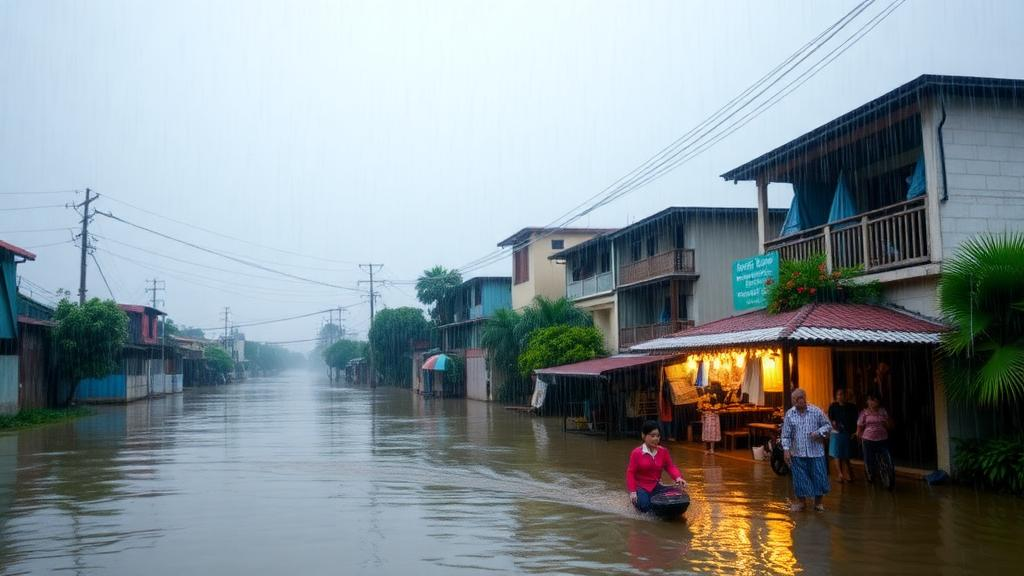
In the low-lying labyrinth of rivers, rice paddies and rapidly growing cities that make up Vietnam’s Mekong Delta, rain does not fall evenly, and it certainly does not change evenly. A new study published in Theoretical and Applied Climatology has dissected more than four decades of daily rainfall records from the northeastern corner of the delta and uncovered a strikingly divided picture: a coastal station losing significant amounts of annual rainfall, an inland urban station gaining it, and the fingerprint of the El Niño–Southern Oscillation emerging only after the raw data are carefully untangled. The findings carry real weight for a delta that is already contending with subsiding land, rising seas and mounting flood risk.
The research team, led by Vu Duy Vinh of the Institute of Oceanography in Vietnam together with Sylvain Ouillon of the University of Toulouse and colleagues, examined daily observations from four weather stations representing four very different settings: a coastal site (VT), a lower-delta station (VK), an estuarine location, and an inland urban station (TSH). All four records were compared over the common period 1983 to 2024, giving the analysis a robust forty-year window. The choice of stations was deliberate. In a delta where the coastline, the river network and the urban sprawl of Ho Chi Minh City all lie within a few hundred kilometres, averaging rainfall across the region would blur exactly the contrasts the scientists wanted to expose.
The first thing the records confirm is how sharply seasonal rainfall is in this part of the world. Between 75 and 85 percent of the annual total arrives during the wet season, driven by the monsoon circulation that dominates Southeast Asian climate. The stations also reveal a clear climatological gradient running from the coast inland, with rainfall amounts and behaviour shifting systematically as one moves away from the sea. That gradient matters, because it means the same large-scale climate driver can push different parts of the delta in different directions, and the new study shows that this is precisely what has been happening over the past four decades.
The most dramatic divergence appears between the coastal station and the urban one. At VT, on the coast, annual rainfall has decreased significantly since 1983. Crucially, the decline is not the result of individual storms becoming weaker; instead, it stems primarily from fewer rainfall events during the core of the monsoon season. In other words, the coast is drying not because its downpours have softened but because the rainy days themselves are becoming scarcer when it matters most. Meanwhile, just inland at VK, the lower-delta station shows no significant long-term trend at all, a reminder that even neighbouring environments in a delta can respond to climate forcing in entirely different ways.
The urban station tells the opposite story. At TSH, rainfall has been increasing, but the mechanism is different from what many might expect. The rise is driven by more frequent wet days and higher accumulated rainfall over the season, rather than by stronger peak daily precipitation. This distinction is more than academic. Urban flooding often depends on the intensity of the heaviest bursts of rain, but the total volume of water falling across a season determines how saturated ground and drainage systems become. An urban environment collecting more rain more often, without dramatic single-day extremes, faces a chronic, cumulative kind of water management challenge rather than a purely acute one.
Untangling the role of the El Niño–Southern Oscillation proved to be the study’s most technically demanding task. ENSO, the periodic warming and cooling of the tropical Pacific that reshapes weather patterns worldwide, is known to influence rainfall across Southeast Asia. Yet when the researchers directly correlated standard ENSO indices with the original rainfall measurements, the relationships were weak, with correlation coefficients below 0.2 in absolute value. On the face of it, the mighty Pacific oscillator seemed barely to register in the delta’s rain gauges.
The resolution came from a sophisticated signal-processing technique called Complete Ensemble Empirical Mode Decomposition with Adaptive Noise, or CEEMDAN. Rather than treating a rainfall record as a single undifferentiated series, CEEMDAN breaks it down into components operating on different timescales, separating short-lived fluctuations from interannual rhythms and longer-term trends. When the researchers isolated the component of the rainfall data corresponding to the ENSO frequency band and compared it with ENSO indices, the associations strengthened considerably, reaching correlations of roughly 0.3 to 0.6. The lesson is an important one for climate science: ENSO’s influence was there all along, but it was masked in the raw data by higher-frequency noise and by longer-term variability layered on top of it.
The decomposition also revealed which aspects of rainfall respond most strongly to ENSO. Rainfall frequency, the persistence of wet spells, and accumulated seasonal rainfall all showed the clearest ENSO-related relationships, while peak daily precipitation remained only weakly tied to the oscillator. This pattern fits the physical picture of how ENSO operates in the region: by shifting large-scale circulation and moisture supply over the western Pacific and Southeast Asia, El Niño and La Niña episodes tend to modulate how often and how persistently rain falls over a season, rather than dictating the intensity of any single storm. For forecasters and water managers, that means ENSO state offers a useful, if imperfect, seasonal clue about whether a wet season will be generous or stingy in total volume, even when it says little about the worst individual downpours.
The broader significance of the study lies in what it says about how long-term climate change and natural interannual variability interact. The authors conclude that long-term rainfall change and ENSO variability jointly shape rainfall extremes in the northeastern delta, and that the two forces cannot be cleanly separated in the raw observations. A coastal zone losing monsoon rain days while an inland city gains wet days is not a contradiction; it is evidence that regional responses to global forcing are filtered through local geography, land use and position relative to the sea breeze, the river plume and the urban heat island. Any flood-risk assessment for the delta that treats the region as a single unit risks getting the answer wrong in both directions, underestimating drying pressure on the coast and underestimating accumulating water loads in the city.
For the millions of people who live and farm in the Mekong Delta, the stakes could hardly be higher. The region is already identified as one of the world’s most vulnerable delta systems, with groundwater extraction driving land subsidence and sea-level rise pushing saltwater ever further inland. Rainfall that arrives less reliably on the coast, and more abundantly over expanding urban areas, adds another layer of complexity to an already precarious water balance. The study’s methodological message may prove as influential as its regional findings: by applying CEEMDAN to separate the timescales embedded in climate records, scientists can recover signals that conventional correlation analysis misses. As climate records lengthen and the need for precise, location-specific adaptation planning grows, that approach is likely to find eager users far beyond the Mekong’s embankments.
Subject of Research: ENSO modulation of extreme rainfall and contrasting coastal and urban rainfall trends in the northeastern Mekong Delta, Vietnam
Article Title: ENSO modulation of extreme rainfall and contrasting coastal–urban trends in the northeastern Mekong Delta
Article References: Vinh, V. D., Ouillon, S., Hai, N. M., Minh, P. T., Van Anh, V. T., & Thinh, N. D. (2026). ENSO modulation of extreme rainfall and contrasting coastal–urban trends in the northeastern Mekong Delta. Theoretical and Applied Climatology, 157(10), Article 674. https://doi.org/10.1007/s00704-026-06611-2
Image Credits: AI Generated
DOI: 10.1007/s00704-026-06611-2
Keywords: ENSO, Mekong Delta, extreme rainfall, monsoon, CEEMDAN, coastal rainfall, urban flooding, Vietnam, climate variability, rainfall trends, flood risk, Theoretical and Applied Climatology
Cite Scienmag News
Violet Maxwell. (October 1, 2026). El Niño’s Hidden Fingerprint: Coastal Rainfall Fades While Cities Soak in Vietnam’s Mekong Delta. Scienmag. https://scienmag.com/el-ninos-hidden-fingerprint-coastal-rainfall-fades-while-cities-soak-in-vietnams-mekong-delta/
Violet Maxwell. "El Niño’s Hidden Fingerprint: Coastal Rainfall Fades While Cities Soak in Vietnam’s Mekong Delta." Scienmag, 1 October 2026, https://scienmag.com/el-ninos-hidden-fingerprint-coastal-rainfall-fades-while-cities-soak-in-vietnams-mekong-delta/. Accessed 5 October 2026.
Violet Maxwell. "El Niño’s Hidden Fingerprint: Coastal Rainfall Fades While Cities Soak in Vietnam’s Mekong Delta." Scienmag. October 1, 2026. https://scienmag.com/el-ninos-hidden-fingerprint-coastal-rainfall-fades-while-cities-soak-in-vietnams-mekong-delta/


