


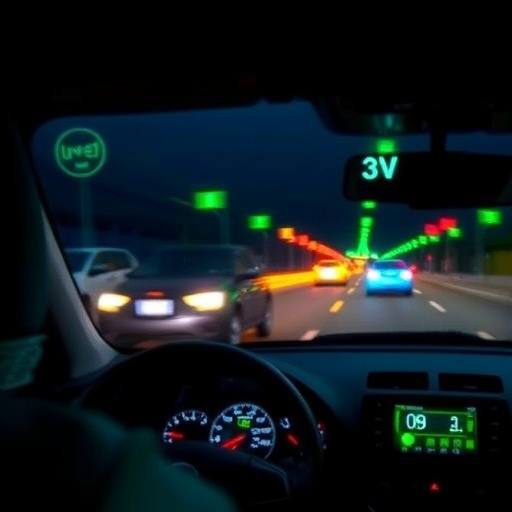
In bustling urban centers across the United States, the frustration of drivers enduring seemingly endless red lights is a familiar scene. Yet, the implications go far beyond mere impatience. Recent research led by scientists at the Massachusetts Institute of Technology uncovers that prolonged idling at signalized intersections may contribute up to 15 percent of the carbon dioxide emissions attributed to land transportation in the U.S. This revelation propels inquiries into how enhancing driving behavior at intersections could simultaneously ease commuter stress and deliver significant environmental benefits.
The study introduces the potent concept of eco-driving — a set of vehicle-based traffic control strategies designed to optimize driving patterns dynamically. By modulating speed to minimize stop-and-go instances and reduce excessive acceleration or deceleration, eco-driving promises reduced fuel consumption and lower emissions without disrupting traffic flow or compromising safety. Central to this research is the application of deep reinforcement learning (DRL), an advanced form of artificial intelligence that autonomously learns optimal driving policies by interacting with highly detailed simulators mimicking real-world traffic conditions.
To tackle the complexity of urban transportation emissions, the MIT team conducted an unprecedented large-scale computational experiment centered on three major American cities: Atlanta, San Francisco, and Los Angeles. These metropolitan areas were digitally reconstructed using data amassed from resources like OpenStreetMap and U.S. geological surveys, enabling the replication of over 6,000 signalized intersections. This intricate virtual environment allowed the researchers to run more than a million unique traffic scenarios, each reflecting a careful combination of underlying factors influencing emissions.
The researchers identified 33 critical variables affecting vehicle emissions, ranging from environmental elements such as temperature and road slope to infrastructural details, including intersection design and signal timing, as well as human factors like driver behavior and vehicle age. This comprehensive factor selection ensured that the simulations remained grounded in the multifaceted reality of urban driving, avoiding oversimplifications that could obscure crucial dynamics.
Through the lens of reinforcement learning, vehicles were essentially equipped with decision-making agents tasked with learning energy-efficient driving strategies. These agents receive continuous feedback, encouraging maneuvers that conserved fuel and penalizing those that wasted energy. The complexity of intersection traffic was addressed by framing the problem as a decentralized multi-agent cooperative control system. Each vehicle independently optimizes its behavior based on local information, cooperating implicitly to improve collective emissions outcomes, without necessitating costly or fragile inter-vehicle communications.
Developing models that generalized well across diverse traffic conditions posed a unique challenge. The team discovered that clustering intersections based on shared characteristics — such as the number of traffic lanes or signal phases — significantly enhanced learning efficiency and effectiveness. Separate reinforcement models were trained for each cluster, yielding improved emission reductions compared to a one-size-fits-all approach.
Given the vast computational demands of simulating entire city-wide traffic networks, the researchers innovatively decomposed the problem to focus on optimizing eco-driving policies at the level of individual intersections. This strategic simplification maintained high fidelity in the analysis by carefully mitigating the influence of local controls on neighboring intersections, avoiding complex network effects that could confound results.
Findings from the study are encouraging: complete adoption of eco-driving practices across all vehicles could lead to carbon emissions reductions at intersections between 11 and 22 percent, varying based on urban layout and traffic characteristics. Denser cities like San Francisco, constrained by tighter street grids, exhibited more modest benefits, while cities like Atlanta, with wider roads and higher speed limits, showed greater emission savings.
Intriguingly, significant benefits also emerge even with partial adoption. Simulation results indicated that if just 10 percent of vehicles employ eco-driving technologies, a city could realize 25 to 50 percent of the full emission reduction potential. This disproportionate impact arises from car-following dynamics, where non-eco-driving vehicles adjust their speed in proximity to eco-driving vehicles, indirectly inheriting smoother driving patterns and subsequently burning less fuel.
Beyond environmental gains, the research observed potential improvements in traffic throughput. By reducing unnecessary stops and smoothing vehicle flows, intersections may accommodate more vehicles per unit time, although the researchers caution that increased capacity could incentivize additional driving, potentially dampening net emission reductions.
Safety considerations remain paramount. Analysis employing surrogate safety metrics like time to collision suggested that eco-driving is as safe as traditional driving from a quantitative standpoint. However, the introduction of eco-driving behaviors could provoke unforeseen human driver reactions, warranting further study to ensure that advancements do not introduce new risks.
Importantly, the eco-driving approach dovetails effectively with other decarbonization strategies in transportation. For example, combining 20 percent eco-driving adoption with ongoing transitions to hybrid and electric vehicles in cities like San Francisco could nearly triple emission reductions compared to eco-driving alone, underscoring the value of integrated, multi-pronged policies.
A compelling aspect of eco-driving’s appeal lies in its relative accessibility. Since most drivers already have smartphones and many vehicles come equipped with increasingly sophisticated automation capabilities, implementing eco-driving interventions can be fast-tracked without massive infrastructural overhauls. Whether delivered through dashboard guidance or direct vehicle-to-infrastructure communications enabling semi-autonomous control, eco-driving represents a shovel-ready solution for reducing urban carbon footprints.
As discussions of climate action intensify, technologies that fuse advanced machine learning with practical transportation engineering offer promising avenues for immediate impact. The MIT study exemplifies how interdisciplinary approaches—blending civil engineering, data science, and AI—can generate actionable insights to mitigate climate change effects while aligning with evolving automotive technologies and urban mobility needs. With further research and thoughtful deployment, eco-driving could become a cornerstone in the multifaceted mission to build sustainable, livable cities.
Cite Scienmag News
Russell Cooper. (August 7, 2025). Eco-Driving Strategies Poised to Dramatically Cut Vehicle Emissions. Scienmag. https://scienmag.com/eco-driving-strategies-poised-to-dramatically-cut-vehicle-emissions/
Russell Cooper. "Eco-Driving Strategies Poised to Dramatically Cut Vehicle Emissions." Scienmag, 7 August 2025, https://scienmag.com/eco-driving-strategies-poised-to-dramatically-cut-vehicle-emissions/. Accessed 4 September 2026.
Russell Cooper. "Eco-Driving Strategies Poised to Dramatically Cut Vehicle Emissions." Scienmag. August 7, 2025. https://scienmag.com/eco-driving-strategies-poised-to-dramatically-cut-vehicle-emissions/


