


Published today in the Alcheringa: An Australasian Journal of Palaeontology, evidence of an ‘Age of Monotremes’ has been unearthed by a team of Australian scientists at the Australian Museum (AM), Museums Victoria and Australian Opal Centre.

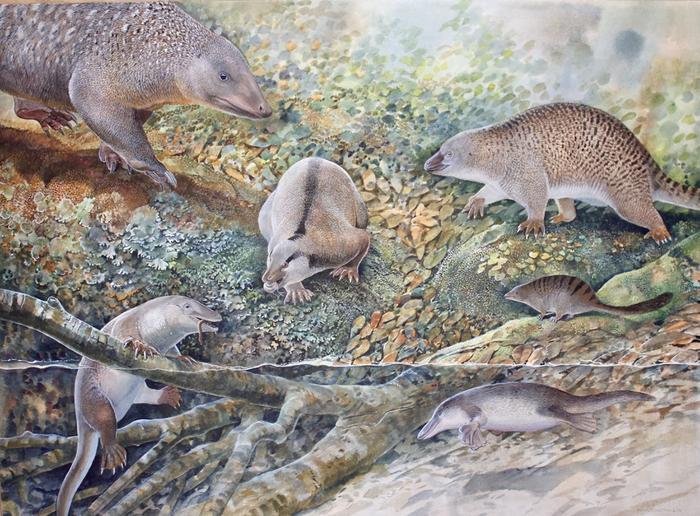
Credit: Illustration by Peter Shouten
Published today in the Alcheringa: An Australasian Journal of Palaeontology, evidence of an ‘Age of Monotremes’ has been unearthed by a team of Australian scientists at the Australian Museum (AM), Museums Victoria and Australian Opal Centre.
The findings were led by two renowned mammalogists, Honorary Associate of the Australian Museum, Professor Tim Flannery; and Professor Kris Helgen, Chief Scientist and Director of the Australian Museum Research Institute (AMRI).
Found in the Lightning Ridge opal fields, NSW, the opalised jaws date back to the Cenomanian Age of the Cretaceous Period, between 102 million to 96.6 million years ago.
Professor Flannery said the research reveals that 100 million years ago, Australia was home to a diversity of monotremes, of which the platypus and the echidna are the only surviving descendants.
“Today, Australia is known as a land of marsupials, but discovering these new fossils is the first indication that Australia was previously home to a diversity of monotremes. It’s like discovering a whole new civilisation,” Professor Flannery said.
Chief Scientist and Director of the Australian Museum Research Institute, Professor Kris Helgen, said the three new species demonstrate combinations of features not previously seen before in other living or fossil monotremes. One of the most striking of the new monotremes, Opalios splendens, retains characteristics of the earliest known monotremes, but also some that foreshadow adaptations in the living monotremes, the echidnas and platypus.
“Opalios splendens sits on a place in the evolutionary tree prior to the evolution of the common ancestor of the monotremes we have today. Its overall anatomy is probably quite like the platypus, but with features of the jaw and snout a bit more like an echidna – you might call it an ‘echidnapus’,” Professor Helgen said.
“The story of how our egg-laying mammals evolved is ‘toothy to toothless’ on the oldest monotreme, Teinolophos trusleri, which dates back to Victoria 130 million years ago. What we see at Lightning Ridge is that by 100 million years ago, some of the monotremes still have five molars but some of them are down to three,” Professor Helgen said.
Professor Flannery highlighted that today, echidnas have no teeth, and platypuses too are essentially toothless.
“Adult platypus have no teeth, though juveniles have rudimentary molars. Just when and why adult platypus lost their teeth after nearly 100 million years is a mystery we think we have solved. It may have been competition with the Australian water rat, which arrived in Australia within the last 2 million years, which caused platypus to seek out softer, slipperier food best processed with the leathery pads that adults use today,” Professor Flannery said.
“What is so unusual about this uniquely Australian story is that in one snapshot we see six different egg-laying mammals living together in Lightning Ridge over 100 million years ago. All of them are holding potential evolutionary destinies that can go off in different directions, and all of them are deep distant ancestors and relatives of the current living monotremes.”
Dr Matthew McCurry, Curator of Palaeontology, Australian Museum, said the discovery of three new genera of monotremes helps to piece together their remarkable evolutionary story.
“There are six species of monotremes, including the three newly described here, within the Cenomanian Lightning Ridge fauna of New South Wales making it the most diverse monotreme assemblage on record. Four species are known from a single specimen, suggesting that diversity remains underrepresented. This discovery adds more than 20 per cent to the previously known diversity of monotremes,” Dr McCurry said.
“We have very few monotreme fossils, and so finding new fossils can tell us more about where they lived, what they looked like and how changes in the environment influenced their evolution. Every significant monotreme fossil currently known fits into this evolutionary story, from Teinolophos, the tiny shrew-like creature in Antarctica 130 million years ago to the present day,” Dr McCurry said.
Co-authors from Museums Victoria Research Institute, Dr Thomas Rich, Senior Curator of Vertebrate Palaeontology, and Honorary Associate Professor Patricia Vickers-Rich AO said these curious, unique and ancient Australian animals still have the power to interest the scientific world.
“The platypus and echidna are iconic Australian species. The discovery of these several new species in one small area suggest that the family tree of the egg laying monotremes is far more complicated than the living platypus and echidna alone suggest,” Dr Thomas Rich said.
“As the fieldwork continues in the Mesozoic of Australia, we continue to increase our understanding of how life changed over time. This, to me, is what makes science so exciting,” Professor Patricia Vickers-Rich AO said.
The fossils were found by Elizabeth Smith and her daughter Clytie of the Australian Opal Centre in Lightning Ridge, who have spent decades working and searching over the opal fields.
“Opal fossils are rare, but opalised monotreme fossils are infinitely more rare, as there’s one monotreme fragment to a million other pieces. We don’t know when, or exactly where, they’ll turn up,” Elizabeth Smith said.
“These specimens are a revelation. They show the world that long before Australia became the land of pouched mammals, marsupials, this was a land of furry egg-layers – monotremes. It seems that 100 million years ago, there were more monotremes at Lightning Ridge than anywhere else on earth, past or present,” Elizabeth said.
Journal
Alcheringa An Australasian Journal of Palaeontology
Article Title
A diverse assemblage of monotremes (Monotremata) from the Cenomanian Lightning Ridge fauna, New South Wales, Australia
Article Publication Date
27-May-2024
Cite Scienmag News
Violet Maxwell. (May 26, 2024). Echidnapus identified from an ‘Age of Monotremes’. Scienmag. https://scienmag.com/echidnapus-identified-from-an-age-of-monotremes/
Violet Maxwell. "Echidnapus identified from an ‘Age of Monotremes’." Scienmag, 26 May 2024, https://scienmag.com/echidnapus-identified-from-an-age-of-monotremes/. Accessed 4 September 2026.
Violet Maxwell. "Echidnapus identified from an ‘Age of Monotremes’." Scienmag. May 26, 2024. https://scienmag.com/echidnapus-identified-from-an-age-of-monotremes/

