


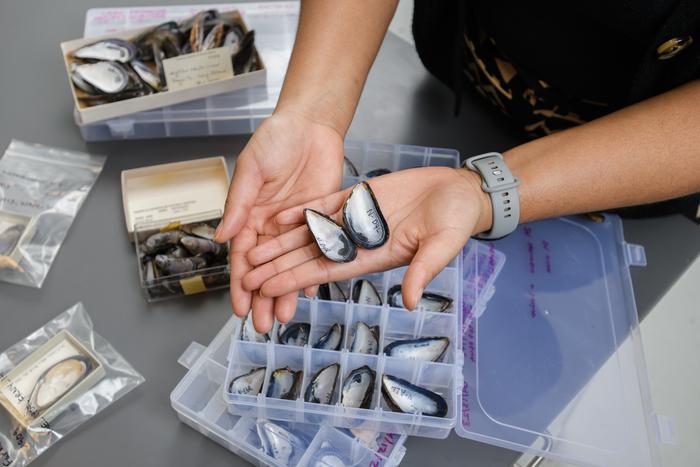
Researchers at the American Museum of Natural History have found that over the last 120 years, the porosity—or small-scale holes—in mussel shells along the East Coast of the United States has increased, potentially due to warming waters. The study, which analyzed modern mussel shells in comparison to specimens in the Museum’s historic collection, was published today in the journal PLOS ONE.

Credit: Daniel Kim/ ©AMNH
Researchers at the American Museum of Natural History have found that over the last 120 years, the porosity—or small-scale holes—in mussel shells along the East Coast of the United States has increased, potentially due to warming waters. The study, which analyzed modern mussel shells in comparison to specimens in the Museum’s historic collection, was published today in the journal PLOS ONE.
“Mussels are important on so many levels: they provide habitats on reefs, they filter water, they protect coasts during storms, and they are important commercially as well—I love mussels and I know many other people do, too,” said Leanne Melbourne, a Kathryn W. Davis postdoctoral fellow in the Museum’s Master of Arts in Teaching program and the lead author on the study. “Human-caused environmental changes are threatening the ability of mussels and other mollusks to form their shells, and we need to better understand what risks will come from this in the future.”
Previous studies on the blue, or common, mussel (Mytilus edulis) have used lab experiments to investigate how ocean warming and acidification impact the form and function of these important marine invertebrates. Melbourne drew on a historical resource—the Museum’s large bivalve collection, which dates to the late 1800s—to trace environmental changes in natural settings.
“Museum collections are ideal for showing change over long stretches of time. Organisms in natural environments have slow exposure to changing conditions, with more time to adapt and more than one stressor,” said co-author Nathalie Goodkin, a curator in the Museum’s Department of Earth and Planetary Sciences. “Laboratory experiments are great at teasing apart individual drivers, but that’s not how things work in the real world.”
Melbourne focused on shells collected in the early 1900s and the 1960s from five sites: Nahant Bay in Massachusetts, the southern end of Cape Cod, the tip of the Long Island Sound, western Long Island Sound, and New York Harbor. She then paired these historic specimens with modern samples from the same sites and conducted a series of comparisons including the thickness of the shells, their surface area and volume, and density and porosity.
The study found that shells collected today are significantly more porous than shells collected in the 1960s and more porous than shells collected at some of the sites in the early 1900s, suggesting that increases in temperature led to increases in porosity. The North Atlantic has experienced seasonal temperature increases of up to 3 degrees Celsius (5.4 degrees Fahrenheit) since 1902, but the warming has not been uniform, which may account for some of the variations in porosity in historical specimens. The influence of the North Atlantic Oscillation, a weather phenomenon that brought colder-than-expected water temperatures in the 1960s, is also a factor.
Porosity is known to affect the structural integrity of mollusk shells, making shells weaker and potentially more susceptible to damage. More work is needed to determine how temperature change, in particular, could be affecting these mussel populations.
“We know that mussel and mussel reef ecosystem services are dependent on robust shell formation. If they are forming weaker shells, they will break more easily, and we might lose these important organisms,” Melbourne said. “But we need more studies first to look at what’s happening here on a materials science level.”
ABOUT THE AMERICAN MUSEUM OF NATURAL HISTORY (AMNH)
The American Museum of Natural History, founded in 1869 with a dual mission of scientific research and science education, is one of the world’s preeminent scientific, educational, and cultural institutions. The Museum encompasses more than 40 permanent exhibition halls, galleries for temporary exhibitions, the Rose Center for Earth and Space including the Hayden Planetarium, and the Richard Gilder Center for Science, Education, and Innovation. The Museum’s scientists draw on a world-class permanent collection of more than 33 million specimens and artifacts, some of which are billions of years old, and on one of the largest natural history libraries in the world. Through its Richard Gilder Graduate School, the Museum offers two of the only free-standing, degree-granting programs of their kind at any museum in the U.S.: the Ph.D. program in Comparative Biology and the Master of Arts in Teaching (MAT) Earth Science residency program. Visit amnh.org for more information.
Journal
PLoS ONE
Method of Research
Experimental study
Subject of Research
Not applicable
Article Title
Using Museum collections to assess the impact of industrialization on mussel (Mytilus edulis) calcification
Article Publication Date
17-Apr-2024
Cite Scienmag News
Violet Maxwell. (April 17, 2024). East coast mussel shells are becoming more porous in warming waters. Scienmag. https://scienmag.com/east-coast-mussel-shells-are-becoming-more-porous-in-warming-waters/
Violet Maxwell. "East coast mussel shells are becoming more porous in warming waters." Scienmag, 17 April 2024, https://scienmag.com/east-coast-mussel-shells-are-becoming-more-porous-in-warming-waters/. Accessed 4 September 2026.
Violet Maxwell. "East coast mussel shells are becoming more porous in warming waters." Scienmag. April 17, 2024. https://scienmag.com/east-coast-mussel-shells-are-becoming-more-porous-in-warming-waters/

