


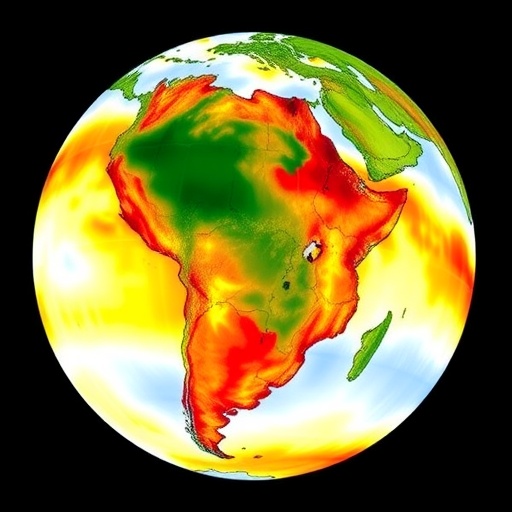
The Amazon rainforest, often hailed as the planet’s greatest reservoir of biodiversity and a critical regulator of Earth’s climate, faces an unprecedented threat from accelerating global warming and human intervention. As the largest continuous tropical forest on Earth, the Amazon not only harbors countless species of flora and fauna but also performs vital ecological functions, including carbon sequestration, that help stabilize the global climate system. Recent projections employing advanced Earth System Models indicate the looming risk of Amazon dieback, a catastrophic decline in forest productivity that could transform this lush rainforest into a savannah-like landscape over the course of the coming centuries.
Emerging from a comprehensive study published in Communications Earth & Environment, this assessment synthesizes data from the Coupled Model Intercomparison Project Phases 5 and 6 (CMIP5 and CMIP6) – the modeling frameworks underpinning the Intergovernmental Panel on Climate Change’s (IPCC) Fifth and Sixth Assessment Reports. By extending their projections far beyond the 21st century to the year 2300, researchers have identified scenarios under which the Amazon’s photosynthetic activity might decline drastically. Specifically, “dieback” is defined in this context as an 80% or greater reduction in Gross Primary Production (GPP) relative to 19th-century baselines in regions historically characterized by high productivity, under pathways of sustained high greenhouse gas emissions.
While models vary in the timing and extent of anticipated dieback, a sobering consensus emerges: the Amazon’s resilience is severely strained under a range of warming thresholds starting as low as 1.5°C above preindustrial levels. The intricate interplay between rising surface temperatures, diminished precipitation, and escalating land-use changes—particularly the conversion of forest to agricultural landscapes—creates a feedback loop that exacerbates ecological stress. Notably, the models employed may yet underestimate the severity of these risks due to gaps in representing critical tropical forest dynamics such as fire regimes and drought-induced mortality mechanisms.
At the heart of this potential ecosystem collapse is the weakening of the Atlantic Meridional Overturning Circulation (AMOC), a major ocean current that redistributes warm water from the tropics to the North Atlantic and influences climate patterns globally. Model projections suggest that a warming-induced decline in AMOC strength will shift the Intertropical Convergence Zone (ITCZ)—a key band of tropical rainfall—southward. This shift translates into hotter, drier conditions across northern Amazonia, compounding water stress. Simultaneously, elevated atmospheric carbon dioxide suppresses evapotranspiration, the process by which vegetation releases moisture, thereby weakening the forest’s own hydrological cycle and further restricting regional precipitation.
Overlaying these trends is the increasing frequency and intensity of El Niño–like climate anomalies, which episodically exacerbate heat and drought in the basin. Although previous research has explored individual aspects of warming, ocean circulation, and ecosystem responses, this study uniquely integrates multiple Earth System Models to provide a robust, mechanistic understanding of how these drivers converge toward triggering Amazon dieback.
The ecological ramifications are profound. Higher temperatures accelerate plant respiration relative to photosynthesis, undermining the carbon sink function of tropical forests. Declining soil moisture and rainfall limit nutrient transport, leading to diminished tree growth, increased mortality, and impaired regenerative capacity. Over time, these stressors push forest ecosystems beyond critical thresholds where dense, carbon-rich vegetation can no longer be sustained. This degradation risk is heightened on the basin’s periphery where land-use changes are most intense, and savannah-like vegetation could become widespread.
This research underscores the Amazon’s role as a climate tipping element—an Earth system component capable of shifting abruptly into a drastically different state once a critical threshold is crossed. The consequences extend beyond the rainforest itself, potentially triggering irreversible feedbacks that exacerbate global climate change. Thus, protecting the Amazon is not merely an environmental imperative confined to South America but a global challenge demanding urgent, coordinated international action.
The authors emphasize that the path forward entails aggressive reduction of greenhouse gas emissions aligned with international climate goals, alongside comprehensive land management and conservation strategies. Enhancing Earth System Models to incorporate detailed tropical forest processes such as fire dynamics and drought mortality will be vital for refining risk assessments and informing policy decisions.
In conclusion, the study paints a stark vision of the Amazon’s future under high-emission scenarios. While some uncertainty remains in exact timelines and local extents, the message is unequivocal: continued warming coupled with deforestation will push the world’s largest rainforest toward large-scale ecosystem collapse. The cascading ecological disruptions foretold in this research demand a paradigm shift in how humanity approaches climate mitigation, sustainable development, and biodiversity conservation.
News Publication Date: 20-Aug-2025
Web References: http://dx.doi.org/10.1038/S43247-025-02606-5
Cite Scienmag News
Violet Maxwell. (August 20, 2025). Earth System Models Predict Onset of Amazon Dieback Within the 21st Century. Scienmag. https://scienmag.com/earth-system-models-predict-onset-of-amazon-dieback-within-the-21st-century/
Violet Maxwell. "Earth System Models Predict Onset of Amazon Dieback Within the 21st Century." Scienmag, 20 August 2025, https://scienmag.com/earth-system-models-predict-onset-of-amazon-dieback-within-the-21st-century/. Accessed 5 September 2026.
Violet Maxwell. "Earth System Models Predict Onset of Amazon Dieback Within the 21st Century." Scienmag. August 20, 2025. https://scienmag.com/earth-system-models-predict-onset-of-amazon-dieback-within-the-21st-century/


