


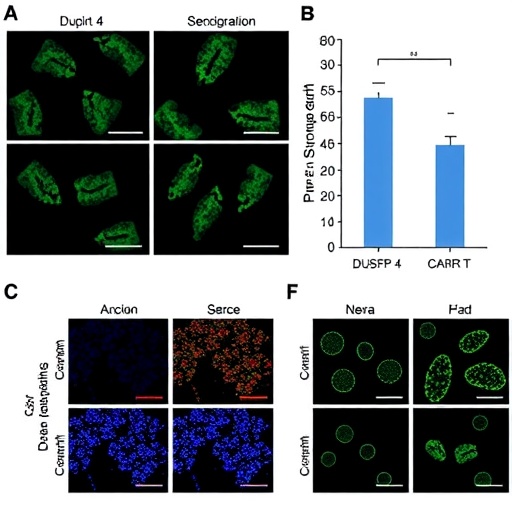
Colorectal cancer has become a proving ground for a new generation of cancer treatments, but one of the most promising approaches, engineered T-cell therapy, still faces a stubborn biological problem: immune cells that are powerful in principle can lose their strength inside a solid tumor. A study by Li, Koh, Zhang and colleagues, published in Nature Communications in 2026, identifies the signaling regulator dual-specificity phosphatase 4, or DUSP4, as a potential way to improve the performance of anti-tumor CD8⁺ T cells and chimeric antigen receptor T cells in mouse models of colorectal cancer. The work places a previously underappreciated molecular switch at the center of efforts to make cellular immunotherapy more durable and effective against tumors that resist immune attack.
CD8⁺ T cells are specialized immune cells capable of recognizing and destroying infected or malignant cells. Their activity depends on a tightly controlled sequence of signals. When a T-cell receptor encounters its target, intracellular pathways involving kinases such as ERK, JNK and p38 help direct proliferation, cytokine production, metabolic adaptation and cytotoxic activity. These pathways must remain responsive, but excessive or prolonged signaling can contribute to dysfunction, exhaustion and loss of killing capacity. DUSP4 belongs to a family of enzymes that remove phosphate groups from signaling proteins. By acting as a molecular brake on selected mitogen-activated protein kinase pathways, DUSP4 can reshape how T cells interpret stimulation rather than simply switching immune activity on or off.
The new research focuses on the possibility that this signaling balance is especially important in the tumor microenvironment. Solid tumors are not passive targets. They can deprive immune cells of nutrients, expose them to suppressive cytokines, create abnormal levels of oxygen and acidity, and repeatedly stimulate them through tumor-associated antigens. These pressures can force T cells into an exhausted state marked by reduced proliferation, impaired cytokine secretion and weakened cytotoxicity. In that setting, the level and activity of DUSP4 may influence whether a CD8⁺ T cell remains functionally adaptable or becomes trapped in a state of ineffective activation. The study’s central message is that manipulating this regulator can strengthen the anti-tumor program of T cells in colorectal cancer models.
The findings are also relevant to CAR-T cell therapy, an approach in which T cells are genetically modified to express a chimeric antigen receptor. Unlike a natural T-cell receptor, a CAR combines an antibody-derived recognition region with intracellular signaling modules that activate the cell after it binds a chosen tumor antigen. This design has produced dramatic responses in several blood cancers, where engineered cells can expand and encounter malignant targets in a comparatively accessible environment. Solid tumors have been more difficult. CAR-T cells must reach the tumor, survive within hostile tissue, maintain their activity despite chronic stimulation and distinguish malignant cells from healthy cells carrying related molecules. The study reports that DUSP4 can boost CAR-T efficacy in mouse colorectal cancer, suggesting that intracellular signaling control may be as important as antigen recognition.
At the mechanistic level, the significance of DUSP4 lies in its ability to tune signaling downstream of immune-cell activation. Phosphorylation acts as a rapid biochemical language: kinases add phosphate groups to proteins, while phosphatases remove them. This reversible system allows T cells to respond quickly and then recalibrate their behavior. A phosphatase such as DUSP4 can affect the intensity, duration and location of signals traveling through the cell. Those changes may influence transcription factors that control effector molecules, including cytotoxic proteins and inflammatory cytokines, as well as genes associated with persistence and exhaustion. The research therefore points toward a more precise form of immunotherapy in which the goal is not indiscriminate activation, but the optimization of signal quality over time.
The colorectal cancer model is important because it reflects a major clinical challenge. Tumors of the colon and rectum can contain substantial immune infiltration, yet the presence of T cells does not guarantee effective tumor destruction. Some infiltrating cells are functionally suppressed, while others may recognize tumor-associated structures but fail to expand or persist. Mouse models allow researchers to test whether changing DUSP4 in immune cells alters tumor control, therapeutic cell expansion or survival within cancer tissue. They also provide an initial setting in which to compare ordinary anti-tumor CD8⁺ T cells with genetically engineered CAR-T cells. However, a response in mice cannot be treated as proof of benefit in patients, because human tumors, immune histories and treatment conditions are considerably more complex.
One possible translational route would involve engineering therapeutic T cells to express higher levels of DUSP4, altering its activity, or selecting cell populations with a favorable DUSP4 signaling profile before infusion. Such modifications could potentially be combined with other strategies, including checkpoint blockade, cytokine support or CAR designs that improve persistence and tumor penetration. Yet phosphatases are context-dependent regulators, and changing one signaling pathway may produce unintended effects. Excessive suppression of kinase activity could reduce initial activation, alter the balance between effector and memory states, or affect the ability of cells to respond to newly encountered tumor cells. For that reason, future studies will need to define the precise dose, timing and cellular context in which DUSP4 is beneficial.
The study arrives as cancer immunology moves beyond the simple question of whether T cells can recognize a tumor. Researchers are increasingly asking how engineered cells sense their surroundings, distribute energy, resist exhaustion and maintain their identity during prolonged treatment. DUSP4 offers a compelling example of this shift toward intracellular circuit design. By showing that a signaling phosphatase can promote anti-tumor CD8⁺ T-cell function and improve CAR-T activity in mouse colorectal cancer, Li and colleagues add a new candidate to the molecular toolkit for cellular therapy. The next steps will be to reproduce the findings across additional tumor models, establish the relevant molecular targets of DUSP4 in human T cells, assess safety and determine whether the approach can overcome the barriers that have limited CAR-T treatment in solid tumors. If those questions are answered successfully, a small regulatory enzyme could become part of a much larger effort to make living cancer medicines more resilient.
Cite Scienmag News
Nathaniel Bowman. (August 15, 2026). DUSP4 Boosts Antitumor CD8+ T Cells, CAR-T Efficacy in Colorectal Cancer Mice. Scienmag. https://scienmag.com/dusp4-boosts-antitumor-cd8-t-cells-car-t-efficacy-in-colorectal-cancer-mice/
Nathaniel Bowman. "DUSP4 Boosts Antitumor CD8+ T Cells, CAR-T Efficacy in Colorectal Cancer Mice." Scienmag, 15 August 2026, https://scienmag.com/dusp4-boosts-antitumor-cd8-t-cells-car-t-efficacy-in-colorectal-cancer-mice/. Accessed 4 September 2026.
Nathaniel Bowman. "DUSP4 Boosts Antitumor CD8+ T Cells, CAR-T Efficacy in Colorectal Cancer Mice." Scienmag. August 15, 2026. https://scienmag.com/dusp4-boosts-antitumor-cd8-t-cells-car-t-efficacy-in-colorectal-cancer-mice/


