


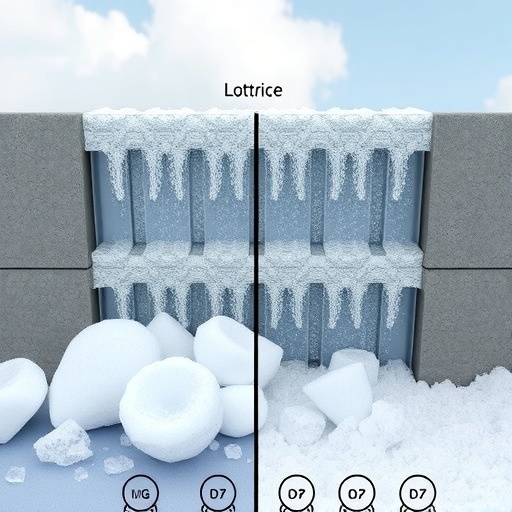
Every ton of cement produced releases roughly as much carbon dioxide into the atmosphere as the chemical reaction it carries inside — and the concrete industry as a whole is responsible for approximately 8% of global anthropogenic CO₂ emissions. Now, a team of researchers from Saudi Arabia has reported a way to fight back from within the material itself, locking carbon dioxide permanently into concrete while simultaneously making it stronger. In a comprehensive comparative study published in Case Studies in Construction Materials, Firas Hilaloglu and colleagues systematically tested two very different ways of feeding CO₂ to concrete — dropping crushed dry ice directly into the mixer, and curing hardened specimens in a sealed, carbon-dioxide-rich chamber — and found that the two approaches produce strikingly different mechanical and durability outcomes depending on the cement chemistry and water content of the mix.
The core chemistry underlying both techniques is elegantly simple. Carbon dioxide reacts with alkaline cement hydration products, chiefly calcium hydroxide and calcium silicate hydrate, to precipitate calcium carbonate — a stable, solid mineral that effectively entombs the greenhouse gas within the concrete matrix. The reaction follows the straightforward stoichiometry of Ca(OH)₂ + CO₂ → CaCO₃ + H₂O. Historically, this carbonation process has been viewed with alarm by structural engineers, because it lowers the alkalinity of the pore solution surrounding steel reinforcement and thereby strips steel of its protective passive layer, opening the door to corrosion. What the new study joins is a growing body of work that reframes carbonation as an asset when it is deliberately controlled and applied early — a strategy known as accelerated carbonation curing, or ACC.
The experimental program was ambitious in scope. Eighteen distinct concrete batches were prepared, spanning three water-to-cement ratios (0.35, 0.45, and 0.55), two Portland cement types (Type I, the ordinary structural workhorse, and Type V, a sulfate-resistant formulation with markedly lower tricalcium aluminate content), and three curing regimes: conventional water curing as a control, dry ice carbonation followed by water curing, and accelerated carbonation curing in a chamber. Cylindrical specimens measuring 100 by 200 millimeters were cast for every combination, and compressive strength was tracked at 7, 28, and 56 days according to ASTM C39, alongside a battery of durability tests including rapid chloride permeability, surface electrical resistivity, volume of permeable voids, water absorption, and carbonation depth measured with a phenolphthalein pH indicator.
The two carbonation routes differ fundamentally in mechanism, and those differences shaped the results. Dry ice — solid CO₂ at roughly −78 °C — sublimates rapidly, so when crushed into a fine powder at a dosage of 0.5% by weight of cement and blended into fresh concrete, it delivers high-purity carbon dioxide directly at the mixing stage. The carbonation reaction proceeds simultaneously with early hydration, and the resulting calcium carbonate is dispersed relatively uniformly throughout the mixture. The dry ice also doubled as a cooling agent: fresh concrete temperatures dropped from 30–33 °C in the control batches to about 23 °C in the dry-ice batches, a side benefit for hot-climate concreting, though the sublimation left no consistent trend in slump across the mixes. Accelerated carbonation curing, by contrast, works from the outside in. Demolded specimens were sealed inside acrylic chambers where the CO₂ concentration was held at 20–25% by volume, monitored continuously by a non-dispersive infrared sensor, with temperature at 20–25 °C and relative humidity regulated at 75–80% using a saturated sodium chloride solution. The gas diffuses through the hardened pore network, so the carbonation products concentrate near the surface and taper toward the interior, filling and refining existing pores rather than dispersing through a developing matrix.
The headline mechanical result belonged to the chamber method. The Type V cement mixture with a water-to-cement ratio of 0.35 subjected to ACC achieved the highest 28-day compressive strength of the entire study, 53.67 megapascals — a 12.2% improvement over its identically proportioned water-cured control. In fact, the water-to-cement ratio emerged as the single most decisive variable governing whether carbonation curing helped at all. Low-w/c concretes (w/c = 0.35) benefited across the board, showing higher strength, lower chloride ion penetrability, higher electrical resistivity, and water absorption below 2%. High-w/c mixes told a bleaker story: batches at w/c = 0.55 never exceeded 30 megapascals and remained stubbornly in the “high” chloride penetrability classification no matter which carbonation treatment they received. Porous, moisture-rich microstructures apparently offer too much pathway and too little reactive substrate for the CO₂ treatment to meaningfully compensate.
Durability testing reinforced the same hierarchy. In the rapid chloride permeability test per ASTM C1202, thin concrete discs sandwiched between sodium chloride and sodium hydroxide solutions under 60 volts of direct current for six hours were judged by the total charge passed. The ACC-treated Type I concrete at w/c = 0.35 stood out: its surface resistivity climbed from 17.73 kilohm-centimeters at 28 days to 21.51 at 56 days, crossing the threshold from “moderate” into the “low” chloride penetrability category — a meaningful milestone for a material destined for aggressive service environments. Carbonation depths measured at 56 days ranged from just 0.11 to 3.1 millimeters across all ACC specimens, well below the 20-millimeter-plus cover depths typical of reinforced concrete, suggesting that deliberate early carbonation remains largely a near-surface phenomenon within the study’s timeframe.
One of the study’s most intriguing findings concerned cement chemistry. Type V cement, with only about 2% tricalcium aluminate (C₃A), consistently showed lower volumes of permeable voids and more favorable transport properties under carbonation curing than Type I cement, which contains about 6% C₃A. The authors attribute this to the susceptibility of AFm and AFt phases — hydrated products of C₃A — to carbonation-induced decomposition and transformation into carbonate-bearing phases, reactions that can be accompanied by shrinkage and microcracking that degrade pore connectivity. In other words, the wrong cement chemistry can turn a carbon-saving cure into a microstructural liability. The researchers caution that these explanations are literature-supported interpretations rather than direct observations, since no SEM, FTIR, or mercury intrusion porosimetry was performed; direct microstructural characterization is flagged as essential future work.
The dry ice results were more equivocal. Prior research by the field had suggested an optimal dry ice dosage of roughly 0.5–0.6% by weight of cement, capable of boosting compressive strength by as much as 31% in some systems, and the present study indeed found performance benefits under selected conditions — particularly in Type V mixes, where dry-ice batches showed reduced permeable void volume, with a maximum reduction of 14.63% at w/c = 0.45. But evaluated across the full matrix of mixes, the single tested dosage of 0.5% delivered less consistent and less reproducible gains than chamber-based ACC. The authors argue that the sealed chamber’s controlled environment produces uniform gas exposure and predictable reaction kinetics, making ACC the more reliable route for systematic enhancement — while conceding that dry ice optimization across wider dosages, moisture conditions, and mixing parameters remains unexplored territory with a distinct practical appeal, since it requires no special curing infrastructure.
Correlation analyses tied the story together. Compressive strength rose as carbonation depth fell, as permeable void volume dropped, and as surface resistivity climbed — with ACC mixtures generally showing steeper regression slopes than dry-ice mixtures, especially for Type V cement, indicating that mechanical performance under chamber curing is unusually sensitive to transport-related microstructure. The overall message for the industry is that carbon capture in concrete is not a one-size-fits-all proposition: the benefit depends on a trio of interlocking factors — the delivery method for the CO₂, the mineral composition of the cement, and the porosity of the mix, dictated largely by its water content. With 8% of global emissions riding on the outcome, the finding that a simple chamber, a salt solution, and a tank of CO₂ can deliver both sequestration and a 12% strength gain may prove to be one of the more commercially legible steps yet toward carbon-negative construction. The team, supported by the Saudi Standards, Metrology and Quality Organization (SASO), notes that longer-term studies must still confirm that early carbonation does not compromise reinforcement passivation over decades — the critical question that stands between laboratory promise and structural reality.
Cite Scienmag News
Denise Maddox. (September 8, 2026). Dry ice and carbonation curing compared for concrete strength and durability. Scienmag. https://scienmag.com/dry-ice-and-carbonation-curing-compared-for-concrete-strength-and-durability/
Denise Maddox. "Dry ice and carbonation curing compared for concrete strength and durability." Scienmag, 8 September 2026, https://scienmag.com/dry-ice-and-carbonation-curing-compared-for-concrete-strength-and-durability/. Accessed 8 September 2026.
Denise Maddox. "Dry ice and carbonation curing compared for concrete strength and durability." Scienmag. September 8, 2026. https://scienmag.com/dry-ice-and-carbonation-curing-compared-for-concrete-strength-and-durability/


