


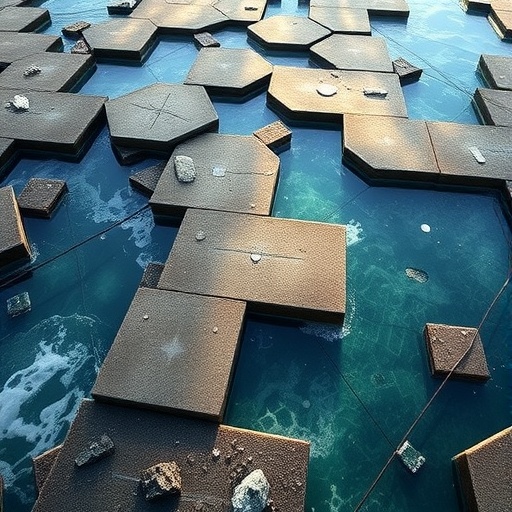
The intricate processes governing carbonate platform dynamics have long captivated geologists and palaeoclimatologists seeking to unravel Earth’s deep-time environmental transitions. In a groundbreaking study published in Communications Earth & Environment, Wang, Burgess, and Rankey delve into the complex morphologies of carbonate platform drowning geometries, shedding light on their profound implications for both depositional processes and palaeoclimate reconstruction. This research not only advances our fundamental understanding of carbonate sedimentation but also illuminates the subtle interplay between Earth’s climatic regimes and the growth patterns of these vital marine structures.
Carbonate platforms, expansive underwater edifices formed predominantly by the accumulation of biogenic carbonate sediments, are critical archives of Earth’s past oceanographic and climatic conditions. Their eventual drowning—the cessation of carbonate production as platforms sink beneath the photic zone—captures a pivotal environmental shift. Understanding the mechanisms and geometrical expressions of such drowning events offers a unique window into paleoceanographic changes, sea-level fluctuations, and biotic responses over geological timescales.
Wang and colleagues’ analysis emphasizes the diversity of carbonate platform drowning geometries, which emerge from a confluence of intrinsic geological processes and external climatic forcings. The study employs high-resolution stratigraphic and sedimentological data combined with advanced numerical modeling to dissect the physical and chemical conditions precipitating platform submergence. This multifaceted approach reveals that drowning geometries are not uniform but instead vary widely depending on factors such as platform size, slope gradient, sediment supply, and prevailing hydrodynamic conditions.
One of the key insights from this work is the recognition that carbonate platform drowning is a multi-process phenomenon influenced heavily by palaeoclimatic oscillations. Fluctuations in ocean temperatures, nutrient availability, and sea-level change create feedback mechanisms that can accelerate or mitigate platform submergence. For example, warming periods often correspond with enhanced carbonate productivity, whereas cooler or more eutrophic conditions may disrupt the balance, triggering drowning.
Furthermore, the spatial morphology of drowning geometries provides diagnostic clues to past environmental settings. Platforms exhibiting asymmetrical drowning geometries, such as tilted or stepped profiles, suggest directional hydrodynamic forces or localized tectonic influences. Conversely, more symmetrical drowning patterns implicate pervasive oceanographic or climatic drivers, such as global sea-level rise or widespread ocean acidification events tied to greenhouse gas fluctuations.
The authors also spotlight how variations in drowning geometries impact carbonate reservoir quality and volume, carrying significant implications for hydrocarbon exploration. Understanding these subtle geometric distinctions assists geoscientists in better predicting reservoir presence and heterogeneity within carbonate successions, bridging the gap between palaeoenvironmental reconstruction and applied geological sciences.
In addition, integrating drowning geometries with palaeoclimate proxies, including stable isotope analyses and fossil assemblage data, elucidates the temporal sequence of environmental stressors leading to platform demise. This holistic perspective reinforces the view that carbonate platform drowning is not merely a passive response to sea-level rise but rather an active interplay of biogeochemical feedbacks and climatic drivers over varied timescales.
The work further challenges prior simplistic models that attributed drowning primarily to rapid transgressions. Instead, Wang et al. demonstrate that gradual changes in ocean chemistry, including shifts in carbonate saturation states and episodic eutrophication, critically modulate platform viability. This nuanced understanding calls for revising conventional paradigms regarding the sensitivity of carbonate systems to past climate perturbations.
A remarkable aspect of this study is its methodological rigor, leveraging three-dimensional stratigraphic reconstructions and multiproxy datasets alongside novel computational algorithms. By marrying empirical field observations with theoretical modeling, the authors succeed in capturing the nonlinear and emergent properties of carbonate platform drowning, offering refined predictive capabilities for future geological scenarios under changing climate conditions.
Implications of this research extend beyond academic circles, informing strategies to anticipate carbon cycle feedbacks in contemporary marine ecosystems. Carbonate platforms are analogues of modern coral reefs, which face escalating threats from anthropogenic climate change. Insights into the palaeoclimatic thresholds that precipitated ancient platform drowning provide critical context for assessing reef resilience and vulnerability today.
The study also paves the way for future investigations exploring the coupling between tectonics, sea level, and carbonate sedimentology within a climatic framework. Delineating how these variables collectively influence platform architecture and sediment accumulation will enhance our capacity to decode Earth’s paleoenvironmental history with greater precision.
Moreover, the refined conceptualization of carbonate platform drowning advanced by Wang and colleagues enables better integration of geological records into Earth system models. Such cross-disciplinary incorporation is essential for reconstructing past climate dynamics and forecasting marine carbonate responses under anticipated global warming scenarios.
In conclusion, this seminal work reconstructs the intricate dance between geological processes and climatic forces that govern carbonate platform drowning. By unpacking the process and palaeoclimate significance of these geomorphic features, Wang, Burgess, and Rankey provide vital new lenses through which to interpret Earth’s ancient environmental transitions. Their multifaceted approach exemplifies how detailed sedimentological studies can unlock broad palaeoclimate insights, bridging gaps across Earth and environmental sciences.
As the climate crisis accelerates, revisiting and learning from the palaeo-record encoded in carbonate platforms becomes increasingly urgent. The dynamics revealed within drowning geometries underscore the fragility and adaptive complexity of carbonate systems, offering cautionary tales and hopeful guidance for managing marine environments in a rapidly evolving world. This research thus stands as a cornerstone contribution, poised to influence both academic inquiry and practical conservation efforts in the decades to come.
Cite Scienmag News
Violet Maxwell. (April 21, 2026). Drowning Geometries Reveal Carbonate Platform Climate History. Scienmag. https://scienmag.com/drowning-geometries-reveal-carbonate-platform-climate-history/
Violet Maxwell. "Drowning Geometries Reveal Carbonate Platform Climate History." Scienmag, 21 April 2026, https://scienmag.com/drowning-geometries-reveal-carbonate-platform-climate-history/. Accessed 3 September 2026.
Violet Maxwell. "Drowning Geometries Reveal Carbonate Platform Climate History." Scienmag. April 21, 2026. https://scienmag.com/drowning-geometries-reveal-carbonate-platform-climate-history/


