


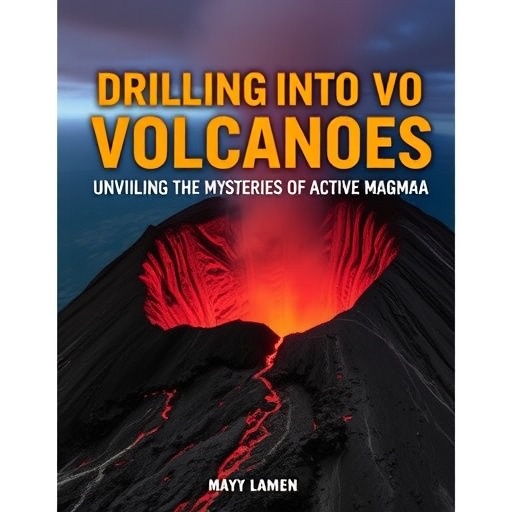
In a groundbreaking study that promises to transform our understanding of volcanic systems, a team of volcanologists from Ludwig-Maximilians-Universität München (LMU) has successfully deciphered the intricate behavior of magma residing beneath an active volcano. Led by Dr. Janine Birnbaum, the team employed an innovative approach that not only illuminates how magma reacts when drilled but also reconstructs physical conditions within subterranean magma chambers with unprecedented precision. Their findings, published in the prestigious journal Nature, hold the potential to revolutionize volcanic monitoring and pave the way for novel geothermal applications.
Volcanoes, though often perceived as spectacular outbursts of nature’s raw power, spend the overwhelming majority of their lifetimes in a quiescent state. Understanding the transition from dormancy to eruption is a grand challenge for volcanologists worldwide. This necessitates an intricate comprehension of magma’s properties—its temperature, pressure, and volatile content—while it is sequestered deep under the Earth’s surface. These parameters govern the eruption dynamics and are crucial for accurate forecasting. However, direct measurements of magma deep within the crust have remained largely elusive due to the extreme inaccessibility of these environments.
The LMU research team innovatively seized a rare opportunity provided by the Iceland Deep Drilling Project (IDDP), which intersects magma at a shocking depth of just over two kilometers beneath the Krafla volcanic field in northeastern Iceland. Unlike the typical kilometers-thick rock layers that usually separate surface from magma, Krafla’s magma reservoir sits unusually near the surface, offering a natural laboratory for direct investigation. During the 2009 drilling operations, descending through the brittle crust, the team unknowingly breached molten magma. The effusive encounter resulted in the sudden quenching of magma by the cold drilling fluids, producing quenched glass chips embedded with gas bubbles.
This serendipitous intersection teased the researchers with an intriguing puzzle. Closer examination of the glass chips revealed small bubbles—indicative of gas exsolution—contrasted by a gas concentration that was paradoxically lower than expected at the estimated temperature and pressure of the magma body. To decode this disequilibrium, Dr. Birnbaum’s group applied a sophisticated numerical model that simulated the thermal and volatile dynamics during the rapid cooling that followed the drilling incident. Their analyses demonstrated that the magma, exposed to cold fluids, took several minutes to cool sufficiently to form glass. During this interval, volatiles, primarily water and carbon dioxide, escaped from the melt, creating bubbles but simultaneously reducing the concentration of dissolved gases in the residual glass.
This dynamic response, the researchers explain, means that the measured gas content in the quenched glass chips does not simply reflect the original volatile state of the magma. Instead, it is a modified snapshot, a “blurry photograph” distorted by the processes occurring during the equilibration window immediately following magma disturbance. By modeling the rate of gas escape and the cooling timeline, the team was able to back-calculate to the original dissolved gas content prior to drilling. Remarkably, their results indicate that gas loss occurred within an astonishingly rapid timeframe of fewer than five minutes, highlighting the magma’s highly reactive nature to perturbation.
The implications of this discovery extend far beyond academic curiosity. Knowing the real-time response of magma to mechanical disturbance is vital for geothermal exploitation strategies, especially in volcanically active regions like Iceland. Enhanced understanding of magma’s volatile content and behavior under drilling conditions can drastically augment the safety protocols of geothermal plants, minimizing the risks of triggering unintended eruptions or blowouts. Furthermore, controlled tapping of magma reservoirs with this refined knowledge can unlock new avenues for geothermal energy extraction, an increasingly critical resource in the global transition to sustainable energy systems.
Underpinning the entire study is the magnetic insight into how dissolved gases influence the physical state of magma. Water and carbon dioxide dissolved in magma lower its melting point and contribute to its explosivity by generating bubbles that expand violently during decompression. The tunneling of these volatiles from magma to the crust and eventually to the surface dictates the style and intensity of volcanic eruptions. Thus, characterizing and quantifying these gases in situ has been a century-old challenge. The LMU study represents a quantum leap, illuminating a window into magma’s elusive storage conditions which were previously inferred only indirectly from erupted products.
The innovative combination of direct sample analysis with numerical modeling emphasizes a paradigm shift in volcanology where theoretical models are anchored by empirical datasets obtained through cutting-edge geothermal drilling projects. Such interdisciplinary research efforts extend the frontier of Earth sciences, linking subsurface geochemistry, physics of magmatic systems, and geothermal engineering. Importantly, the research invites re-evaluation of existing volcanic monitoring frameworks, suggesting that real-time tracking of volatile loss and magma response to mechanical intrusion could signal precursors to eruptive activity.
By elucidating the minute-by-minute transformations of magma when perturbed, this research also serves as a cautionary tale for future geothermal operations in active volcanic zones worldwide. It underscores that the magmatic environment is neither static nor homogeneous but a dynamic, responsive system capable of rapid volatile redistribution. This responsiveness has to be factored into risk assessments and operational guidelines for geothermal wells that intersect magmatic or hydrothermal reservoirs, particularly in regions where volcanic hazards are a constant threat.
Moreover, the approach pioneered by the LMU team could inspire new monitoring techniques based on the detection of rapid volatile escape events, potentially via seismic, acoustic, or gas detection sensors. These techniques could offer real-time insights into magma chamber dynamics, improving eruption forecasts and providing earlier warnings to populations at risk. As humanity increasingly turns to exploiting the Earth’s internal heat, understanding the rheology of magma and its volatile behavior will be central to aligning energy development with geohazard mitigation.
Ultimately, the revelation that magma reservoirs can be probed and their storage conditions resolved to such detail at accessible depths has global ramifications. Many volcanic fields with geothermal potential could benefit from similar investigations, merging scientific inquiry with pragmatic energy solutions. This delicate balance between harnessing volcanic materials and safeguarding human lives and ecosystems exemplifies the future trajectory of volcanology within the energy sciences.
Dr. Janine Birnbaum and her colleagues have thus not only opened a new chapter in the study of active volcanic systems but have also laid the groundwork for harnessing Earth’s fiery heat while deciphering the tremulous signals of magma’s restless pulse beneath our feet. Their work, a testament to ingenuity and interdisciplinary collaboration, heralds a new era where the subsurface secrets of volcanoes are unveiled—not by chance but by design.
News Publication Date: 25-Mar-2026
Web References: https://doi.org/10.1038/s41586-026-10317-w
References: Published article in Nature, DOI: 10.1038/s41586-026-10317-w
Cite Scienmag News
Violet Maxwell. (March 26, 2026). Drilling into Volcanoes: Unveiling the Mysteries of Active Magma. Scienmag. https://scienmag.com/drilling-into-volcanoes-unveiling-the-mysteries-of-active-magma/
Violet Maxwell. "Drilling into Volcanoes: Unveiling the Mysteries of Active Magma." Scienmag, 26 March 2026, https://scienmag.com/drilling-into-volcanoes-unveiling-the-mysteries-of-active-magma/. Accessed 5 September 2026.
Violet Maxwell. "Drilling into Volcanoes: Unveiling the Mysteries of Active Magma." Scienmag. March 26, 2026. https://scienmag.com/drilling-into-volcanoes-unveiling-the-mysteries-of-active-magma/


