


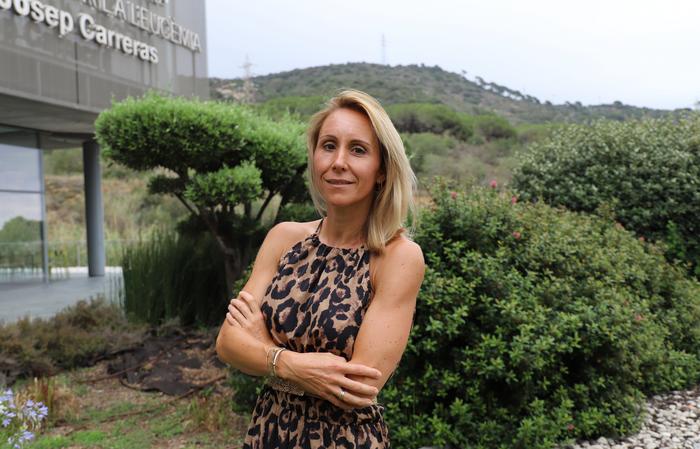
Today, the European Haematology Association (EHA) has awarded its prestigious and exclusive Bilateral Collaborative Grants in Madrid, as part of the opening ceremony of the EHA Annual Congress. Among the selected projects is the one proposed by Dr Biola M. Javierre, head of the 3D chromatin organisation research group at the Josep Carreras Leukaemia Research Institute, and Dr Björn Chapuy from Charité Universitätsmedizin Berlin (Germany). The project aims to shed light on the role of mutations in noncoding regions of the genome in the development of diffuse large B-cell lymphoma (DLBCL).

Credit: Josep Carreras Leukaemia Research Institute
Today, the European Haematology Association (EHA) has awarded its prestigious and exclusive Bilateral Collaborative Grants in Madrid, as part of the opening ceremony of the EHA Annual Congress. Among the selected projects is the one proposed by Dr Biola M. Javierre, head of the 3D chromatin organisation research group at the Josep Carreras Leukaemia Research Institute, and Dr Björn Chapuy from Charité Universitätsmedizin Berlin (Germany). The project aims to shed light on the role of mutations in noncoding regions of the genome in the development of diffuse large B-cell lymphoma (DLBCL).
To qualify for the Bilateral Collaborative Grants, projects must meet very stringent criteria, such as coming from two independent research groups based in Europe with shared interests and complementary expertise. This collaboration is expected to enrich both groups and generate high-impact new knowledge.
The EHA is the largest association of haematologists in Europe, dedicated to promoting excellence in patient care, research, and education. Its annual congress gathers thousands of specialists to discuss the latest developments in the field and serves as an ideal platform to establish new collaborations.
This current research proposal emerged from such collaborative environments. Dr Javierre will provide her expertise in the liCHi-C promoter capture method, developed in her laboratory, in collaboration with Dr Björn Chapuy, who has an extensive catalogue of DLBCL samples and preclinical models. The project will be funded for two years of high-level research and will include the recruitment of new researchers.
Mutations in noncoding regions
In recent years, up to five subtypes of DLBCL have been identified, each characterised by specific genetic alterations (mutations). This facilitates diagnosis and provides clues about the disease’s progression, which is crucial for clinical management. However, many lymphomas still do not have a known cause, making ongoing research essential to find answers.
Previous studies of the DLBCL tumour genome have shown that many mutations, although not directly affecting genes, impact the disease’s development. Many of these mutations occur in distant regulatory regions, parts of the genome that control the function of genes located at considerable distances.
The challenge is that, generally, it is not known which genes are controlled by each of these regions. They could be many, and not all related to DLBCL. Therefore, Dr Javierre’s team will use the liCHi-C methodology, capable of determining which genes physically contact these regulatory regions and are thus under their influence.
Although the experimental work will be conducted in preclinical models of the disease and is not expected to have an immediate impact on patients, this research will identify which genes are affected by mutations in noncoding regions and their role in the development of DLBCL. It is hoped that this information can be used to benefit patients, either as disease biomarkers or as new therapeutic targets in the future.
Cite Scienmag News
Nathaniel Bowman. (June 14, 2024). Dr Biola M. Javierre receives a prestigious grant for the study of B-cell Lymphoma. Scienmag. https://scienmag.com/dr-biola-m-javierre-receives-a-prestigious-grant-for-the-study-of-b-cell-lymphoma/
Nathaniel Bowman. "Dr Biola M. Javierre receives a prestigious grant for the study of B-cell Lymphoma." Scienmag, 14 June 2024, https://scienmag.com/dr-biola-m-javierre-receives-a-prestigious-grant-for-the-study-of-b-cell-lymphoma/. Accessed 4 September 2026.
Nathaniel Bowman. "Dr Biola M. Javierre receives a prestigious grant for the study of B-cell Lymphoma." Scienmag. June 14, 2024. https://scienmag.com/dr-biola-m-javierre-receives-a-prestigious-grant-for-the-study-of-b-cell-lymphoma/

