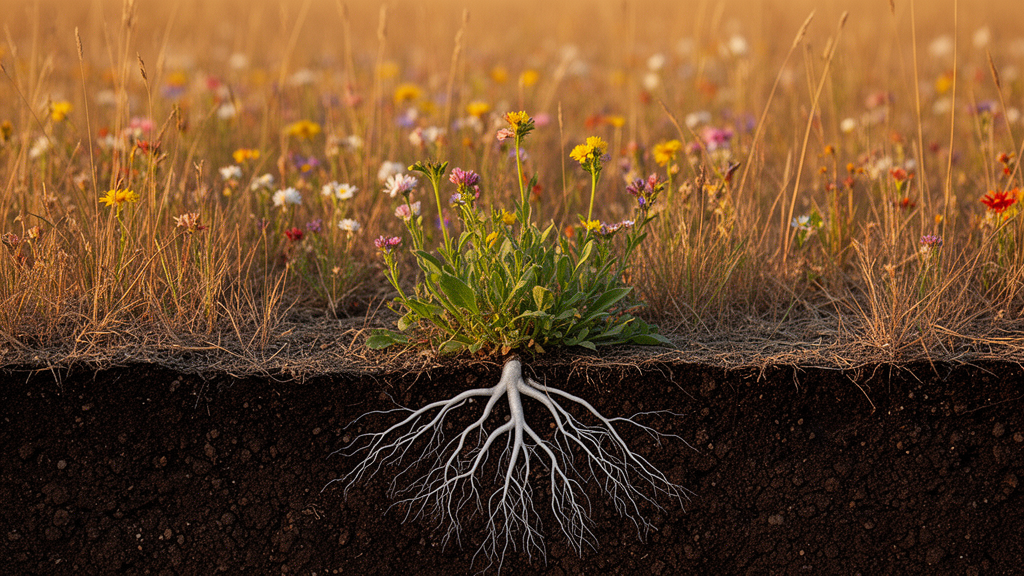
Beneath every patch of grassland lies a hidden trading network. Arbuscular mycorrhizal fungi (AMF) thread their way through the soil and into plant roots, exchanging phosphorus, nitrogen, water, and protection from pathogens for the carbon sugars that only plants can make. For decades, ecologists have assumed that more of these fungal partners is simply better: richer fungal communities should mean more complementary nutrient pathways, healthier plants, and more productive ecosystems. A new greenhouse experiment, published in Web Ecology by Yelyzaveta Shpilkina of the University of Alicante and colleagues, upends that comfortable assumption. The study found that increasing fungal richness actually reduced plant biomass production overall, and that the winners and losers of fungal diversity depended sharply on which kind of plant was asking for help.
The team assembled 128 miniature grassland communities in pots at the University of Alicante, each containing four individuals drawn from sixteen common European grassland species. Eight were grasses, including meadow fescue, perennial ryegrass, and timothy; eight were forbs, the broad-leaved wildflowers of the meadow, including yarrow, daisy, ribwort plantain, and dandelion. By varying the proportion of grasses from zero to one hundred percent, the researchers created a gradient of functional diversity, a coarse but informative proxy for how differently the species in each pot made their living. Half the pots received living inoculum of four AMF species commonly found in European grasslands, cultured at Agroscope’s Swiss Collection of Arbuscular Mycorrhizal Fungi; the other half received the same inoculum after sterilization. Every pot also received a microbial filtrate to equalize the background soil community, isolating the effect of the fungi themselves.
Then came the twist that reshaped the entire study. When the researchers checked their controls, they found that the supposedly fungus-free pots were anything but. Root colonization averaged 53 percent in sterilized controls versus 61 percent in inoculated pots, and the proportion of AMF DNA reads among all fungal sequences was essentially identical in both treatments. Airborne spores, incomplete substrate sterilization, or fungal propagules hitchhiking on surface-sterilized seeds most likely seeded the control pots. A truly AMF-free control, the authors concluded, was unattainable, which is arguably more realistic: in nature, soils are never fungus-free, and plants always respond against a backdrop of resident mycorrhizal communities.
Rather than scrapping the experiment, the team pivoted. DNA extracted from the soils of 96 pots was amplified with fungal ITS2 primers and sequenced on an Illumina NovaSeq platform, yielding nearly 5.7 million quality-filtered reads. After clustering at 97 percent identity and screening against the UNITE and FungalTraits databases, the researchers identified 233 AMF operational taxonomic units among 6355 fungal OTUs. Crucially, the living inoculum had not simply added fungi; it had restructured the community. Rarefied AMF richness was significantly lower in inoculated pots, apparently because the four introduced strains, known competitors such as Rhizoglomus and Claroideoglomus, monopolized root and soil niches and excluded the background taxa. Inoculation had inadvertently created a gradient of fungal diversity rather than a simple presence-versus-absence contrast.
That gradient told an unexpected story. Contrary to the complementarity hypothesis, which predicts that diverse fungal communities should boost plant productivity through differentiated resource uptake, biomass production declined as AMF richness rose. Root biomass showed the clearest signal, decreasing significantly with fungal richness regardless of the grass proportion in the community. Aboveground production also fell with richness, though the effect was weaker and moderated by community composition. The most productive communities were grass-dominated pots carrying the engineered low-diversity inoculum, a result that directly contradicts the expectation that diversity begets function at every level of the soil food web.
The explanation the authors favor is one of dominance rather than diversity. Fungal taxa differ enormously in how effectively they deliver nutrients to their hosts, and the four inoculated species are among the best-documented performers in the literature. By concentrating the community around a few highly functional, highly competitive strains, inoculation produced more biomass per plant even as it squeezed out the broader fungal repertoire. In other words, a few excellent traders beat a large crowd of mediocre ones, at least for total biomass. This mechanism echoes findings from agricultural soils, where competitive inoculant strains can lift crop yields while eroding the indigenous mycorrhizal diversity that underpins long-term ecosystem resilience.
Yet the biomass ledger concealed a deeper asymmetry between plant types. When the researchers examined how the response to fungal richness varied with grass dominance, a pattern emerged: the negative effect of fungal richness on leaf production weakened as the proportion of forbs increased. Communities dominated by forbs benefited more from a diverse AMF community than grass-dominated ones, which thrived instead under the low-diversity inoculum. Although this interaction was statistically marginal, the authors attribute it to fundamental differences in resource economy. Grasses, with their fast growth and fine root architecture, are often less dependent on mycorrhizal supply, whereas many forbs, particularly non-nitrogen-fixing species with higher carbon demands from multiple symbioses, rely more heavily on fungal partners and may profit from a wider menu of fungal strategies.
The study also revealed a striking division of labor between the aboveground and belowground worlds. Aboveground biomass was governed primarily by plant functional composition: grass-dominated communities produced the most shoot material, likely because grasses’ upright growth form allows them to escape competition for light, while forbs with broad horizontal leaves shade more easily. Belowground biomass, by contrast, was governed primarily by fungal diversity, with almost no influence of plant composition. This split suggests that AMF act chiefly through root-mediated resource acquisition and allocation, a finding consistent with recent large-scale evidence that mycorrhizal symbiosis enhances soil carbon storage by pushing biomass investment underground. The hyphal networks that flourish under such investment may in turn improve soil structure, water retention, and nutrient availability for the whole community.
For the booming industry in commercial mycorrhizal biofertilizers, the implications are sobering. Inoculants are increasingly marketed as a green alternative to chemical fertilizers, and they can indeed raise yields. But this experiment demonstrates that adding fungi is not the same as adding fungal diversity, and that the two can move in opposite directions. A commercial treatment that concentrates the community around a few productive strains may boost short-term biomass in grass-dominated systems while sacrificing the native diversity that forb-rich, biodiverse grasslands depend on. The authors argue that sustainable land management requires understanding the specific interactions between plant functional groups and fungal community composition, not simply dosing soils with spores.
The broader lesson is that the relationship between biodiversity and ecosystem function, one of ecology’s most celebrated patterns, is not a simple staircase. Context matters at every scale: which plants are present, which fungi are present, and how their resource economies match. By coupling DNA-based assessments of fungal richness with experimental gradients of plant functional diversity, this study offers a template for disentangling those mechanisms in semi-arid grasslands and beyond. The next step, the authors suggest, is to extend the joint assessment of plant and fungal functional diversity to ecosystem processes such as nutrient cycling, where their models already hinted at treatment-dependent shifts in soil nitrogen and phosphorus availability. In the hidden economy beneath our feet, it seems, diversity is currency, but who gets rich depends entirely on who is trading.
Subject of Research: Effects of arbuscular mycorrhizal fungal diversity and plant functional composition on biomass production in semi-arid grassland communities
Article Title: Forb species benefit more than grasses from a diverse arbuscular mycorrhizal fungal community in semi-arid grasslands
Article References: Shpilkina, Y., Vasar, M., Asensio, S., Ochoa, V., Gozalo, B., Enste, K., Zobel, M., de Bello, F., van der Heijden, M., Maestre, F. T., & Neuenkamp, L. (2026). Forb species benefit more than grasses from a diverse arbuscular mycorrhizal fungal community in semi-arid grasslands. Web Ecology, 26(2), 119-155. https://doi.org/10.5194/we-26-119-2026
Image Credits: AI Generated
Keywords: arbuscular mycorrhizal fungi, soil biodiversity, grasslands, forbs, grasses, plant functional diversity, biomass production, fungal inoculants, root colonization, DNA metabarcoding, semi-arid ecosystems, sustainable agriculture
Cite Scienmag News
Roger Howard. (October 8, 2026). Diverse Soil Fungi Help Wildflowers, Not Grasses, Thrive in Dry Grasslands. Scienmag. https://scienmag.com/diverse-soil-fungi-help-wildflowers-not-grasses-thrive-in-dry-grasslands/
Roger Howard. "Diverse Soil Fungi Help Wildflowers, Not Grasses, Thrive in Dry Grasslands." Scienmag, 8 October 2026, https://scienmag.com/diverse-soil-fungi-help-wildflowers-not-grasses-thrive-in-dry-grasslands/. Accessed 8 October 2026.
Roger Howard. "Diverse Soil Fungi Help Wildflowers, Not Grasses, Thrive in Dry Grasslands." Scienmag. October 8, 2026. https://scienmag.com/diverse-soil-fungi-help-wildflowers-not-grasses-thrive-in-dry-grasslands/