


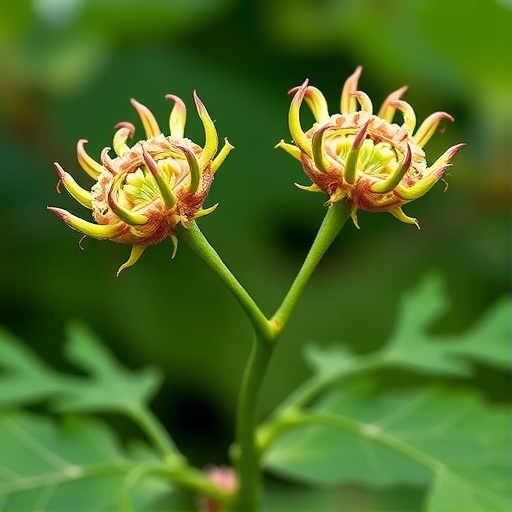
A hidden network of plant peptide hormones may be giving legumes a far more sophisticated immune system than scientists previously recognized. In a study published in Nature Plants, researchers report that soybean produces a surprisingly diverse family of defence-activating peptides derived from conserved subtilase precursor proteins. Although these molecules can differ dramatically in sequence, they are each capable of triggering strong and tissue-specific resistance against pathogens. The discovery suggests that plants have evolved a flexible molecular vocabulary for detecting danger, with different peptide–receptor combinations tuning immune responses to particular tissues, threats or stages of infection.
The peptides, known as GmSubPEPs, were originally identified in extracts from soybean leaves. They belong to a class of plant signalling molecules often compared with cytokines in animals because they transmit information between cells and coordinate physiological responses. GmSubPEPs are produced from larger precursor proteins associated with subtilases, a group of proteases that process proteins and participate in development, stress responses and immunity. Once released from their precursors, the short mature peptides can interact with receptor kinases embedded in the plant cell membrane. These receptors then initiate intracellular signalling cascades that alter gene activity, protein phosphorylation and defensive chemistry.
The new research reveals that GmSubPEP is not a single uniform signal. Instead, soybean contains an expanded collection of related peptide variants whose mature sequences are highly diverse. This finding is unexpected because peptide hormones often retain conserved amino-acid motifs that are essential for receptor recognition and biological activity. In the SubPEP system, however, conserved precursor frameworks appear to provide a stable production platform while allowing the active peptide regions to evolve rapidly. The result is a family of molecular signals that share a common origin but may deliver distinct instructions to the plant immune system.
To determine whether the sequence differences had functional consequences, the researchers examined how individual GmSubPEPs affected soybean tissues and pathogen resistance. The peptides were found to activate robust defence responses, but their effects were not identical. Some variants produced particularly strong responses in specific tissues, indicating that the immune system does not simply switch on in the same way throughout the plant. Instead, each peptide may help direct protection to the location where it is most needed, limiting the potential costs of unnecessary immune activation while preserving a rapid response to invasion.
The study combined transcriptomic and phosphoproteomic analyses to map these effects at molecular resolution. Transcriptomics measures changes in RNA abundance, revealing which genes become activated or repressed after peptide treatment. Phosphoproteomics examines phosphorylation, a reversible chemical modification that can rapidly change the activity, stability or location of proteins. Together, the two approaches showed that individual GmSubPEPs activate overlapping immune programmes while also engaging unique pathways. Shared responses likely represent a core defence system, whereas peptide-specific changes may provide the fine control required to tailor immunity to different biological circumstances.
This layered signalling architecture is important because plant immunity must balance speed with precision. A strong defence response can restrict microbial growth, but it can also consume energy, divert nutrients and damage the plant’s own tissues. By using multiple ligands that activate partly distinct receptor and signalling networks, soybean may be able to adjust the intensity and character of its response. One peptide could favour early warning and transcriptional reprogramming, while another could more strongly influence phosphorylation-based signalling or tissue-specific protective mechanisms. The findings therefore portray peptide hormones as dynamic regulators rather than simple on-and-off immune switches.
The researchers also identified a striking genomic arrangement underlying this diversity. The genes encoding the SubPEP peptides and those encoding their receptors, named GmSubPEP Receptors, or GSPRs, are physically interspersed within a genomic cluster. Such clustering can bring related genes into a shared evolutionary and regulatory environment. It may also allow ligand and receptor genes to diversify together, preserving useful pairings while generating new combinations. The arrangement is especially significant because a peptide can only influence immunity if it is recognized by an appropriate receptor, and the study found that GSPRs differ in their binding affinities for their corresponding ligands.
Receptor binding affinity describes how strongly a receptor interacts with a peptide. Even modest differences in affinity can influence how much peptide is required to trigger a response, how long signalling persists and which tissues respond most effectively. Differential affinity may therefore help explain why closely related GmSubPEPs produce distinct biological outcomes. The clustered genomic organization could support a process of co-evolution in which new peptide variants arise alongside receptor variants capable of detecting them. Over time, this may generate specialized ligand–receptor pairs that expand the plant’s capacity to sense and respond to microbial threats.
The researchers extended their analysis across legume lineages, proposing that the SubPEP–GSPR system reflects a broader evolutionary strategy rather than an isolated feature of soybean. Conserved subtilase scaffolds may provide the ancestral framework, while the mature peptide segments and their receptors diversify under pressure from changing pathogen communities. This model offers a possible explanation for how plants build complex immune repertoires without inventing entirely new protein architectures for every signal. It also raises the prospect of identifying similar peptide–receptor modules in other crops by searching genomes for conserved precursor structures, clustered receptor genes and peptide sequences with immune activity.
The discovery could eventually have practical consequences for crop protection. Because GmSubPEPs activate natural defence pathways, they might be used as biological treatments, breeding targets or components of engineered immune systems. However, translating the findings into agriculture will require careful testing. A peptide that protects one tissue could have a different effect elsewhere, and excessive immune stimulation may reduce growth or yield. Researchers will also need to establish how these signals behave under field conditions, how long their activity lasts and whether pathogens can adapt to them. Even so, the study provides a new framework for exploring plant immunity: rather than searching for one universal defence hormone, scientists may be able to design or combine specialized peptide–receptor modules that strengthen protection while minimizing physiological costs.
Cite Scienmag News
Drew Townsend. (August 18, 2026). Diverse Legume Defence Signals and Clustered Receptors Co-Evolved from Conserved Subtilase Scaffolds. Scienmag. https://scienmag.com/diverse-legume-defence-signals-and-clustered-receptors-co-evolved-from-conserved-subtilase-scaffolds/
Drew Townsend. "Diverse Legume Defence Signals and Clustered Receptors Co-Evolved from Conserved Subtilase Scaffolds." Scienmag, 18 August 2026, https://scienmag.com/diverse-legume-defence-signals-and-clustered-receptors-co-evolved-from-conserved-subtilase-scaffolds/. Accessed 4 September 2026.
Drew Townsend. "Diverse Legume Defence Signals and Clustered Receptors Co-Evolved from Conserved Subtilase Scaffolds." Scienmag. August 18, 2026. https://scienmag.com/diverse-legume-defence-signals-and-clustered-receptors-co-evolved-from-conserved-subtilase-scaffolds/


