


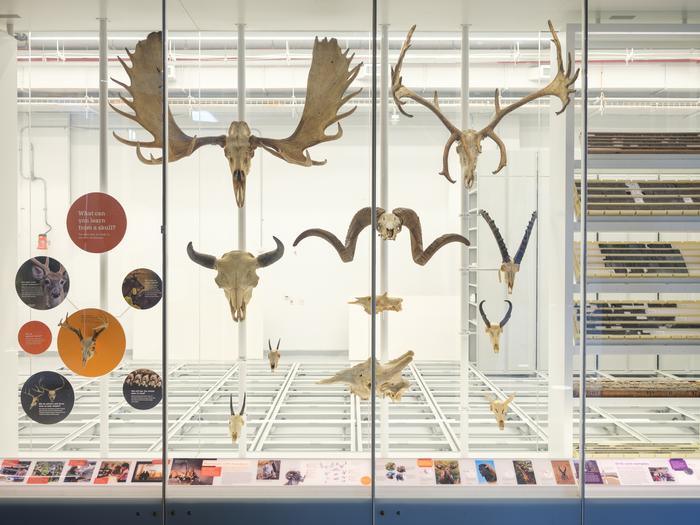
From the small ossicones on a giraffe to the gigantic antlers of a male moose—which can grow as wide as a car—the headgear of ruminant hooved mammals is extremely diverse, and new research suggests that despite the physical differences, fundamental aspects of these bony adaptations likely evolved from a common ancestor. This finding is published today in the journal Communications Biology by researchers from the American Museum of Natural History and Baruch College and the CUNY Graduate Center.

Credit: Alvaro Keding/ ©AMNH
From the small ossicones on a giraffe to the gigantic antlers of a male moose—which can grow as wide as a car—the headgear of ruminant hooved mammals is extremely diverse, and new research suggests that despite the physical differences, fundamental aspects of these bony adaptations likely evolved from a common ancestor. This finding is published today in the journal Communications Biology by researchers from the American Museum of Natural History and Baruch College and the CUNY Graduate Center.
“Horns and antlers are incredibly diverse structures, and scientists have long debated their evolutionary origins,” said Zachary Calamari, an assistant professor at Baruch College and the CUNY Graduate Center and a research associate at the Museum. “This genomic research not only gets us closer to solving an evolutionary mystery, but also helps us better understand how bone forms in all mammals.”
There are about 170 modern ruminant hoofed mammal species with headgear, and many more in the fossil record. The headgear we see today comes in four types—antlers, horns, ossicones, and pronghorns—and they are used in a variety of ways, including for defense, recognition of other members of the species, and mating. Until recently, scientists were unsure if these various bony headgear evolved independently in each ruminant group or from a shared common ancestor.
As a comparative biology Ph.D. student in the Museum’s Richard Gilder Graduate School, Calamari began investigating this question using genomic and computer-based 3D shape analysis. Working with the Museum’s Frick Curator of Fossil Mammals John Flynn, Calamari focused on sequencing transcriptomes, the genes expressed in a tissue at a specific time, for headgear. Their research supports the idea that all of the ruminant headgear forms evolved from a common ancestor as paired bony outgrowths from the animals’ “forehead,” the area near the frontal bones of the skull.
“Our results provide more evidence that horns form from the cranial neural crest, an embryonic cell layer that forms the face, rather than from the cells that form the bones on the sides and back of the head,” Flynn said. “It is striking that these are the same cells that form antlers. And the distinctive patterns of gene expression in cattle horns and deer antlers, relative to other bone and skin tissue “controls,” provide compelling evidence of shared origin of fundamental aspects of these spectacular bony structures in an ancient ancestor.”
By comparing their newly sequenced cattle horn transcriptome to deer antler and pig skin transcriptomes, Calamari and Flynn confirmed for the first time with transcriptomes that family-specific differences in headgear likely evolved as elaborations on a general bony structure inherited from a common ancestor.
“In addition to gene expression patterns that support a single origin of horns and antlers, our results also show the regulation of gene expression patterns in these structures may differ from other bones,” Calamari said. “These results help us understand the evolutionary history of horns and antlers and could suggest that differences in other ruminant cranial appendages, like ossicones and pronghorns, are also elaborations on a shared ancestral cranial appendage.”
This study was funded in part by the Richard Gilder Graduate School and the National Science Foundation, grant nos. DGE-0966166 and DDIG DEB-1601299.
ABOUT THE AMERICAN MUSEUM OF NATURAL HISTORY (AMNH)
The American Museum of Natural History, founded in 1869 with a dual mission of scientific research and science education, is one of the world’s preeminent scientific, educational, and cultural institutions. The Museum encompasses more than 40 permanent exhibition halls, galleries for temporary exhibitions, the Rose Center for Earth and Space including the Hayden Planetarium, and the Richard Gilder Center for Science, Education, and Innovation. The Museum’s scientists draw on a world-class permanent collection of more than 30 million specimens and artifacts, some of which are billions of years old, and on one of the largest natural history libraries in the world. Through its Richard Gilder Graduate School, the Museum offers two of the only free-standing, degree-granting programs of their kind at any museum in the U.S.: the Ph.D. program in Comparative Biology and the Master of Arts in Teaching (MAT) Earth Science residency program. Visit amnh.org for more information.
Journal
Communications Biology
Article Title
Gene expression supports a single origin of horns and antlers in hoofed mammals
Article Publication Date
20-May-2024
Cite Scienmag News
Drew Townsend. (May 20, 2024). Diverse headgear in hoofed mammals evolved from common ancestor. Scienmag. https://scienmag.com/diverse-headgear-in-hoofed-mammals-evolved-from-common-ancestor/
Drew Townsend. "Diverse headgear in hoofed mammals evolved from common ancestor." Scienmag, 20 May 2024, https://scienmag.com/diverse-headgear-in-hoofed-mammals-evolved-from-common-ancestor/. Accessed 4 September 2026.
Drew Townsend. "Diverse headgear in hoofed mammals evolved from common ancestor." Scienmag. May 20, 2024. https://scienmag.com/diverse-headgear-in-hoofed-mammals-evolved-from-common-ancestor/

